When it comes to safety, especially in environmental health or construction, the terms “friable” and “non-friable” are often used. However, the meaning behind these words might not be entirely clear to everyone. In this article, we’ll explain what “friable” and “non-friable” mean, where they’re commonly used, and the critical difference between them. Whether you’re a beginner, student, or just trying to understand how these words apply in real life, we’ll break it down in a simple and digestible way.
The distinction between friable and non-friable materials can be confusing for many. Common mistakes include using them interchangeably or not understanding the significance of this distinction in fields like construction or asbestos management. But getting this right is vital because it impacts how certain materials are handled, especially when it comes to health and safety.
By the end of this article, you’ll understand the differences between friable and non-friable materials, why this matters, and how to avoid making common mistakes. Let’s dive in and clear up this confusion once and for all.
Friable vs Non-Friable – Quick Answer
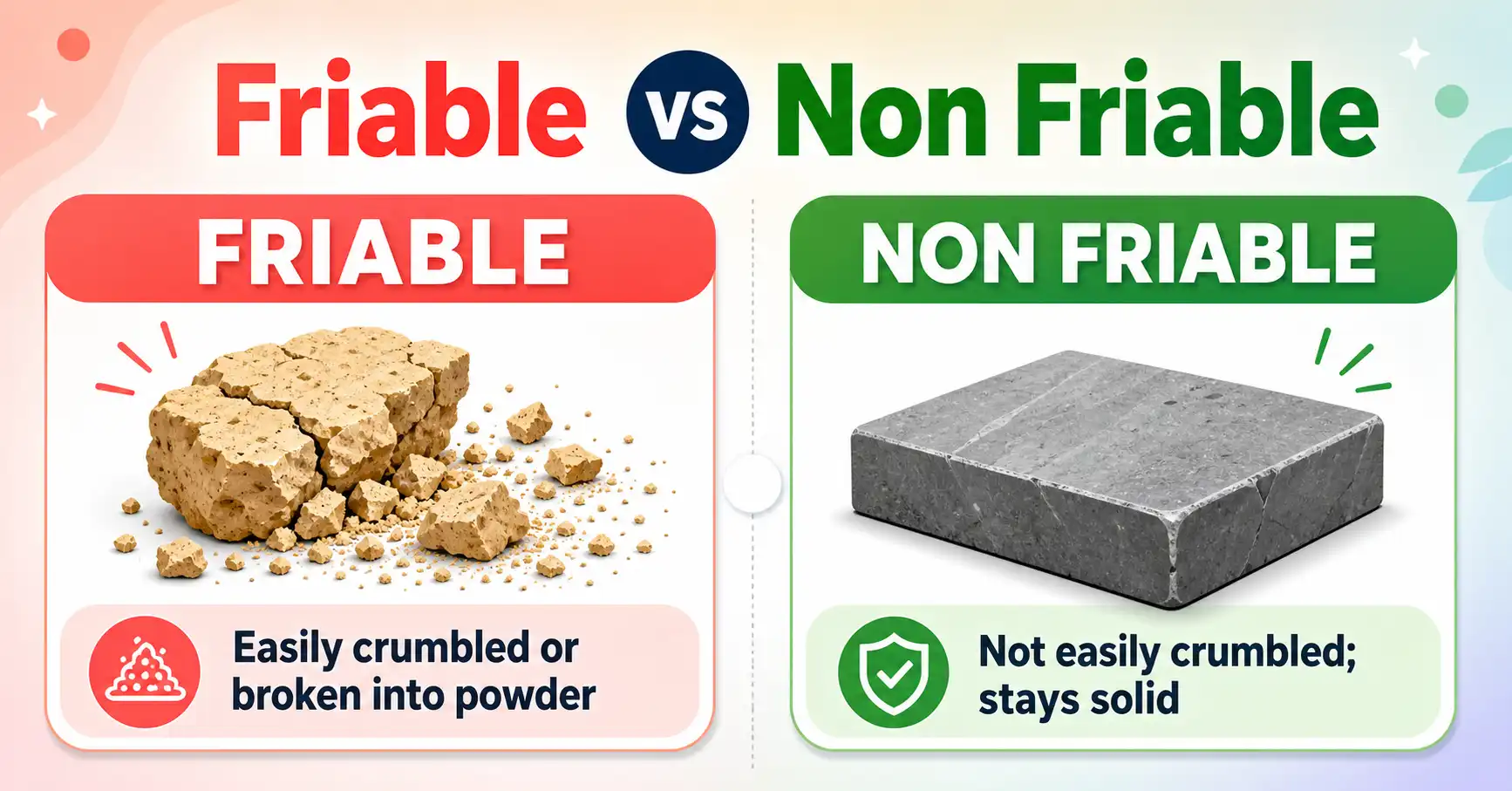
The key difference between friable and non-friable materials is their ability to break down into small particles. Friable materials can easily crumble or break into fine particles, which can be inhaled. Non-friable materials, on the other hand, do not easily break apart. This distinction is crucial in health and safety contexts, such as asbestos removal.
Meaning of Friable
The term “friable” refers to materials that are easily crumbled, pulverized, or broken into fine pieces with little effort. These materials pose a higher risk in environments where airborne particles are a concern. In particular, friable materials can release dangerous particles, like asbestos fibers, into the air, which can be harmful when inhaled.
Examples of Friable Materials:
- Asbestos-containing insulation
- Crumbling concrete or drywall
- Certain older building materials
Meaning of Non-Friable
On the other hand, “non-friable” refers to materials that are not easily broken down or crumbled. These materials are more stable and typically pose less risk when it comes to airborne particles. However, they still need to be handled carefully, especially if they contain substances like asbestos in a more stable form.
Examples of Non-Friable Materials:
- Asbestos cement sheets
- Concrete that has been well maintained
- Stone tiles
Easy Decision Rule:
- Use “friable” for materials that can be easily broken into small particles.
- Use “non-friable” for materials that remain intact and do not easily crumble.
The Origin of Friable vs Non-Friable
The terms “friable” and “non-friable” have their origins in materials science and industrial health. The word “friable” comes from the Latin word friare, meaning “to break.” This explains why friable materials are easily breakable or crumbled. The distinction became particularly important during the 20th century when the use of asbestos in building materials was widespread. Asbestos fibers are friable, meaning they could easily become airborne and cause health problems.
Non-friable materials, on the other hand, do not present this same danger because they maintain their integrity, even if disturbed.
Reason for Confusion Today
One of the main reasons people confuse “friable” and “non-friable” is that they both refer to materials found in everyday life and construction. People often mistake the terms because both can be associated with materials that contain hazardous substances, like asbestos. Additionally, the difference isn’t always immediately obvious, especially when a material may appear solid but could still break down under certain conditions.
British vs American English Spelling
Interestingly, there is no difference in how “friable” and “non-friable” are spelled between British and American English. Both versions of English use the same terms and spellings for these words, so there’s no need to worry about this distinction.
How to Choose the Right Word Fast
For US Audience:
- If you’re dealing with materials that could break down into fine particles that are a health risk, you’re likely dealing with friable materials.
For UK/Global Audience:
- The rules are the same: “friable” means easily broken down, while “non-friable” means stable and intact.
Common Mistakes with Friable vs Non-Friable
Here are some common mistakes people make when using these terms:
❌ Incorrect: “The asbestos in my house is non-friable, so it’s safe to leave it alone.”
✅ Correct: “The asbestos in my house is friable, so it must be handled with care.”
❌ Incorrect: “This concrete is friable and needs to be repaired.”
✅ Correct: “This concrete is non-friable and does not pose a health risk unless severely damaged.”
Friable vs Non-Friable in Real-Life Examples
- Emails
In a professional email discussing workplace safety, you might say:
“We need to check if the insulation in the building is friable before beginning construction.”
This helps ensure the correct term is used for materials that may release harmful particles. - News
A news article might explain:
“Due to the age of the building, experts are concerned about friable asbestos exposure during renovation.” - Social Media
On social media, someone might post:
“Be careful! Old tiles can have non-friable asbestos, so don’t disturb them.” - Formal Writing
In formal writing, such as reports on construction safety, the terms would be used like:
“Testing revealed that the insulation was friable, requiring immediate removal.”
Friable vs Non-Friable – Word Usage Patterns and Search Trends
Asbestos-related searches tend to spike when people are concerned about home renovation or construction, especially in older buildings. Many people, especially students, ESL learners, and professionals, look up the terms “friable” and “non-friable” because they don’t fully understand the difference.
Misuse of these terms can create confusion. For example, calling a friable asbestos material “non-friable” might result in improper handling, which could pose a health risk.
Comparison Table: Friable vs Non-Friable
| Feature | Friable | Non-Friable |
| Meaning | Easily crumbled or broken into small particles | Not easily broken or crumbled |
| Part of Speech | Adjective | Adjective |
| Context of Use | Construction, health, environmental safety | Construction, health, environmental safety |
| Formal vs Informal | Formal (Health & Safety context) | Formal (Health & Safety context) |
| Common Mistakes | Misusing it for materials that don’t crumble easily | Calling friable materials safe when they are not |
| Correct Example | “The insulation is friable, handle with care.” | “The concrete is non-friable, no immediate risk.” |
Semantic FAQs
- Is Friable the same as Non-Friable?
No, friable means easily broken into small particles, while non-friable means stable and intact. - Which one is correct in formal writing?
Both terms are correct in formal writing but should be used in the proper context based on material safety. - Can they be used interchangeably?
No, they should not be used interchangeably because they describe different types of materials. - Why do people confuse them?
People often confuse them because both terms are related to building materials, especially when asbestos is involved. - Can grammar tools catch this mistake?
Most grammar tools won’t catch misuse of “friable” and “non-friable” since they are used in specialized contexts like construction and health.
Conclusion
To sum up, the difference between friable and non-friable materials is significant in areas like construction, health, and safety. Always remember: friable refers to materials that break down easily into fine particles, and non-friable refers to stable materials that do not crumble easily. The most important mistake to avoid is calling a friable material “non-friable,” as this could lead to improper handling and increased health risks.
In short, whenever you’re dealing with construction or renovation materials, check whether they are friable or non-friable to ensure safe handling. Keep this in mind: friable = breakable = health risk; non-friable = stable = safer.

Ibrahim Jhon is an English language editor with over ten years of experience working with writers, publishers, and international businesses. He specialises in word choice, grammar accuracy, and the differences between British and American English.