
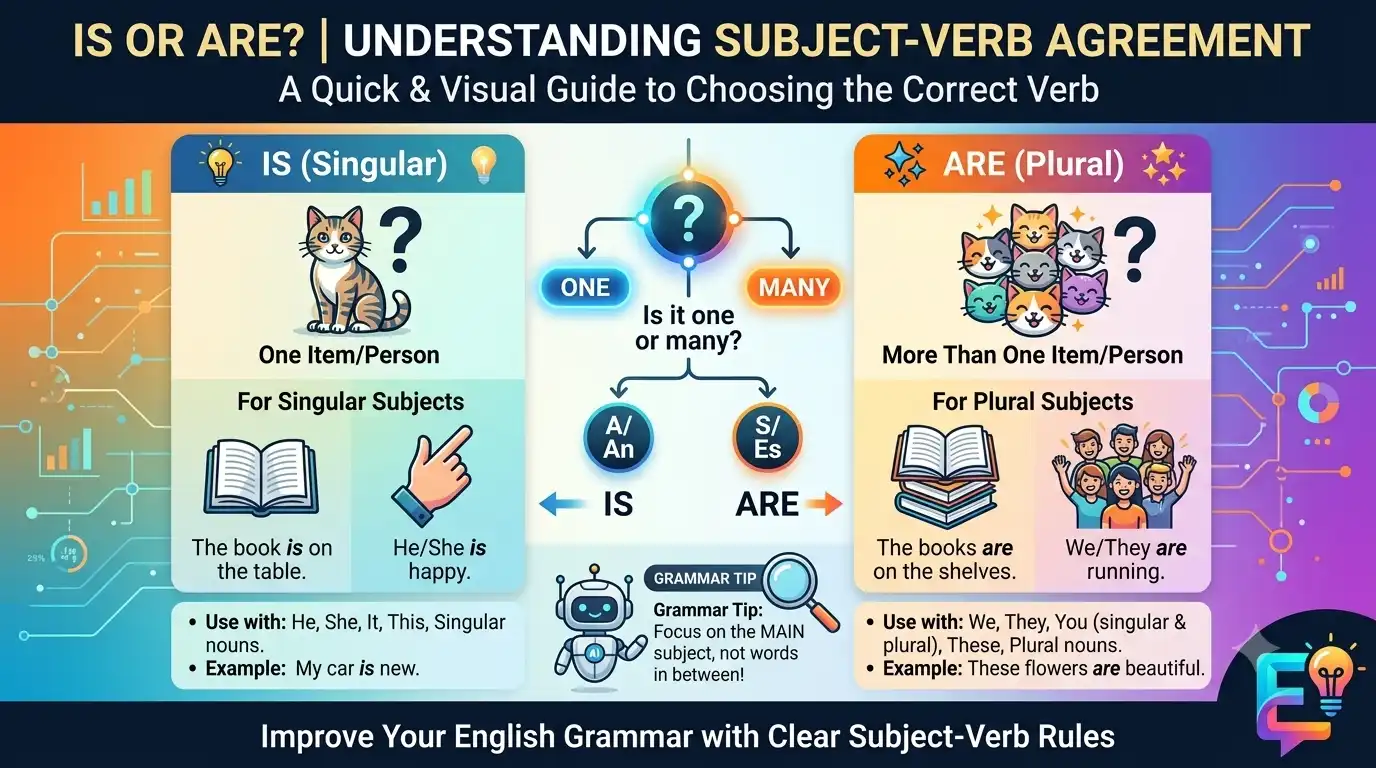
Meta Description: Confused about is vs are? Learn the simple subject-verb agreement rule, see real examples, and stop second-guessing your sentences for good.
Introduction
You’re halfway through typing a sentence. Your fingers freeze over the keyboard. “The team is ready” or “the team are ready”? “Everyone is here” or “everyone are here”?
If you’ve ever deleted a sentence just to dodge this decision, you’re not alone. Is vs are is one of the most common grammar mix-ups in the English language — and it trips up native speakers just as often as learners.
Here’s the good news: once you understand why English splits into “is” and “are,” you’ll never need to guess again. This isn’t about memorizing a giant list of exceptions. It’s about understanding one simple idea — and then applying it everywhere.
By the end of this guide, you’ll know exactly which word to use, even in the trickiest sentences involving teams, groups, and tricky pronouns like “everyone” or “none.”
Is vs Are: The Core Rule
Both “is” and “are” come from the verb “to be.” The word you choose depends entirely on one thing: the subject of your sentence.
- Use is with singular subjects (one person, place, or thing)
- Use are with plural subjects (more than one) — and always with “you”
That’s it. That’s the whole foundation.
Examples:
- She is a teacher. (singular subject: she)
- They are teachers. (plural subject: they)
- You are right. (always “are” with you, even for one person)
- The dog is barking. (singular: dog)
- The dogs are barking. (plural: dogs)
Quick Reference Table
| Subject Type | Correct Verb | Example |
|---|---|---|
| I | am | I am tired. |
| He / She / It | is | He is late. |
| You | are | You are welcome. |
| We | are | We are ready. |
| They | are | They are outside. |
| Singular noun | is | The car is fast. |
| Plural noun | are | The cars are fast. |
Where People Actually Get Stuck
The basic rule feels easy — until real sentences throw curveballs at you. Here’s where “is vs are” confusion really lives.
1. Collective Nouns (Team, Family, Group)
Words like team, family, group, staff, and audience refer to multiple people, but they’re grammatically treated as one unit — so they usually take “is.”
- The team is winning. (correct — treated as a single unit)
- The family is arriving tonight.
Exception: If you’re emphasizing the individual members acting separately, “are” can work in British English:
- The team are arguing among themselves about the strategy.
For most everyday writing (especially US English), default to “is” with collective nouns.
2. “There Is” vs “There Are”
This is one of the biggest traps because people focus on the word “there” instead of the actual subject, which comes after it.
- There is a book on the table. (subject: book — singular)
- There are books on the table. (subject: books — plural)
Tip: Cover up “there” and look at what follows. That word decides “is” or “are.”
3. Indefinite Pronouns (Everyone, Everybody, None, Each)
Words like everyone, everybody, someone, anybody, each, and nobody feel like they mean “many people” — but grammatically, they’re singular.
- Everyone is invited. (not “everyone are”)
- Each of the students is responsible for their own project.
- Nobody is answering the phone.
“None” is the one true exception — it can go either way depending on context:
- None of the cake is left. (referring to an uncountable amount)
- None of the students are ready. (referring to countable people)
4. Compound Subjects Joined by “And” vs “Or”
- “And” usually creates a plural subject → use “are”
- Tom and Jerry are best friends.
- “Or” / “Nor” keeps the verb matched to the closer subject
- Neither the teacher nor the students are ready.
- Neither the students nor the teacher is ready.
Is vs Are in Questions and Negatives
The same singular/plural logic applies when you flip the sentence into a question or add “not.”
| Statement | Question | Negative |
|---|---|---|
| She is happy. | Is she happy? | She is not (isn’t) happy. |
| They are happy. | Are they happy? | They are not (aren’t) happy. |
A Simple Trick to Never Get It Wrong Again
Whenever you’re unsure, ask yourself: “Am I talking about one thing, or more than one?”
- One thing → is
- More than one thing → are
- “You,” “we,” “they” → always are
If a sentence still feels tricky, try replacing the subject with “he” (is) or “they” (are) in your head. It almost always reveals the right answer instantly.
Practice Examples
Test yourself before checking the answers below:
- My parents ___ visiting this weekend.
- The news ___ shocking.
- Everybody ___ welcome to join.
- The scissors ___ on the desk.
- Physics ___ my favorite subject.
Answers: 1. are | 2. is | 3. is | 4. are | 5. is
(Notice: “news” and “physics” look plural but are treated as singular — a classic trap worth remembering!)
Frequently Asked Questions
Q: Is “the data is” or “the data are” correct? In modern everyday English, “the data is” is widely accepted, especially in casual and business writing. In strict academic or scientific writing, “the data are” (treating “data” as the plural of “datum”) is still preferred.
Q: Do you say “everyone is” or “everyone are”? Always “everyone is.” Words like everyone, everybody, and everything are grammatically singular, even though they refer to many people.
Q: Is it “the majority is” or “the majority are”? Both can be correct depending on context. Use “is” when referring to the group as a whole (The majority is in favor) and “are” when emphasizing individuals (The majority of voters are undecided).
Q: Which is correct: “you is” or “you are”? “You are” is always correct — “you” never pairs with “is,” even when referring to a single person.
Q: Is “there’s” the same as “there is”? Yes, “there’s” is simply the contraction of “there is,” so it should only be used with singular subjects (There’s a problem, not There’s two problems).
Final Takeaway
The is vs are rule boils down to a simple question: singular or plural? Once you train yourself to spot the real subject of a sentence — even when it’s hiding after “there,” disguised as a collective noun, or tucked into a tricky pronoun — you’ll write with confidence every time.
Keep this guide bookmarked, run through the practice examples a few times, and this decision will soon become second nature — no more hesitating mid-sentence.
Want to master more tricky word pairs like this one? Explore our full library of grammar comparison guides and never second-guess your writing again.

Ibrahim Jhon is an English language editor with over ten years of experience working with writers, publishers, and international businesses. He specialises in word choice, grammar accuracy, and the differences between British and American English.