
I have corrected this mix-up in more places than most writers expect. One version showed up in a school report that said, “The team added resources were useful.” Another appeared in an online store listing that promised “an added charger sold separately.” Both lines sounded awkward, but the bigger problem was trust. The first made the student sound unsure of basic grammar. The second made shoppers think the charger already came in the box. That kind of wording can cause complaints, returns, and embarrassing rewrites.
Here is why the confusion happens: added and additional both point to “more,” but they do not work the same way in a sentence. One often describes something that has already been put in. The other usually describes something extra that is available, needed, or requested. Writers I have worked with often swap them because the meanings overlap in everyday speech.
By the end, you will know the real difference, where each word fits, which one sounds more natural in formal writing, and how to make the choice fast.
Added vs Additional – Quick Answer
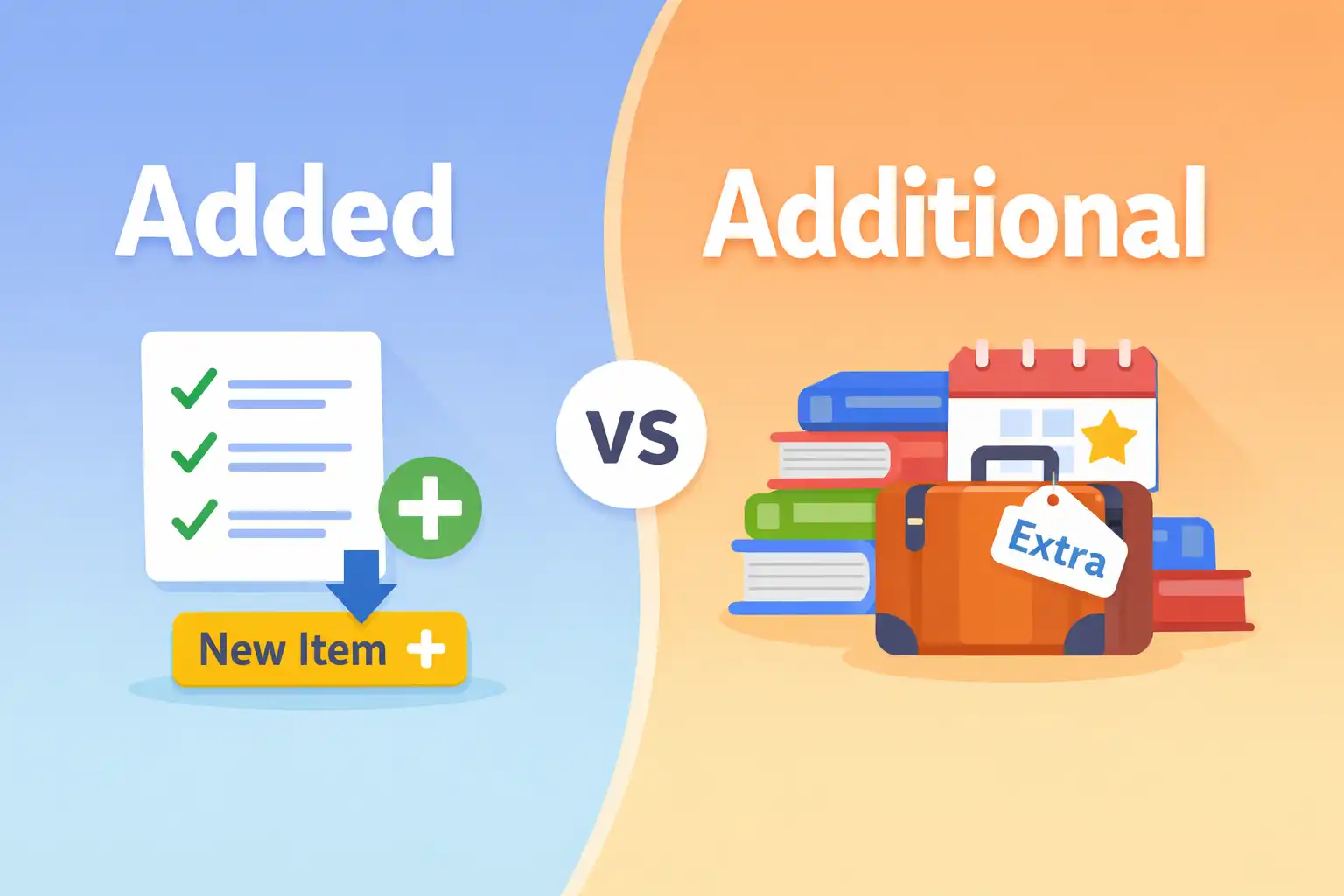
Added usually means something has been included, increased, or put in already. Additional means extra, more, or beyond what is already there. Use added for a result of an action, and additional for an extra amount, item, or requirement.
Meaning of Added
Added is usually the past participle or adjective form of add. It points to something that was put in, joined, or increased.
Example from editing: I once changed “additional flavor was mixed into the sauce” to “added flavor was mixed into the sauce” in a recipe note, because the writer meant the flavor had already been put in.
Meaning of Additional
Additional is an adjective that means extra, more, or supplementary. It describes something beyond the first amount or set.
In my experience editing content, this word appears often in forms, contracts, school instructions, and customer service emails: “additional documents,” “additional fees,” “additional support.”
One decision rule
Use added when the sentence focuses on something already put in. Use additional when the sentence asks for or describes something extra.
The Origin of Added vs Additional
The word added comes from the verb add, which entered English through Old French and ultimately traces back to Latin addere, meaning “to give to” or “attach to.” That origin still shows in modern use. When something is added, it has been attached, included, or increased.
Additional comes from the same Latin root, but through the noun idea of “addition.” Over time, it developed into an adjective meaning “extra” or “supplementary.” That small shift matters. One word keeps the action close. The other names the extra amount.
This shared history is exactly why modern writers confuse them. They are related by family, but they do different jobs. I have seen this most often in ESL writing, where learners know both words connect to “add” and assume they are interchangeable. Native speakers make a different mistake. They often choose additional because it sounds more formal, even when added is the cleaner fit.
A useful historical note: older formal English often favored longer Latinate words in legal and official writing. That habit helped additional become common in institutional English, while added stayed stronger in practical, everyday description.
British vs American English
There is no major British vs American English difference in the meaning of added and additional. Both varieties use the same core distinction.
The real difference is usually tone, not grammar. In American business writing, additional often appears in forms, service pages, and workplace instructions. In British and Commonwealth writing, the same pattern holds, though some editors trim additional when extra sounds more direct.
I have seen UK school materials prefer “additional information” and US software screens prefer the same phrase. So the grammar stays stable. Style is where the slight shift happens.
| Aspect | American English | British English |
| Meaning difference | No difference | No difference |
| Common formal phrase | additional information | additional information |
| Everyday shorter option | extra details | extra details |
| Tone of additional | official, professional | official, professional |
| Tone of added | descriptive, action-based | descriptive, action-based |
How to Choose the Right Word Fast
For a US audience, use additional when you mean “extra” in customer-facing, workplace, or school writing. Think: “additional fees,” “additional documents,” “additional questions.” Use added when the thing has already been included: “added sugar,” “added benefit,” “added security.”
Fast US rule: If the extra thing already went in, use added. If you still need or offer more, use additional.
For a UK or Commonwealth audience, the same rule works. British editors may cut wordy phrases faster, so “extra support” may beat “additional support” in plain-language writing. Still, between these two words, the distinction stays the same.
Fast UK rule: Choose added for inclusion, additional for extra amount.
For global or professional writing, additional is safer when the sentence is about requirements, options, or requests. Added is better when you describe a feature, ingredient, increase, or benefit that already exists.
Fast professional rule: Requirements take additional. Results take added.
This is where many product writers slip. I once edited a software page that said, “Users can buy added storage.” That sounded wrong because the storage was not yet included. “Additional storage” fixed it at once.
Common Mistakes with Added vs Additional
Editors see this error most often in places where tone matters and space is tight.
❌ Please send added documents by Friday.
✅ Please send additional documents by Friday.
Why: The documents are extra documents still needed, not documents already inserted somewhere.
❌ This cereal contains additional sugar.
✅ This cereal contains added sugar.
Why: The sugar has already been put into the product.
❌ We offer added seats for premium guests.
✅ We offer additional seats for premium guests.
Why: The seats are extra seats available to book.
❌ The added cost will be shown at checkout if you choose gift wrap.
✅ The additional cost will be shown at checkout if you choose gift wrap.
Why: In e-commerce, shoppers expect additional cost for an extra charge not yet applied. I have seen wording like this trigger support tickets because customers thought the fee was already included.
❌ The report includes additional comments from the editor in the margin.
✅ The report includes added comments from the editor in the margin.
Why: Those comments were actually inserted into the document.
❌ The school asked for added information about attendance.
✅ The school asked for additional information about attendance.
Why: The school wants more information, not information that has already been added.
Added vs Additional in Real-Life Examples
In a professional email, I would write:
“Please send any additional invoices before 3 p.m. so finance can close the file today.”
That sounds natural because the sender needs more invoices.
In news writing, a cleaner line would be:
“The label now warns consumers about added preservatives in the imported snacks.”
I have corrected this in food-related copy before. News style usually prefers the precise word over the longer one.
On social media, a brand might post:
“We heard your feedback, so we added weekend support at no additional cost.”
This is a useful paired example. The support was added. The cost is additional only if it is extra.
In a formal document, you are more likely to see:
“Applicants may submit additional evidence within 14 days.”
That wording is standard because the evidence is extra material the applicant can still provide.
One of the clearest real-world patterns I have seen is in school essays. Students often write “added details” when the teacher asked for “additional details.” The first can work in a narrow context, but the second is usually the intended meaning: more detail is needed.
Added vs Additional – Word Usage Patterns and Search Trends
The people who search this phrase are usually students, ESL learners, teachers, copywriters, and office professionals. Some are checking grammar before sending an email. Others are trying to sound more natural in reports, listings, and web copy.
The real-world consequence can be small or costly depending on context. A student who writes “added references are required” in an exam answer may lose marks for awkward expression. A business that writes “added charges may apply” on a pricing page risks confusing customers about whether those charges are already part of the total. I have seen this kind of wording lead to back-and-forth with clients who thought the pricing copy sounded slippery.
The error pattern differs between ESL learners and native speakers, and that is the detail many comparison pages miss. ESL learners often swap the words because they map both to a single word in their first language meaning “extra” or “added.” Native speakers do something else. They overuse additional to sound formal, then place it where an action-based word is better. That is why native writing sometimes sounds inflated, while ESL writing sometimes sounds slightly off in grammar.
Here is the fast comparison that resolves most confusion:
| Feature | Added | Additional |
| Meaning | already included, inserted, increased | extra, more, supplementary |
| Part of speech | adjective; past participle of add | adjective |
| Curved edges possible | Not applicable | Not applicable |
| Used in formal writing | Yes, but usually for results or ingredients | Yes, very common for requests and requirements |
| Common mistake | used when “extra” is meant | used when something has already been put in |
| Correct example | added sugar, added benefit | additional documents, additional cost |
FAQs — People Also Ask
Is added the same as additional?
No. Added points to something already put in. Additional means extra or more.
Which is more formal: added or additional?
Additional usually sounds more formal in business, academic, and legal writing.
Do native speakers confuse added and additional?
Yes. Native speakers often overuse additional because it sounds official, even when added is more accurate.
Can I say added information?
Yes, but only when the information has actually been inserted or appended. For “more information,” use additional information.
Is added cost correct?
Sometimes, but additional cost is more natural when you mean an extra charge. Pricing pages usually need additional.
Why do product labels say added sugar, not additional sugar?
Because the sugar was put into the product. The phrase describes an ingredient already included.
Which word should I use in emails?
Use additional for requests like files, details, or documents. Use added for benefits, notes, or features already included.
Conclusion
Overall, the one distinction that matters most is simple: added looks backward to something already put in, while additional looks outward to something extra beyond the first amount. That is the split editors rely on every day.
The most common mistake to avoid is using added when you really mean “more.” I have seen that error in student essays, product listings, and client emails, and it nearly always makes the sentence sound off. Sometimes it does more than that. It can make a writer look unsure, or make a customer think a fee or feature is already included.
In short, ask one quick question before you choose. Has the thing already been put in, or is it simply extra? If it is already included, go with added. If it is more than what you already have, choose additional. That rule is not fancy, but it is the one that keeps your writing clear.

Ibrahim Jhon is an English language editor with over ten years of experience working with writers, publishers, and international businesses. He specialises in word choice, grammar accuracy, and the differences between British and American English.