A man signs a letter with “John Smith Jr.” and his son signs with “John Smith Sr.” Later, a form rejects both names. Now they worry: did we use the titles wrong? This small pair of letters causes more confusion than most people expect. Students, writers, and even office staff pause when they see jr vs sr because the rules feel unclear.
The confusion matters because these titles connect to identity. They appear on legal papers, school records, and email signatures. One small mistake can mix up two people with the same name. So readers often search this topic when they want a fast, safe answer.
In this guide, you will learn the meaning, origin, and real usage in plain English. You will also see quick examples that remove doubt.
Jr. vs. Sr.: Quick Difference (In One Minute)
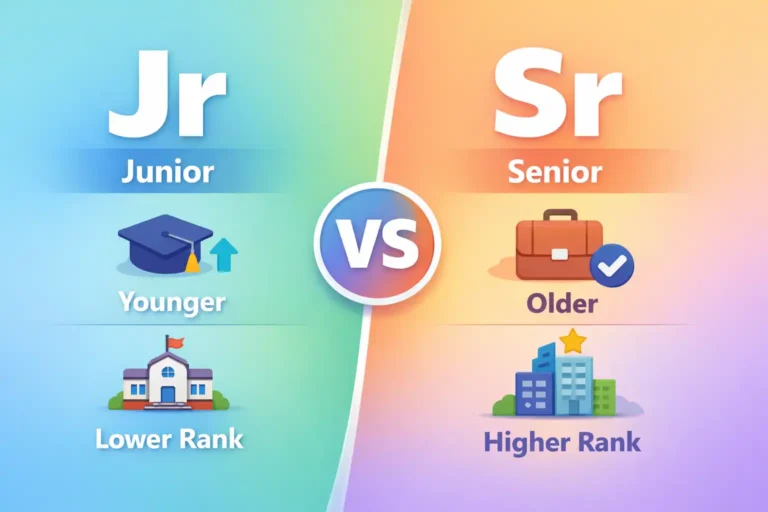
- Jr means a younger person with the same name as a parent
- Sr means the older person in that name pair
- They show family order, not age alone
- Example: John Smith Sr. (father), John Smith Jr. (son)
Easy rule: use Sr for the parent, Jr for the child.
Origin & Etymology of Jr. and Sr.
The words come from Latin roots. Junior meant “younger,” and senior meant “older.” People started adding these labels when families reused the same full name across generations. At first, towns used them to avoid confusion in records. Then the habit spread into legal and social writing.
However, modern life increased the confusion. Today many people share names that are not family names. So readers sometimes assume jr and sr show age difference between strangers. In reality, the titles work only inside one family line. They mark position in a naming chain, not general age.
Writers often confuse this because the short forms look casual. Yet the meaning stays formal. Editors usually see mistakes when someone adds Jr or Sr to unrelated people with the same name.
British vs American English Spelling
Both British and American English use Jr. and Sr. in almost the same way. The main difference sits in punctuation.
In American English, a period usually follows the abbreviation.
In British English, writers often drop the period.
| Style | Younger title | Older title |
| American English | Jr. | Sr. |
| British English | Jr | Sr |
However, the meaning never changes. Only the dot changes. Professional writing follows the local style guide, but personal writing stays flexible.
How to Choose the Right Word Fast
If you write for a US audience, add the period: Jr. and Sr.
If you write for the UK or Commonwealth, skip the period.
If you write for a global audience, match the style of the document.
No spelling difference changes the meaning. So the real choice is formatting, not grammar. In professional documents, consistency matters more than the dot itself.
Common Mistakes with Jr vs Sr
People often mix usage rules. Here are frequent errors:
❌ John Smith Jr is older than his father
✅ John Smith Sr is the older person
Jr never means “younger in general.” It means younger within the name pair.
❌ Add Jr to a friend with the same name
✅ Use Jr only for family naming lines
❌ Drop the title in legal records
✅ Keep the title if it appears on official documents
These mistakes happen because writers treat the titles like nicknames. In truth, they act more like identity markers.
Jr vs Sr in Everyday Examples
Email:
“Please contact Michael Brown Jr. for the update.”
News:
“The award went to David Lee Sr., a long-time teacher.”
Social media:
“Happy birthday to Marcus Hill Jr!”
Professional writing:
“The contract lists Robert King Sr. as the owner.”
Each example shows the title attached directly to the full name. Writers do not separate it with extra words.
When Jr./Sr. Matters Most (Forms, Legal Docs, Healthcare)
Search interest stays steady because families still reuse names. Students and ESL learners search this topic when filling forms. Writers check it when editing biographies. Professionals confirm it during legal paperwork.
Misuse causes real confusion in records. Imagine a hospital file that drops Jr. The system may attach data to the wrong person. So even a tiny suffix matters in identity tracking.
Overall, the topic looks simple, but mistakes carry real-world impact.
Jr vs Sr Comparison Table
| Feature | Jr | Sr |
| Meaning | Younger family member | Older family member |
| Part of speech | Title suffix | Title suffix |
| Context of use | Same-name child | Same-name parent |
| Formal vs informal | Used in formal records | Used in formal records |
| Common mistake | Used for strangers | Used as age label |
| Correct example | Daniel Cruz Jr. signed | Daniel Cruz Sr. approved |
This table removes the core confusion: the titles show family order, not random age.
FAQs
Is Jr the same as Sr?
No. Jr marks the younger name holder. Sr marks the older one.
Which one is correct in formal writing?
Both are correct when they match the person’s legal name.
Can they be used interchangeably?
No. Swapping them changes identity.
Why do people confuse them?
They assume the words show age, not family order.
Can grammar tools catch this mistake?
Usually no. Tools check spelling, not identity logic.
Is there a British vs American difference?
Only punctuation changes. Meaning stays the same.
Conclusion
Jr and Sr look tiny, yet they carry strong meaning. They connect names across generations and protect identity in writing. Many people confuse them because they think the titles show simple age. In truth, they show position inside one family naming line.
Overall, remember the structure: Sr stands for the parent, Jr stands for the child. Never assign the labels to unrelated people. Finally, keep punctuation consistent with your audience. The safest rule is simple: family order decides the title, not age alone. Hold that rule in mind, and you will never mix them again.

Daniel Morris writes about English word differences and spelling confusion. His focus is to provide clear, simple explanations with practical usage examples.