
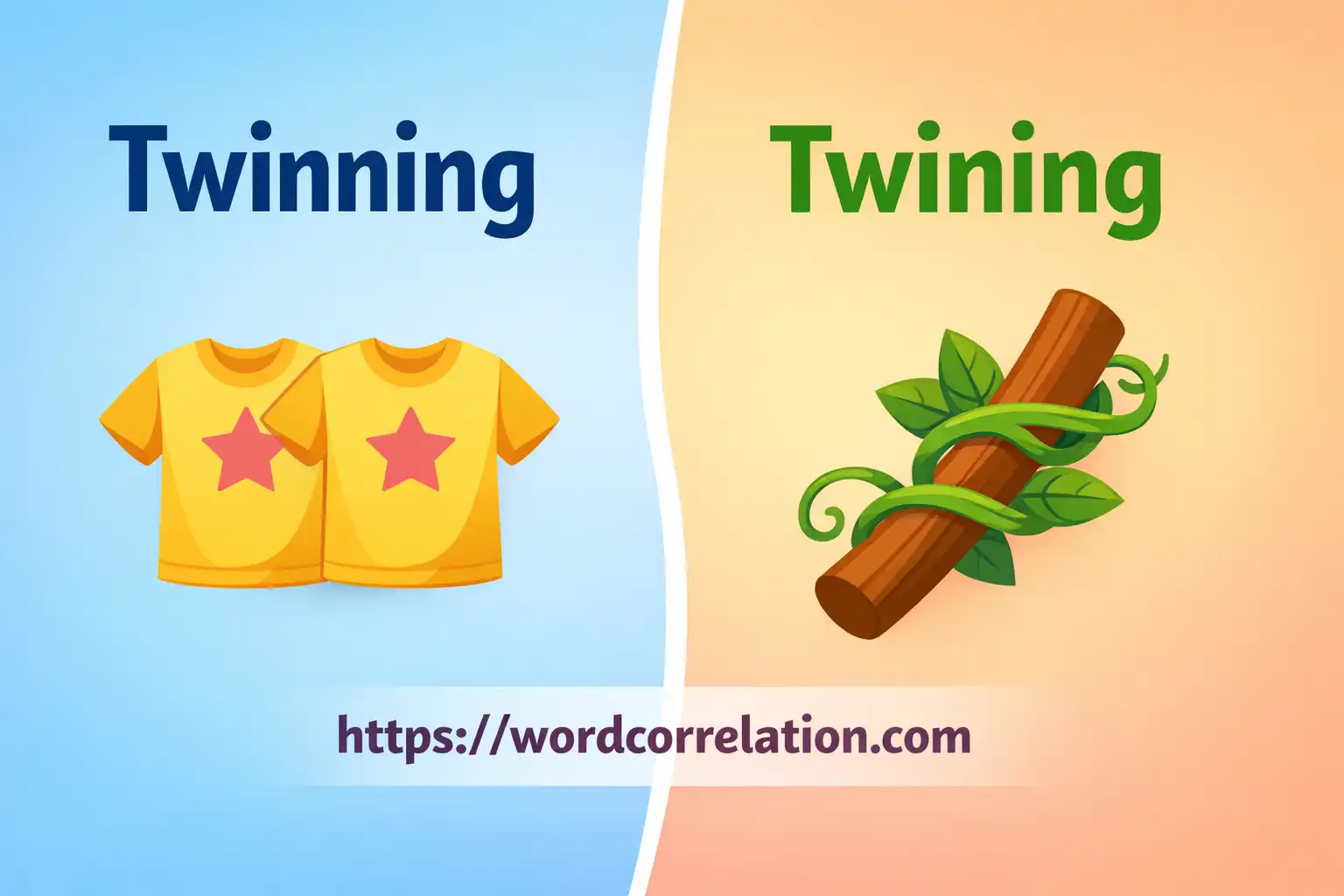
When deciding between twinning or twining, the correct choice depends on whether you are describing matching pairs (twinning) or winding spiral movements (twining). Twinning comes from the base word twin and refers to pairing, matching, or creating duplicates. Twining comes from twine and describes twisting, wrapping, or spiraling around a support.
Understanding the root words and basic spelling rules behind these terms will ensure your writing remains clear, grammatically precise, and polished.
Quick Answer: Twinning vs. Twining at a Glance
| Term | Base Word | Part of Speech | Pronunciation | Primary Meaning | Example Context |
|---|---|---|---|---|---|
| Twinning | Twin | Present Participle / Noun / Adjective | /ˈtwɪn.ɪŋ/ (TWIN-ing) | Matching, doubling, pairing, or giving birth to twins. | “The sisters wore matching dresses, twinning for the photograph.” |
| Twining | Twine | Present Participle / Adjective / Noun | /ˈtwaɪ.nɪŋ/ (TWYN-ing) | Winding, twisting, spiraling, or weaving strands around an object. | “The ivy was twining around the wooden trellis.” |
| Twinings | Twining (Proprietary) | Proper Noun | /ˈtwaɪ.nɪŋz/ (TWYN-ingz) | A famous British tea brand (named after founder Thomas Twining). | “She offered her guests a warm cup of Twinings Earl Grey tea.” |
What Does “Twinning” Mean?
Definition and Grammatical Role
Twinning (pronounced /ˈtwɪn.ɪŋ/) is the present participle, gerund, or adjective form of the verb twin.
Because twin is a single-syllable word ending in a consonant-vowel-consonant (CVC) pattern, English spelling rules require doubling the final “n” before adding the suffix -ing.
Twinning refers to the act of pairing two items, wearing identical outfits, creating duplicates, or forming official partnerships between two bodies (such as sister cities). It is also used as a technical term in metallurgy, geology, and computing.
- Base Word: Twin
- Vowel Sound: Short i (as in in or win)
- Key Idea: Two identical or paired entities
Example Sentences for “Twinning”
- Social Media & Fashion: “The two best friends posted a selfie on Instagram with the caption ‘twinning on Friday!'”
- Municipal Partnerships: “The city council signed a town twinning agreement with a coastal municipality in France.”
- Biology & Genetics: “Higher rates of fraternal twinning have been documented in certain family lines.”
- Technology & Engineering: “The manufacturing plant uses digital twinning software to simulate machine performance in real time.”
- Crystallography & Geology: “Mineralogists identified symmetrical crystal twinning inside the quartz formation.”
- Education & Academics: “The university established a twinning program allowing students to split their degree between two international campuses.”
- Sports & Animation: “In synchronized swimming, precise twinning of movements across team members is essential for a high score.”
What Does “Twining” Mean?
Definition and Grammatical Role
Twining (pronounced /ˈtwaɪ.nɪŋ/) is the present participle, adjective, or gerund form of the verb twine.
The base word twine ends in a silent “-e”. Standard English grammar dictates that you drop the final “-e” before adding -ing, resulting in a single “n” (twining).
Twining describes the action of twisting, spiraling, or winding around a central axis or support. In botany, a twining stem is a climbing mechanism where a plant wraps spirally around a host plant or trellis.
- Base Word: Twine
- Vowel Sound: Long i (as in vine or fine)
- Key Idea: Winding, twisting, or spiraling string or stems
Example Sentences for “Twining”
- Botany & Gardening: “The twining morning glory vines climbed quickly up the garden trellis.”
- Textiles & Crafting: “She spent the afternoon twining colorful cords into a decorative macramé wall hanging.”
- Literary & Descriptive: “The story depicted two serpent figures twining around a central magical staff.”
- Physical Movement: “The dancer performed a fluid routine, twining long silk ribbons around her arms.”
- Architecture & Design: “Wrought iron banisters featured twining leaf motifs along the staircase.”
- Nature & Forestry: “Wild honeysuckle was twining around the trunk of the old oak tree.”
- Anatomy & Movement: “The thick ivy roots held firm, twining tightly through the stone wall cracks.”
Twinning vs. Twining: Key Differences
| Feature | Twinning | Twining |
|---|---|---|
| Root Word | Twin (noun/verb) | Twine (noun/verb) |
| Vowel Sound | Short i (/ɪ/ as in pin) | Long i (/aɪ/ as in pine) |
| Spelling Rule | Double the consonant (-nn-) | Drop the silent -e (-n-) |
| Core Concept | Matching, pairing, duplicating | Winding, twisting, spiraling |
| Primary Contexts | Fashion, sister cities, biology, tech | Plants, ropes, crafts, weaving |
| Synonyms | Pairing, matching, mirroring, duplicating | Spiraling, winding, twisting, entwining |
Why People Confuse These Words
The mix-up between these two words stems from two distinct linguistic factors: spelling mechanics and phonetic similarity.
┌─────────────────────────────────────────────────────────────┐
│                    SPELLING RULE MATRIX                     │
├──────────────┬─────────────┬─────────────────┬──────────────┤
│ Root Word    │ Pattern     │ Rule            │ Result       │
├──────────────┼─────────────┼─────────────────┼──────────────┤
│ Twin         │ C-V-C       │ Double final 'n'│ Twinning     │
│ Twine        │ Silent -e   │ Drop silent 'e' │ Twining      │
└──────────────┴─────────────┴─────────────────┴──────────────┘
1. The CVC Double-Consonant Rule vs. Silent E Drop Rule
- Twin → Twinning: Twin is a single-syllable word ending in Consonant-Vowel-Consonant (t-w-i–n). When adding a vowel suffix like -ing, you double the final consonant to preserve the short vowel sound (
/ɪ/). - Twine → Twining: Twine ends in a silent -e. When adding -ing, drop the silent -e. Because there is only one “n”, the preceding vowel retains its long sound (
/aɪ/).
2. Conceptual Overlap
Both words suggest a close relationship or connection between two strands or entities:
- Twin connects two identical or paired items.
- Twine connects two or more strands wound together.
This structural similarity leads writers to interchange the spellings unintentionally.
Memory Trick to Remember the Difference
Use the “Double N vs. Single Vine” mnemonic:
Two Ns for Two Twins (
-nn-):
- TWINNING has two Ns sitting side-by-side—just like two twins standing together!
One N for One Vine (
-n-):
- TWINING has one N that winds like a single climbing vine!
     [ T W I N N I N G ]              [ T W I N I N G ]
       │       │                        │
       └───┬───┘                        └─── Single N =
      Two Ns = Two Twins                     Climbing Vine!
Example Sentences Side-by-Side
Comparing these words in similar contexts highlights how changing a single letter alters the meaning entirely:
| Context | Correct Use: Twinning (-nn-) | Correct Use: Twining (-n-) |
|---|---|---|
| Nature & Animals | “The cattle farmer celebrated the twinning of his prize cow.” | “The snake was twining itself around the low tree branch.” |
| Fashion & Style | “Look at the siblings twinning in their matching sweater vests!” | “She wore a golden necklace with twining metal threads.” |
| Decor & Design | “The interior designer used twinning wall sconces for balance.” | “Ivy was twining around the patio pillars.” |
| Literature & Drama | “The plot features the twinning of two parallel character arcs.” | “The poet described emotions twining like roots in the soil.” |
| Crafts & Materials | “The artisan showcased twinning glass vases side by side.” | “He spent hours twining hemp fibers into sturdy marine cordage.” |
Common Mistakes People Make
Mistake 1: Writing “Twining” When Referring to Matching Outfits
- Incorrect: “My best friend and I are twining today in blue denim!”
- Correct: “My best friend and I are twinning today in blue denim!”
- Why it happens: Writers forget to double the “n” after the short vowel in twin, creating a word that rhymes with dining.
2: Writing “Twinning” When Describing Climbing Vines
- Incorrect: “The jasmine plant is twinning up the porch pillar.”
- Correct: “The jasmine plant is twining up the porch pillar.”
- Why it happens: Writers assume that spiraling or wrapping around something requires a double consonant.
Mistake 3: Misspelling the Tea Brand “Twinings” as “Twinnings”
- Incorrect: “I bought a box of Twinnings mint tea.”
- Correct: “I bought a box of Twinings mint tea.”
- Why it happens: People assume the brand name comes from twins rather than the founder’s surname, Thomas Twining (pronounced with a long i).
Frequently Asked Questions
Is it “twinning” or “twining” outfits?
It is always twinning outfits. The term comes from the noun twin and refers to two people wearing matching or identical clothing.
How do you pronounce Twinings tea?
Twinings tea is pronounced /ˈtwaɪ.nɪŋz/ (TWYN-ingz), with a long i sound like twine or fine. It is named after founder Thomas Twining, who established the brand in London in 1706.
Why does “twinning” have two Ns while “twining” has one?
“Twinning” doubles the “n” because its base word (twin) ends in a single consonant following a single short vowel (CVC rule). “Twining” drops the silent -e from twine, leaving a single “n” that indicates a long vowel sound.
What does “twining vine” mean in botany?
A twining vine is a climbing plant that supports itself by growing in a spiral path around vertical supports, such as stakes, wires, or other plants (e.g., morning glories or pole beans).
Can “twinning” be used as a technical engineering term?
Yes. In engineering and manufacturing, digital twinning refers to creating a virtual model that mirrors a physical object, process, or system in real time.
What is town twinning?
Town twinning (or sister city pairing) is an agreement between two towns or cities in different geographical regions to promote commercial, cultural, and educational ties.
Conclusion
Choosing between twinning and twining comes down to whether you mean matching or winding:
- Use twinning (with two Ns) when describing matching outfits, pairs, duplicates, sister towns, or giving birth to twins.
- Use twining (with one N) when describing vines, threads, or arms twisting and spiraling around an object.
To keep your writing error-free, remember: Two Ns for two twins, one N for a climbing vine!

Ibrahim Jhon is an English language editor with over ten years of experience working with writers, publishers, and international businesses. He specialises in word choice, grammar accuracy, and the differences between British and American English.