Many writers stop when they see peeked or peaked. The words look close. They also sound the same. Because of that, confusion feels normal. However, the meanings differ a lot. One word talks about looking. The other word talks about reaching the top. Therefore, one small letter can change the whole sentence.
Students, bloggers, and ESL learners often search this topic. They want a clear answer. Moreover, they want easy rules. Grammar books feel heavy. In contrast, real writing needs simple help. This article solves that exact problem. It explains the difference in plain English. Additionally, it shows where mistakes happen. You will also see clear examples from daily life.
Meanwhile, you will learn how to choose the right word fast. The guide also shows common errors to avoid. As a result, your writing will sound clear and correct. Overall, this article gives one goal: remove doubt forever. By the end, you will know which word fits your sentence every time.
For quick clarity on confusing pairs, the word comparison hub is a good resource.
Peeked or Peaked – Quick Answer
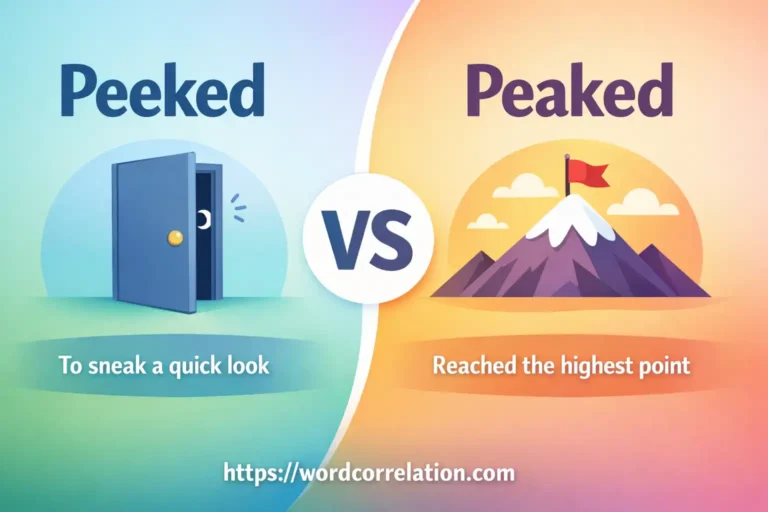
Peeked means to look quickly or secretly.
Peaked means to reach the highest point.
- She peeked through the door.
- Sales peaked in July.
Use peeked for eyes.
Use peaked for levels or results.
The Origin of Peeked or Peaked
Both words came from Old English. However, their paths differ.
Peeked comes from a word meaning “to look narrowly.” People used it for quick or sneaky looks. Therefore, it stayed close to the idea of seeing.
Peaked comes from “peak,” which means a pointed top, like a mountain. As a result, writers used it for the highest point of anything.
Confusion happens because the words sound the same. Moreover, English spelling does not help learners. In contrast, the meanings never overlap. One always relates to sight. The other always relates to height or level.
This example is covered under our word confusion pillar for sound-alike errors.
British English vs American English Spelling
Both American and British English use peeked and peaked the same way. However, learners still worry about spelling differences.
Here is a clear view:
| Feature | Peeked | Peaked |
| Spelling | Same in US & UK | Same in US & UK |
| Meaning | Look quickly | Reach highest point |
| Usage | Informal & formal | Informal & formal |
In contrast to other English words, no regional spelling change exists here. Therefore, you can use the same rule everywhere.
Which Spelling Should You Use?
Choice depends on meaning, not location.
For the US audience, use peeked for looking. Use peaked for maximum level.
For the UK or Commonwealth, the same rule applies.
For global or professional writing, clarity matters most. Therefore, think about the action first.
Ask one question:
“Am I talking about eyes or a top point?”
That question gives the answer fast.
Common Mistakes with Peeked or Peaked
Many writers mix these words in stress or excitement. However, small checks fix everything.
❌ She peaked through the window.
✅ She peeked through the window.
(Reason: eyes are looking.)
❌ Interest peeked last year.
✅ Interest peaked last year.
(Reason: interest reached a high level.)
❌ He peeked in performance.
✅ He peaked in performance.
(Reason: performance has levels.)
Always connect peeked with seeing. Always connect peaked with reaching a top.
A similar sound confusion appears in pail or pale.
Peeked or Peaked in Everyday Examples
Daily writing shows this mix-up often. Therefore, examples help.
Emails:
- She peeked at the message.
- Profits peaked this quarter.
News:
- The reporter peeked behind the scenes.
- Inflation peaked in June.
Social media:
- I peeked at spoilers.
- My energy peaked today.
Professional writing:
- The auditor peeked into records.
- Productivity peaked after training.
These examples show a simple pattern. Eyes equal peeked. Results equal peaked.
Peeked or Peaked – Google Trends & Usage Data
Search data shows strong interest in peeked or peaked. Students search it before exams. Writers search it while editing. ESL learners search it while learning basics.
Most mistakes appear in:
- School essays
- Blog posts
- Social captions
Correct usage rises when people learn the eye-versus-peak rule. As a result, confusion drops fast. Overall, clarity improves with one memory trick.
Another helpful comparison is foul or fowl.
Comparison Table: Peeked vs Peaked
| Feature | Peeked | Peaked |
| Meaning | Look quickly or secretly | Reach the highest point |
| Part of Speech | Verb | Verb |
| Context of Use | Vision or checking | Growth, success, levels |
| Formal vs Informal | Both | Both |
| Common Mistake | Used for success | Used for seeing |
| Correct Example | She peeked inside | Sales peaked early |
This table removes doubt at once. Therefore, keep it as a quick check.
Semantic FAQs (People Also Ask)
Is peeked the same as peaked?
No. One means looking. The other means reaching the top.
Which one is correct in formal writing?
Both work, but meaning decides the choice.
Can they be used interchangeably?
Never. Meanings do not overlap.
Why do people confuse them?
They sound the same. Spelling causes doubt.
Can grammar tools catch this mistake?
Sometimes. However, tools miss context.
Is there a British vs American difference?
No difference exists.
Conclusion
Overall, peeked or peaked creates stress for many writers. However, the fix stays simple. One word connects to eyes. The other connects to the top. Therefore, meaning decides spelling, not sound.
Use peeked when someone looks quickly. Use peaked when something reaches its highest point. Moreover, ignore accent or region. English stays the same here. A similar sound confusion appears in pail or pale.
Always avoid guessing. Instead, stop for one second. Ask the eye-or-top question. As a result, mistakes disappear. Finally, remember this easy rule:
If you can see it, peeked fits. If it reaches a top, peaked wins.

Daniel Morris writes about English word differences and spelling confusion. His focus is to provide clear, simple explanations with practical usage examples.