You type a quick email. You write, “Thank you for your presense.” Then the red line appears. You pause. Is it presence or presense?
Many people search for presence vs presense because they see both spellings online. Some think one is British and one is American. Others believe both are correct in different cases. But that is not true. One word is real. The other is simply a spelling mistake.
This confusion happens in emails, school essays, job applications, and even social media posts. And spelling errors can hurt your writing. They may look small, but they change how people see your work. In this guide, you will learn the correct spelling, why the mistake happens, and how to remember the right form forever.
Presence vs Presense – Quick Answer
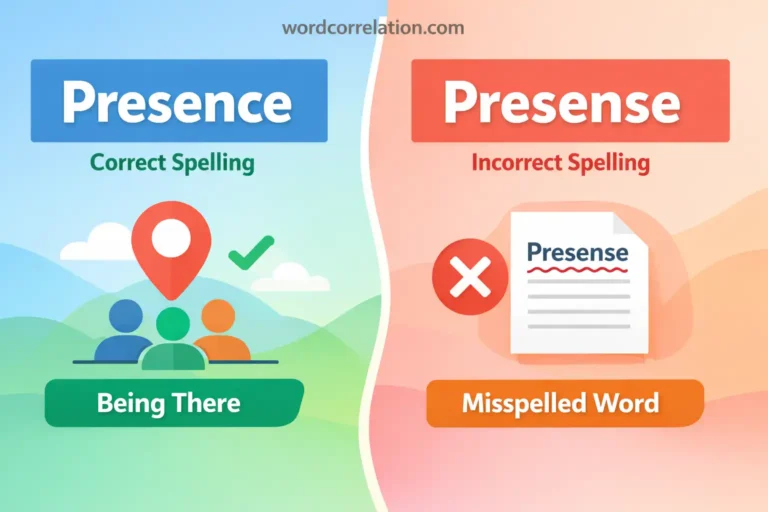
- Presence is the correct spelling.
- Presense is incorrect and not a real word.
✅ Correct: Thank you for your presence.
❌ Incorrect: Thank you for your presense.
Easy rule: If it relates to “present,” it ends with -ence, not -ense.
The Origin of Presence vs Presense (simple history)
The word presence comes from Latin. It comes from praesentia, which means “being there.” Later, it entered Old French as presence. Then English adopted it.
So, the spelling with -ence has existed for hundreds of years.
Now you may ask, why do people write presense?
The answer is simple. English has many words that end in -sense, like:
- sense
- nonsense
- common sense
Because of that pattern, writers sometimes change presence into presense by mistake. The sound is similar, so the brain guesses the wrong spelling.
However, history shows only presence is correct. The other form has no linguistic basis.
British English vs American English Spelling
Many spelling differences exist between British and American English. For example:
| American | British |
| defense | defence |
| license | licence |
So people often assume presense might be a British version.
However, that is not true.
Both American English and British English use:
- ✅ presence
- ❌ presense
There is no regional variation here. The spelling never changes.
How to Choose the Right Word Fast
This section is easy because there is only one correct choice.
US
Use presence.
UK / Commonwealth
Use presence.
Global or Professional Writing
Always use presence.
There is no alternative spelling. If you see presense, it is a typo.
So the real task is not choosing between two correct words. It is avoiding one common mistake.
Common Mistakes with Presence vs Presense
Writers often confuse this spelling in formal situations. That is why it matters.
Here are common errors:
❌ Thank you for your presense at the meeting.
✅ Thank you for your presence at the meeting.
❌ The teacher marked “presense” in red.
✅ The teacher marked “presence” in red.
The mistake usually happens because:
- The word sounds like “sense.”
- People type fast.
- Autocorrect does not always fix it.
Editors see this error often in student writing and business emails. So learning the correct form improves your clarity and credibility.
Presence vs Presense in Everyday Examples
Now let’s see how presence works in real life.
In Emails
“Thank you for your presence at our event.”
This is very common in formal messages. The correct spelling shows professionalism.
In News Writing
“The president’s presence at the summit drew attention.”
News outlets always use the correct spelling.
On Social Media
“Your presence here means a lot to me.”
Even casual writing should use the correct form.
In Professional Writing
“The company maintains a strong online presence.”
Here, presence means visibility or influence. The spelling remains the same.
No matter the situation, presence stays correct.
Presence vs Presense – Usage Patterns & Search Interest
Search interest for presence vs presense usually comes from:
- Students writing essays
- ESL learners
- Job applicants
- Bloggers and content writers
Many users type “presense” into search engines. Then they wonder why spell check flags it.
One real-world issue happens in job applications. If someone writes:
“I appreciate your presense during the interview.”
That small error can reduce trust. It may look careless, even if the person is qualified.
So this article solves a clear problem. It removes doubt. It confirms that only one spelling exists. And it helps you avoid an embarrassing mistake.
Quick Comparison Table
| Feature | Presence | Presense |
| Meaning | Being there; existence | Not a real word |
| Part of Speech | Noun | None |
| Context of Use | Formal and informal writing | Incorrect spelling |
| Formal Usage | Yes | Never |
| Common Mistake | Confused with “sense” ending | Misspelling of presence |
| Correct Example | Her presence was calming. | ❌ Her presense was calming. |
This table shows clearly that only one option works.
Semantic FAQs
Is presense ever correct?
No. Presense is always incorrect.
Is presence the same in British and American English?
Yes. Both use the same spelling: presence.
Why do people confuse presence and presense?
They hear the “sense” sound and copy that spelling pattern.
Can grammar tools catch this mistake?
Most tools highlight presense as incorrect.
Is presence formal or informal?
It works in both formal and informal writing.
Can presence mean online visibility?
Yes. “Online presence” means digital visibility or activity.
Is presence related to present?
Yes. Both words share the same Latin root meaning “to be there.”
Conclusion
Overall, the debate around presence vs presense is simple once you see the truth. Only presence is correct. The word comes from Latin and has always used the -ence ending. Meanwhile, presense is just a spelling mistake caused by sound confusion.
This mistake appears often because English has many “-sense” words. But that pattern does not apply here. British English and American English both use the same spelling. There is no variation.
In short, always write presence when you mean “being there” or “existence.” Never write presense.
Finally, remember this easy rule:
If the word connects to “present,” it ends in -ence.
Keep that in mind, and you will never make this mistake again.

Daniel Morris writes about English word differences and spelling confusion. His focus is to provide clear, simple explanations with practical usage examples.