Many people stop while writing because of one small doubt. The doubt is simple, yet annoying. Should you write procede or proceed? This confusion happens often. Students face it in exams. Professionals see it in emails. ESL learners meet it in daily writing. However, the mistake keeps repeating.
The problem exists because both words look similar. Moreover, spellcheck tools do not always help. As a result, writers feel unsure and slow down. Meanwhile, wrong spelling can hurt clarity and trust. Therefore, learning the correct form matters a lot.
This article solves that exact problem. It explains why the confusion exists. It also shows which word is correct and why. Additionally, you will learn how to use it in real life. Examples stay simple. Explanations stay clear. Finally, one easy rule will help you remember the answer forever.
To confirm the correct spelling, use the word comparison hub.
procede or proceed – Quick Answer
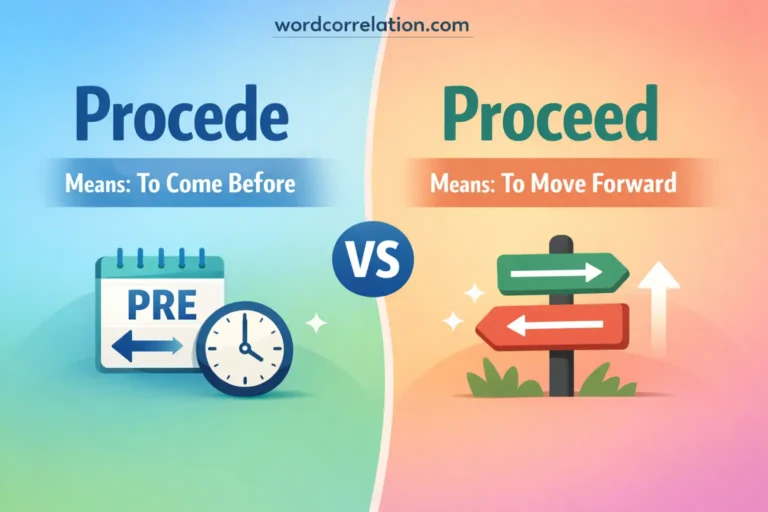
Proceed is correct.
Procede is always wrong.
- Proceed means to move forward or continue.
- Procede is a common spelling mistake.
Example:
✅ Please proceed with the task.
❌ Please procede with the task.
The Origin of procede or proceed
The word proceed comes from Latin. It comes from procedere, which means “to go forward.” Therefore, the meaning stays strong and clear today.
However, English spelling changed over time. Meanwhile, the sound stayed the same. As a result, many people guess the spelling. That guess often becomes procede, which feels right but is wrong.
Moreover, English has many silent letters. The double “e” sound adds to the confusion. In contrast, the spelling rule stayed fixed. Only proceed entered modern English. So, the confusion exists because sound and spelling do not match perfectly. This mismatch causes repeated errors.
This pair is included in our spelling errors pillar.
British English vs American English Spelling
Many writers ask if this is a UK vs US issue. However, the answer is simple.
Both British and American English use proceed. In contrast, procede is never accepted in any region.
Here is a simple comparison:
| Feature | British English | American English |
| Correct spelling | Proceed | Proceed |
| Alternate spelling | None | None |
| Common mistake | Procede | Procede |
Therefore, no regional difference exists. The rule stays the same everywhere.
Which Spelling Should You Use?
The answer depends on correctness, not location.
For US writers:
Always use proceed. Schools and style guides agree.
For UK or Commonwealth writers:
Use proceed in all cases. Dictionaries confirm this rule.
For global or professional writing:
Choose proceed every time. Clients and readers expect accuracy.
Meanwhile, avoid guessing. When unsure, remember the double “e.” That detail saves time and stress. Another common misspelling is despite or inspite.
Common Mistakes with procede or proceed
Writers repeat the same errors again and again. However, fixing them is easy.
❌ Incorrect: Please procede to the next step.
✅ Correct: Please proceed to the next step.
Explanation: The verb always has double “e.”
❌ Incorrect: We will procede after lunch.
✅ Correct: We will proceed after lunch.
Explanation: Sound does not change spelling.
❌ Incorrect: Procede carefully with the plan.
✅ Correct: Proceed carefully with the plan.
Explanation: Spellcheck may miss this error.
Therefore, checking manually matters.
procede or proceed in Everyday Examples
You see proceed everywhere. Understanding context helps memory.
Emails:
Please proceed with the payment today.
News:
The court allowed the trial to proceed.
Social media:
Let’s proceed with kindness.
Formal writing:
The committee decided to proceed with the proposal.
In contrast, procede never fits any situation. If you see it, it is wrong.
procede or proceed – Google Trends & Usage Data
Search data shows strong patterns. Therefore, the insight helps learners.
By country:
The US, UK, India, and Australia search this term often.
By user type:
Students search before exams. Writers check before publishing. ESL learners verify spelling rules. Professionals confirm email accuracy.
Correct usage vs mistakes:
“Proceed” dominates published content. “Procede” appears mostly in error searches. Overall, people search because they want certainty.
A related spelling issue appears in presense or presence.
Comparison Table: procede vs proceed
| Feature | Proceed | Procede |
| Meaning | To move forward | No meaning |
| Part of speech | Verb | None |
| Context of use | All formal and informal | Never correct |
| Formal vs informal | Works everywhere | Always wrong |
| Common mistakes | Misspelling as procede | Assuming it is valid |
| Correct example | Please proceed | Not applicable |
This table removes confusion instantly.
Semantic FAQs (People Also Ask)
Is procede the same as proceed?
No. Procede is incorrect. Proceed is correct.
Which one is correct in formal writing?
Proceed is always correct.
Can they be used interchangeably?
No. Only proceed works.
Why do people confuse them?
Sound-based spelling causes the mistake.
Can grammar tools catch this error?
Some tools miss it. Manual checking helps.
Is there a British vs American difference?
No difference exists at all.
Conclusion
Overall, the confusion between procede or proceed comes from spelling, not meaning. The sound tricks the ear. However, the rule stays firm. Only proceed is correct in every form of English.
In short, remember the double “e.” That small detail prevents big mistakes. Moreover, correct spelling builds trust. Readers notice accuracy quickly. Meanwhile, wrong spelling distracts and weakens writing.
Finally, use this easy rule:
If you mean “go forward,” always write proceed.
Never write procede. Avoid it completely.
With that rule, writing becomes faster and clearer. Confidence also grows. Therefore, proceed with confidence every time. Another common misspelling is despite or inspite.

Daniel Morris writes about English word differences and spelling confusion. His focus is to provide clear, simple explanations with practical usage examples.