
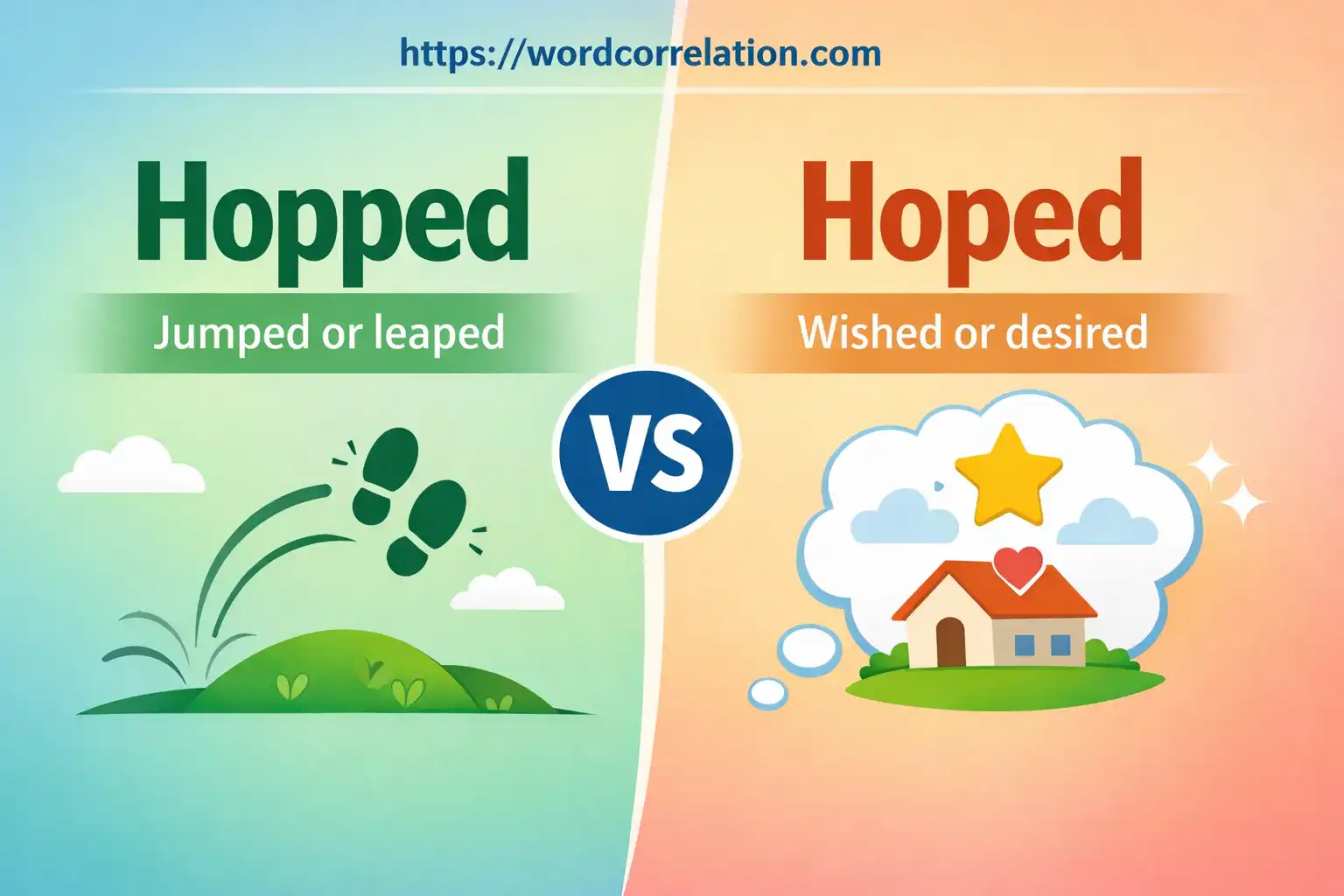
If you have ever typed a sentence and paused to wonder whether you should write hopped or hoped, you are not alone. These two words look almost identical on screen, but they carry completely different meanings. One is about physical movement. The other is about desire, wish, and expectation. Mixing them up in your writing can change your entire sentence — and not in a good way.
In this guide, we break down the difference between hopped and hoped, explain where each word comes from, show you how to use them correctly in sentences, and give you a simple trick to never confuse them again.
What Does “Hoped” Mean?
Hoped is the simple past tense and past participle of the verb hope.
To hope means to want something to happen, especially when you are not sure whether it will. It expresses a desire, expectation, or wish. When you hoped for something, it means you had that wish or expectation in the past.
Root verb: hope Past tense: hoped Present participle: hoping
Example Sentences Using “Hoped”
- She hoped the interview would go well, but she was still nervous.
- He hoped to finish the project before the deadline.
- They hoped for a warm and sunny day on their wedding.
- I hoped you would call — I was waiting all evening.
- We hoped the rain would stop before the match.
Notice how in every sentence above, hoped refers to an internal emotional state — a wish, a desire, or an expectation. There is no physical action taking place. It is entirely in the mind of the subject.
What Does “Hopped” Mean?
Hopped is the simple past tense and past participle of the verb hop.
To hop means to jump lightly or move quickly, usually on one foot or with both feet together. It can also mean to move from one place to another in a quick or informal way. In informal American English, hopped can also mean excited or stimulated — for example, “hopped up on caffeine.”
Root verb: hop Past tense: hopped Present participle: hopping
Example Sentences Using “Hopped”
- The rabbit hopped across the garden and disappeared behind the bush.
- She hopped out of bed the moment her alarm went off.
- He hopped on the first train to London without buying a ticket.
- The children hopped from one stone to the next across the stream.
- We hopped between three coffee shops before finding one we liked.
In every sentence above, hopped describes a physical action — jumping, leaping, moving, or transferring quickly from one place to another. It is active, visible, and external.
Hopped vs Hoped: Side-by-Side Comparison
| Feature | Hoped | Hopped |
| Root Verb | hope | hop |
| Meaning | to wish or desire something | to jump or move quickly |
| Type of Action | internal / emotional | physical / external |
| Spelling Rule | single “p” (silent e dropped) | double “p” (short vowel rule) |
| Example | She hoped to win | The frog hopped away |
The Spelling Difference Explained
This is where most people get confused. Both words sound similar when spoken quickly, and the spelling difference is just one letter — a single p versus double pp. But the reason for this difference is an important grammar rule.
The Silent “E” Rule (for hoped)
The verb hope ends in a silent e. When you add -ed to form the past tense, you simply drop the e and add -ed.
- hope → hoped ✅
- hope → hoped (not hopeed, not hoped with extra letters)
The Short Vowel Doubling Rule (for hopped)
The verb hop ends in a consonant-vowel-consonant (CVC) pattern: h-o-p. The vowel o is short. When a single-syllable verb ends in a CVC pattern with a short vowel, you must double the final consonant before adding -ed or -ing.
- hop → hopped ✅
- hop → hopping ✅
This is why hopped has double p and hoped does not.
The same rule applies to similar verb pairs:
- tap → tapped | tape → taped
- rip → ripped | ripe → riped (incorrect — riped is not a standard word)
- plan → planned | plane → planed
Understanding this rule helps you not only with hopped and hoped but with dozens of other commonly confused verb forms in English.
Common Mistakes Writers Make
Mistake 1: Writing “hoped” when you mean “hopped”
❌ The frog hoped across the pond. ✅ The frog hopped across the pond.
Frogs do not wish — they jump. Use hopped for physical movement.
Mistake 2: Writing “hopped” when you mean “hoped”
❌ She hopped to get into the university of her dreams. ✅ She hoped to get into the university of her dreams.
Unless she was literally jumping toward the university gates, hoped is the correct word here.
Mistake 3: Confusing the -ing forms
The same confusion exists with hoping and hopping.
- hoping = present participle of hope (wishing)
- hopping = present participle of hop (jumping)
❌ He was hopping to get a promotion this year. ✅ He was hoping to get a promotion this year.
When Can “Hopped” Have a Figurative Meaning?
In casual and informal English, hopped sometimes takes on extended meanings beyond physical jumping.
“Hopped up” — means overly excited or stimulated, often because of caffeine, sugar, or drugs.
- The kids were hopped up on candy after the party.
“Bar hopping” / “pub hopping” — means going to several bars or pubs one after another in a single evening.
- They spent the night bar hopping across the city.
“Island hopping” — means traveling between multiple islands on a trip.
- We spent two weeks island hopping across the Philippines.
In all these figurative uses, hopped still carries the core idea of quick movement or energetic action — just applied in a broader context.
Memory Trick: How to Always Get It Right
Here is a simple trick you can use every time you are unsure:
Ask yourself: Is someone wishing something — or jumping somewhere?
- Wishing = hoped (hope → hoped, one p)
- Jumping = hopped (hop → hopped, two p’s)
You can also remember it this way:
- “Hope” has a silent e at the end → hoped keeps that gentle, quiet energy — just like a wish is quiet and internal.
- “Hop” is short and punchy → hopped doubles its energy with two p’s, just like a jump has double the physical force.
Quick Practice: Fill in the Blank
Try these sentences on your own before checking the answers:
- She ________ to arrive before the storm started.
- The sparrow ________ from branch to branch in the oak tree.
- He ________ for better news from the doctor.
- They ________ on a flight to New York at the last minute.
- I ________ you would remember my birthday.
Answers: 1. hoped | 2. hopped | 3. hoped | 4. hopped | 5. hoped
Frequently Asked Questions
Is “hopped” always about physical movement? Mostly yes, but in informal English it can also describe excitement (“hopped up”) or moving between places quickly (“bar hopping”).
Can “hoped” ever describe something physical? No. Hoped is always about an internal emotional state — a wish, desire, or expectation. It never describes a physical action.
Is “hopeing” a correct spelling? No. The correct spelling is hoping (not hopeing). The silent e in hope is dropped before adding -ing.
Is “hoping” and “hopping” the same mistake as “hoped” and “hopped”? Yes, exactly. The same root words and the same spelling rules apply. Hoping is from hope, and hopping is from hop.
Final Summary
To wrap it up simply:
- Hoped = past tense of hope = you wanted something to happen
- Hopped = past tense of hop = you jumped or moved quickly
The spelling difference — one p vs two p’s — comes directly from English grammar rules about short vowels and silent e endings. Once you understand those rules, you will never confuse these two words again.
The next time you write a sentence and feel unsure, just ask: Is someone wishing — or jumping? That single question will always point you to the right word.

Ibrahim Jhon is an English language editor with over ten years of experience working with writers, publishers, and international businesses. He specialises in word choice, grammar accuracy, and the differences between British and American English.