
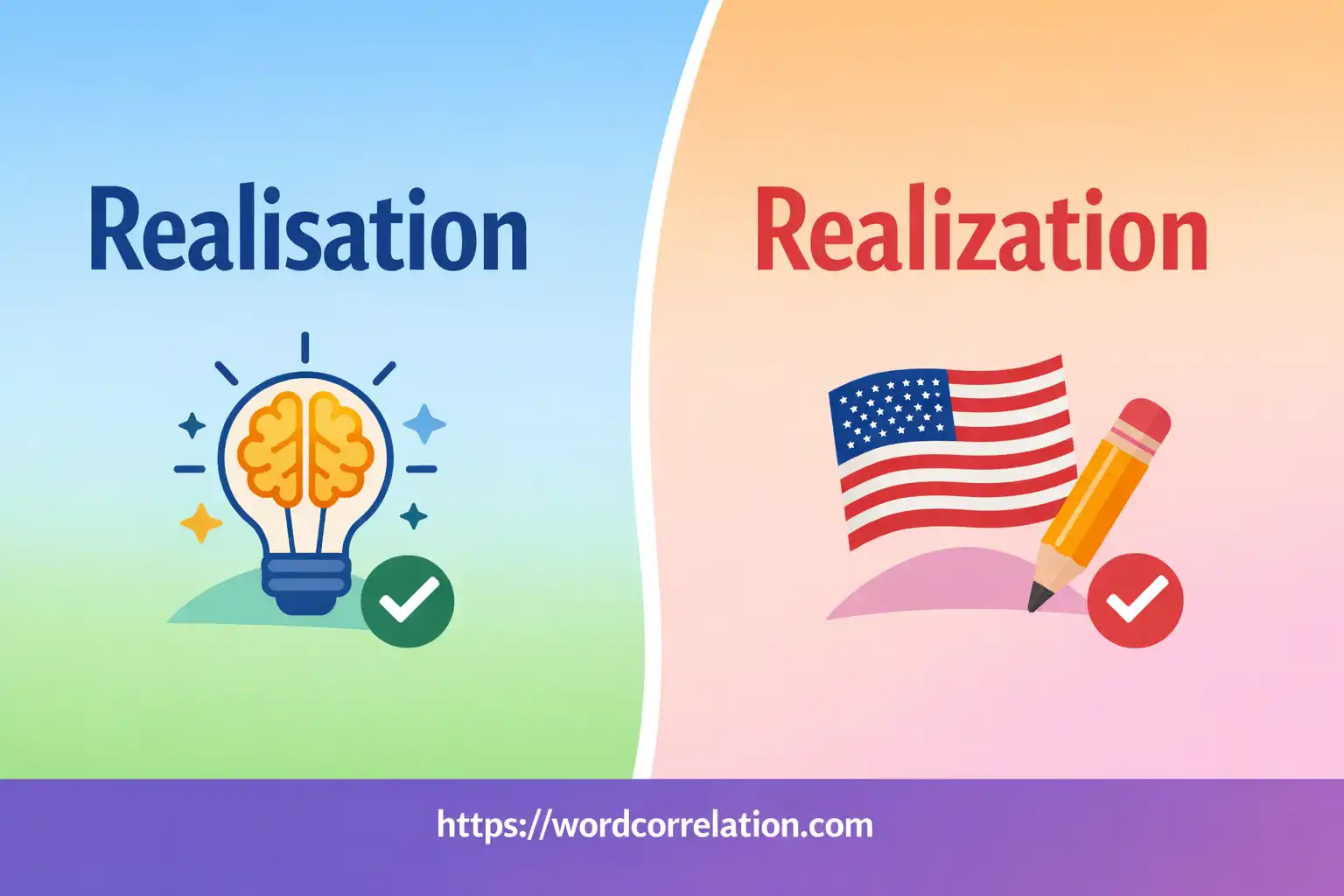
When deciding whether to write realisation or realization, the correct choice depends almost entirely on your target audience’s geographical region. Realization (with a “z”) is the standard spelling in American and Canadian English, while realisation (with an “s”) is the prevailing spelling in British, Australian, and New Zealand English.
Both spellings share the exact same definitions: becoming aware of something, achieving a long-sought goal, or converting physical assets into cash.
Here is a quick breakdown to help you choose the right spelling immediately:
Quick Answer Table (At-a-Glance)
| Term | Regional Preference | Part of Speech | Primary Meaning | Quick Example |
|---|---|---|---|---|
| Realization | American & Canadian English | Noun | Becoming aware; achieving a goal; converting assets to cash | Her sudden realization changed the team’s entire strategy. |
| Realisation | British, Australian, & NZ English | Noun | Becoming aware; achieving a goal; converting assets to cash | The realisation of her lifelong dream took years of hard work. |
What Does “Realization” Mean?
Part of Speech & Pronunciation
- Part of Speech: Noun (singular or uncountable)
- Pronunciation:
/ˌriː.ə.ləˈzeɪ.ʃən/(pronounced ree-uh-luh-ZAY-shun)
Definitions & Structural Contexts
The term realization is the primary spelling used throughout North America. It derives from the verb realize and refers to the process or moment of making something real, tangible, or fully understood:
- Becoming Aware (Epiphany): The moment an individual suddenly understands a truth, situation, or fact.
- Attainment of a Goal: The act of fulfilling a plan, dream, or ambition (the realization of a vision).
- Financial & Asset Liquidation: In accounting and business, the process of selling assets or investments to convert them into actual cash.
- Music & Phonetics: In classical music, creating a full accompaniment from a figured bass; in linguistics, the actual phonetic production of a sound.
6 Example Sentences in Different Contexts
- Epiphany Context: A sudden realization hit the lead investigator as she re-examined the financial disclosures.
- Goal Attainment Context: Winning the national championship was the realization of a dream he had pursued since childhood.
- Corporate Finance Context: The company scheduled the realization of its offshore assets to satisfy upcoming debt obligations.
- Scientific Context: The practical realization of fusion energy remains one of modern physics’ greatest challenges.
- Creative Arts Context: The film director praised the set designer for the vivid visual realization of the fantasy world.
- Psychological Context: Therapy helped the patient come to the gradual realization that his anxiety stemmed from burnout.
What Does “Realisation” Mean?
Part of Speech & Pronunciation
- Part of Speech: Noun (singular or uncountable)
- Pronunciation:
/ˌrɪə.laɪˈzeɪ.ʃən/(pronounced ree-uh-lye-ZAY-shun)
Definitions & Structural Contexts
Realisation is the preferred spelling across the United Kingdom, Australia, New Zealand, Ireland, and most global publishers using Commonwealth conventions. It carries identical dictionary definitions to realization:
- Mental Understanding: The act of comprehending or becoming conscious of a reality.
- Fulfillment of Plans: Turning abstract ideas into physical results or achievements.
- Financial Asset Sale: Converting holdings or investments into liquid currency within UK and Commonwealth accounting frameworks.
6 Example Sentences in Different Contexts
- UK Media Context: British news outlets reported a growing realisation among voters regarding the economic impact of the policy.
- Australian Public Policy Context: The government announced a grant aimed at the full realisation of regional infrastructure projects.
- Academic Publishing Context: Her paper details the historical realisation of democratic reforms across nineteenth-century Europe.
- Literary Narrative Context: The novel’s climax hinges on the protagonist’s quiet realisation that he has been betrayed.
- European Commerce Context: The audit firm oversaw the orderly realisation of the company’s European subsidiaries.
- Performing Arts Context: Stage directors celebrated the breathtaking realisation of the opera’s final act in London.
Realisation vs Realization: Key Differences Comparison Table
| Feature | Realization (with Z) | Realisation (with S) |
|---|---|---|
| Dominant Regions | United States, Canada, Philippines | United Kingdom, Australia, New Zealand, Ireland |
| Etymological Root | Greek -izein via Late Latin -izare | French -iser influence on British English |
| Oxford English Stance | Preferred (Oxford Spelling standard) | Accepted as general British English standard |
| Collocations | Sudden realization, asset realization | Gradual realisation, full realisation |
| Parallel Spelling Patterns | Visualization, organization, recognize | Visualisation, organisation, recognise |
Why People Confuse These Words
The confusion between realisation and realization is not a matter of correct versus incorrect grammar, but rather a classic split between American English and British English spelling conventions.
1. The “-ize” vs. “-ise” Regional Split
During the 18th and 19th centuries, American lexicographers like Noah Webster sought to simplify and standardize American spelling. They favored the -ize ending for verbs derived from Greek roots (-izein), leading to words like realize, organize, and visualize, alongside their noun forms ending in -ization.
In contrast, 19th-century British English spelling became heavily influenced by French verbs ending in -iser. As a result, British spelling increasingly adopted -ise and -isation.
2. The Oxford Spelling Myth
Many writers mistakenly believe that realization is strictly an “Americanism.” In reality, the -ize spelling is historically older in English literature than the -ise spelling.
In fact, the prestigious Oxford University Press (and the Oxford English Dictionary) continues to prefer -ize and -ization for words with Greek etymological roots—a standard known as Oxford Spelling. Therefore, seeing realization in a British academic journal published by Oxford is entirely standard.
3. Parallel Suffix Groups (Visualization or Visualisation)
This regional pattern applies consistently across an entire family of words. If you write realization, you will naturally use visualization, organization, and characterization. If you write realisation, you will pair it with visualisation, organisation, and characterisation.
Memory Trick to Remember the Difference
Use these simple regional visual anchors to select the correct spelling every time:
RealiZation = Zip code / Zone (USA)
Look at the Z in RealiZation:
Think "Zip Code" or "American Zone."
Use RealiZation for US & Canadian audiences!

RealiSation = Sovereign / Shire (UK)
Look at the S in RealiSation:
Think "Sovereign" or "British Shire."
Use RealiSation for UK, Australian, & Commonwealth audiences!
Extending the Rule to “Visualization or Visualisation”
You can apply this exact same mnemonic to related words like visualization or visualisation:
- VisualiZation: Features a Z $\rightarrow$ Standard in the Zip-code nation (USA).
- VisualiSation: Features an S $\rightarrow$ Standard in Sovereign territories (UK/Commonwealth).
Example Sentences Side-by-Side
| Context | American English (Realization / Visualization) | British / Commonwealth English (Realisation / Visualisation) |
|---|---|---|
| Personal Epiphany | His realization came after reviewing the data. | His realisation came after reviewing the data. |
| Data & Design | Data visualization helps spot key trends. | Data visualisation helps spot key trends. |
| Corporate Assets | Asset realization yielded high returns. | Asset realisation yielded high returns. |
| Project Planning | The realization of our goals is near. | The realisation of our goals is near. |
Common Mistakes People Make
1. Assuming “Realization” Is Forbidden in British English
- Myth: You must never use realization in British writing.
- Fact: Realization is fully acceptable in British English under Oxford style guidelines. While most UK newspapers (like The Guardian) prefer realisation, academic journals and major publishers frequently use realization.
2. Inconsistent Suffix Usage Within the Same Document
- Incorrect: The company completed the realisation of its strategy through clear data visualization.
- Correct (US Style): The company completed the realization of its strategy through clear data visualization.
- Correct (UK Style): The company completed the realisation of its strategy through clear data visualisation.
- Why: Consistency is essential. Do not mix -isation and -ization spellings within a single manuscript or report.
3. Applying the “Z” Rule to Words That NEVER Take a “Z”
- Incorrect: advertize, exercize, surprize, revize
- Correct: advertise, exercise, surprise, revise
- Why: Certain English words do not derive from the Greek -izein root. Words like surprise, exercise, revise, and advertise must always be spelled with an s in both American and British English.
Frequently Asked Questions (FAQ)
What is the main difference between realisation and realization?
There is no difference in definition, grammar, or usage. Realization is the standard spelling in American and Canadian English, while realisation is preferred in British, Australian, and New Zealand English.
How does “visualization or visualisation” relate to this spelling rule?
The exact same regional spelling rule applies. Visualization (with a “z”) is used in North America, while visualisation (with an “s”) is standard in Commonwealth English.
Is “realization” an Americanism?
No. The -ize suffix predates the United States by centuries and stems directly from Greek and Latin roots. Oxford University Press retains -ize as its preferred standard in British academic publications.
Which spelling should I use for international business writing?
If your audience is based primarily in North America, use realization. For British, Australian, or European audiences, use realisation. If following a corporate global style guide, select one style and maintain complete consistency.
Does the verb form follow the same rule?
Yes. Realize is the American/Canadian verb spelling, while realise is the British/Commonwealth verb spelling. The same applies to past-tense forms (realized vs realised) and present participles (realizing vs realising).
Are both spellings recognized by spellcheckers?
Yes. Digital spellcheckers will accept either form, provided your software’s language setting is calibrated to the appropriate dialect (e.g., English (US) vs English (UK)).
Conclusion
Choosing between realisation or realization comes down to matching your spelling to your reader’s regional background:
- Use realization (and visualization) for American and Canadian audiences or publications adhering to Oxford spelling rules.
- Use realisation (and visualisation) for UK, Australian, and Commonwealth readers.
To maintain a polished professional voice, choose one regional convention at the start of your project and apply it consistently across all derivative terms.

Ibrahim Jhon is an English language editor with over ten years of experience working with writers, publishers, and international businesses. He specialises in word choice, grammar accuracy, and the differences between British and American English.