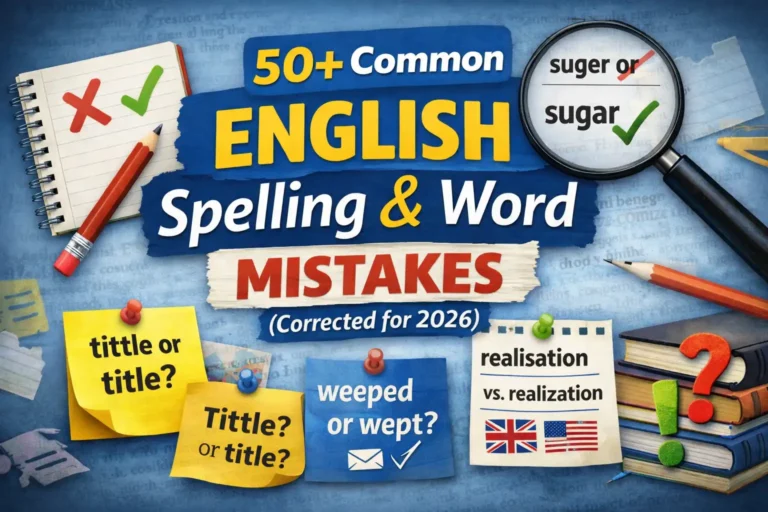
English spelling and word mistakes are very common. Even good English speakers make these mistakes. People often ask questions like “sugar or suger?”, “title or tittle?”, and “weeped or wept?”. These questions can be confusing.
This guide explains common English spelling and word mistakes using easy rules and clear examples. It shows the correct words and the wrong words. By the end, you will know which words are right and how to use them correctly.
🔹 Quick Answer
Many English spelling mistakes happen because words look the same or are spelled differently. For example, “sugar” is correct (not suger), “wept” is correct (not weeped), and “title” is correct (not tittle). Some words change in American and British English. Learning the correct spelling helps you write better and avoid mistakes.
1. Sugar vs Suger
❌ suger
✅ sugar
Sugar is the correct spelling.
Suger is a misspelling and should never be used in standard English.
✔ Example:
Add one spoon of sugar to the tea.
2. Weeped vs Wept (Past Tense of Weep)
❌ weeped
✅ wept
Wept is the correct past tense and past participle of weep.
✔ Example:
She wept quietly after hearing the news. If you’re unsure about similar spellings, check our main word comparison hub for quick clarity.
3. Realization vs Realisation (UK vs US)
Both spellings are correct, depending on English style:
- Realization → American English
- Realisation → British English
✔ Choose one style and stay consistent.
4. Visualization vs Visualisation
- Visualization → American English
- Visualisation → British English
✔ Both mean forming a mental image.
5. Title vs Tittle
❌ tittle (when you mean heading)
✅ title
- Title → name of a book, article, or position
- Tittle → a very small mark (rarely used word)
✔ Correct:
The title of the book is interesting.
6. Hazard vs Hazzard
❌ hazzard
✅ hazard
Hazard is the only correct spelling.
✔ Example:
Smoking is a health hazard. For more tricky word forms like this, explore the word comparison hub for side-by-side explanations.
7. Stories vs Story’s vs Storys
✔ stories → correct plural
❌ story’s → possessive (not plural)
❌ storys → incorrect
✔ Example:
She wrote many short stories.
8. Faeces vs Feces (UK vs US)
- Faeces → British English
- Feces → American English
✔ Both are correct depending on regional spelling.
9. Model vs Modle
❌ modle
✅ model
✔ Example:
This car is the latest model. For correct spelling confirmation, use the word comparison hub.
10. Lambda vs Lamda
❌ lamda
✅ lambda
Lambda is the correct spelling of the Greek letter.
11. Proceed vs Procede
❌ procede
✅ proceed
✔ Example:
Please proceed with the payment.
12. Remuneration vs Renumeration
❌ renumeration
✅ remuneration
- Remuneration → payment or compensation
- Renumeration → incorrect in most contexts
13. Presence vs Presense
❌ presense
✅ presence
✔ Example:
His presence was reassuring.
14. Proof vs Prove
- Proof → noun (evidence)
- Prove → verb (to demonstrate)
✔ Example:
Can you prove this claim with proof? Another noun-versus-verb choice is proof or prove.
15. In Spite vs Inspite
❌ inspite
✅ in spite
✔ Example:
He succeeded in spite of difficulties.
16. Weenie vs Wienie
✔ weenie → correct spelling
❌ wienie → incorrect
17. Quatro vs Cuatro
- Cuatro → correct Spanish word for “four”
- Quatro → incorrect in Spanish (except as brand names)
18. Information vs Informations
✔ information → uncountable noun
❌ informations
✔ Correct:
This information is helpful.
19. Foul vs Fowl
- Foul → dirty or unfair
- Fowl → bird
✔ Example:
That was a foul decision.
20. Mama vs Mamma / Momma
✔ mama → standard
✔ mamma → acceptable variant
⚠ momma → informal
Why These Mistakes Matter
- Incorrect spellings reduce credibility
- Google may understand mistakes, but trust decreases
- Correct usage improves:
- SEO
- Readability
- Professional writing
Conclusion
English spelling confusion is normal—but repeating mistakes is avoidable. This guide covered the most searched spelling and word-confusion problems, including sugar vs suger, title vs tittle, realization vs realisation, weeped vs wept, and many more.
By using dictionary-approved spellings, understanding UK vs US differences, and avoiding common incorrect forms, you can write with confidence and clarity. Bookmark this page as a reference guide whenever you’re unsure about a word.
Frequently Asked Questions (FAQs)
1. Is it sugar or suger?
Sugar is correct. Suger is a spelling mistake.
2. Is weeped a word?
No. The correct past tense of weep is wept.
3. Which is correct: title or tittle?
Title is correct when referring to a name or heading. Tittle is a rare word meaning a small mark.
4. Is it realisation or realization?
Both are correct. Realisation is British English, while realization is American English.
5. What is the correct spelling: hazard or hazzard?
Hazard is correct. Hazzard is incorrect.
6. Is it stories or story’s?
Stories is the correct plural. Story’s is possessive, not plural.
7. Is proceed or procede correct?
Proceed is correct. Procede is incorrect.
8. What is the difference between remuneration and renumeration?
Remuneration means payment. Renumeration is usually incorrect.
9. Is visualization or visualisation correct?
Both are correct. Visualization is US spelling, visualisation is UK spelling.
10. Is faeces or feces correct?
Both are correct—faeces (UK) and feces (US).

Daniel Morris writes about English word differences and spelling confusion. His focus is to provide clear, simple explanations with practical usage examples.