
You typed one spelling. Autocorrect changed it. Now you’re not sure which one is right. This happens to writers, designers, students, and native speakers every single day. The answer is simple — but it depends on where you are.
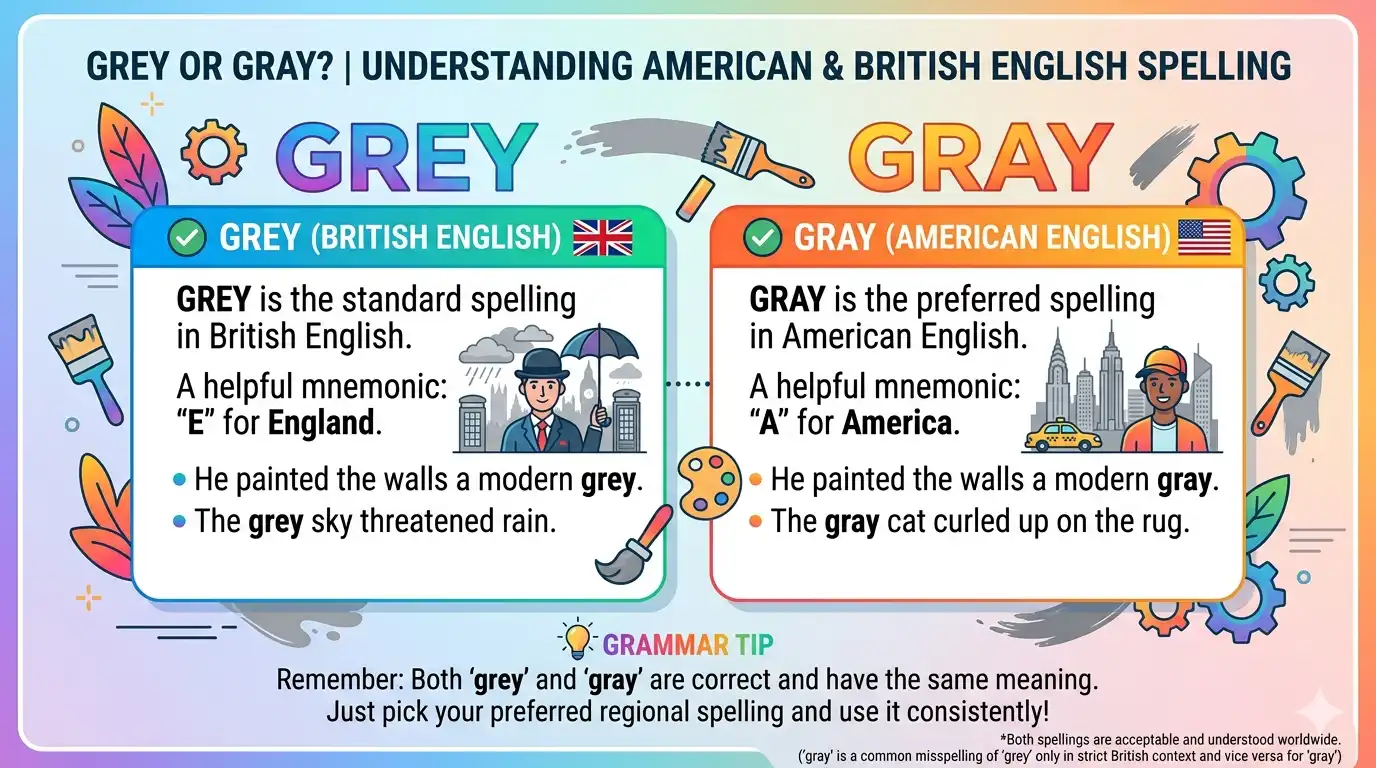
Both grey and gray are correct. They mean the same thing. The only difference is regional spelling. Grey is standard in British English. Gray is standard in American English. That’s it.
But there’s more to it than just “pick one.” Proper nouns, scientific terms, brand names, and formal writing all carry specific rules. This guide covers everything — etymology, usage, exceptions, UK vs US difference, examples, and FAQs — so you never have to second-guess yourself again.
What Do Grey and Gray Actually Mean?
Grey and gray both describe the same colour — the neutral shade that sits between black and white. You see it in storm clouds, elephant skin, silver hair, charcoal suits, and concrete walls.
The word works as three parts of speech:
As an adjective: It describes colour. The sky turned gray before the storm. She wore a grey coat to the meeting.
As a noun: It names the colour itself. The room was painted in shades of gray. He preferred grey over navy for his car.
As a verb: It means to become grey, especially hair. His hair had grayed significantly over the decade. Her temples began to grey in her early thirties.
The verb form is less commonly known but fully correct in both spellings.
Etymology: Where Did These Two Spellings Come From?
Both grey and gray come from the same Old English root: grǣg. In Middle English, the word appeared in several forms — grey, gray, greye, graye — used interchangeably.
The split happened slowly over centuries, not overnight.
In the 18th and 19th centuries, British spelling began to settle on grey as the standard. Meanwhile, in America, lexicographer Noah Webster published his influential American Dictionary of the English Language in 1828. Webster deliberately simplified and Americanised many spellings — “colour” became “color,” “honour” became “honor,” and grey became gray.
Webster’s dictionary became the backbone of American schoolbooks, government documents, and publishing. Over the following century, gray became the default in the United States while grey held firm across Britain and the Commonwealth.
Today, both spellings appear in every major dictionary. Neither is wrong. The distinction is geographic, not grammatical.
The Core Rule: UK vs US English
This is the rule that solves 95% of all grey/gray questions:
| Region | Spelling | Example |
| United States | gray | The car is gray. |
| United Kingdom | grey | The car is grey. |
| Canada | grey (mostly) | The sky looks grey today. |
| Australia | grey (mostly) | A grey kangaroo crossed the road. |
| New Zealand | grey (mostly) | The wool is a natural grey. |
| Ireland | grey (mostly) | His suit was charcoal grey. |
A simple mnemonic helps: A for America = grAy. E for England = grEy.
If you are writing for an American audience — articles, essays, product descriptions, marketing copy — use gray.
If you are writing for a British, Canadian, Australian, or Commonwealth audience, use grey.
For global or mixed audiences, choose one and stay consistent throughout the document.
Exceptions: When the Spelling Is Fixed
This is where most articles fail. Certain proper nouns, brand names, and scientific terms have fixed spellings that do not follow the regional rule. You cannot swap them.
Fixed “Grey” Spellings (Even in American English)
Earl Grey tea — The blend is named after Charles Grey, the 2nd Earl Grey. The spelling is part of the proper name.
Grey Goose vodka — A French brand with a fixed spelling.
Grey Poupon mustard — Also French in origin, fixed as “grey.”
Grey’s Anatomy — The TV drama uses the British spelling.
Fifty Shades of Grey — The novel by British author E.L. James uses British spelling throughout.
Greyhound (the dog breed and bus company) — Fixed compound word.
Greylag goose — The bird’s name is fixed.
Grey matter — While “gray matter” is also used in American English, “grey matter” is common globally and both are accepted in scientific writing.
Fixed “Gray” Spellings (Even in British English)
The Gray (Gy) — The SI unit of absorbed radiation dose is named after British physicist Louis Harold Gray. It is always spelled Gray in scientific and medical contexts, regardless of location.
The patient received 2 gray of radiation.
Thomas Gray — The 18th-century British poet. His name is spelled with an A.
Zane Grey — The American Western novelist. Fixed proper name.
Gray wolf — In American English and much of scientific literature, gray wolf is the accepted common name for Canis lupus.
The lesson: when a proper noun or a unit of measurement is involved, always check the standard spelling. Regional rules do not apply.
Grey and Gray in Phrases and Idioms
Several common English phrases use grey or gray. In these cases, follow the same regional rule — use gray in American English and grey in British English.
Gray area / Grey area A situation that is ambiguous, unclear, or falls between two defined categories. The contract had a gray area about overtime pay. The ethics of the decision fell into a grey area.
Gray matter / Grey matter Refers to the brain, or intelligence more broadly. Solving that puzzle required some serious gray matter.
Going gray / Going grey The process of hair losing its pigment with age. He started going gray in his late thirties.
Gray-haired / Grey-haired Describing someone with gray or grey hair. The grey-haired professor entered the lecture hall.
Gray market / Grey market A market where goods are sold outside of official channels but not illegally. The device was available on the gray market before the official launch.
All of these phrases follow the standard UK/US split. There is no fixed version for idioms.
Grey and Gray in Design, Branding, and Writing
Designers, marketers, and content creators often run into grey/gray decisions that go beyond grammar.
Colour Codes and Design Tools
In web design and graphic design, both spellings work in CSS and design software. However, the named CSS colour is gray (American spelling). Tools like Adobe Photoshop, Canva, and Figma typically use “gray” in their interface language, as most major software is developed in the United States.
CSS: color: gray; is valid. color: grey; is also valid — both are recognised.
Brand Voice and Consistency
If your brand serves a UK audience, “grey” reinforces local identity. If your brand is American, “gray” is the expected spelling. For international brands, pick one spelling and apply it consistently across all marketing materials, style guides, and product descriptions.
Mixing “grey” in one headline and “gray” in the next paragraph signals careless editing — even if both are technically correct.
Side-by-Side Example Sentences
Seeing both spellings in parallel makes the rule easier to remember.
| American English (gray) | British English (grey) |
| The fog made everything look gray. | The fog made everything look grey. |
| She painted the walls a light gray. | She painted the walls a light grey. |
| His beard had gone completely gray. | His beard had gone completely grey. |
| The whale is gray with white markings. | The whale is grey with white markings. |
| There’s a gray squirrel in the garden. | There’s a grey squirrel in the garden. |
| It was a dull, gray November morning. | It was a dull, grey November morning. |
Same meaning. Same sentence structure. Different audience, different spelling.
Grammar Quick-Check: Using Gray/Grey Correctly
Writers sometimes make errors not in which spelling they choose but in how they use the word. Here are the most common mistakes.
Adjective before a noun: correct. She wore a gray dress. ✓
Adjective after a linking verb: correct. The dress is gray. ✓
As a noun: correct. That shade of gray suits the room. ✓
As a verb: correct but often forgotten. His hair has grayed since last year. ✓ Her temples are beginning to grey. ✓
Mixing spellings in one document: avoid. The gray walls matched the grey carpet. ✗ — Pick one.
Using “grey” in American academic writing: avoid unless it’s a proper noun. Most American style guides (APA, Chicago, AP) expect “gray” in US-context writing.
Frequently Asked Questions
Is grey or gray correct?
Ans: Both are correct. Grey is the British spelling. Gray is the American spelling. The choice depends on your audience and location.
Which spelling does Google prefer for SEO?
Ans: Google does not prefer one spelling over the other for ranking purposes. However, your content should be consistent with the regional variety it targets. A page aimed at UK readers should use “grey.” A page for American readers should use “gray.”
Can I use both grey and gray in the same article?
Ans: It is best to pick one and stay consistent. The only exception is when you need to mention both deliberately — for example, in an article like this one that explains the difference. In that case, mention both spellings early, then settle into one.
Is “gray area” or “grey area” correct?
Ans: Both are correct. Use “gray area” in American English and “grey area” in British English.
Why does Earl Grey use the British spelling even in America?
Ans: Because “Earl Grey” is a proper noun — a name. The spelling is fixed to the historical figure (Charles Grey, 2nd Earl Grey). It does not change based on regional rules.
What about Canada, Australia, and New Zealand?
Ans: These countries follow British spelling conventions in most formal contexts, so “grey” is preferred. However, American spellings have significant influence in everyday usage, and both appear in casual writing.
Is the word grayed or greyed?
Ans: Both are correct verb forms. “Grayed” is American English. “Greyed” is British English. His hair grayed over the years (US). His hair greyed over the years (UK).
What is the Gray unit in science?
Ans: The gray (symbol: Gy) is the SI unit of absorbed ionising radiation. It is always spelled with an A regardless of location. Named after British physicist Louis Harold Gray (1905–1965).
Which spelling is more common globally?
Ans: “Grey” is more common globally because more English-speaking countries follow British conventions. However, “gray” dominates in the United States, which produces a large share of English-language content online.
Conclusion
The grey vs. gray debate has a clean answer: both are right, and which one you use depends on your audience.
Use gray when writing for American readers. Use grey when writing for British, Australian, Canadian, or Commonwealth readers. For global audiences, pick one and stay consistent throughout your document.
Remember the exceptions. Earl Grey, Grey Goose, and Grey’s Anatomy always keep the E. The scientific unit Gray always keeps the A. Proper nouns do not follow regional rules.
Beyond spelling, the word works as an adjective, noun, and verb — and all three forms follow the same regional split.
If you write for the web, mention both spellings once near the top of your content to capture search traffic from both regional audiences. After that, commit to one spelling and keep it consistent.
Whether it’s the grey skies of London or the gray plains of the American Midwest — same colour, same word, same meaning. Just a different letter, and a different side of the Atlantic.
Sources: Merriam-Webster Dictionary, Oxford English Dictionary, British National Corpus, Corpus of Contemporary American English (COCA), Noah Webster’s American Dictionary of the English Language (1828), Grammarly Editorial Standards, Google Search Trends data.

Ibrahim Jhon is an English language editor with over ten years of experience working with writers, publishers, and international businesses. He specialises in word choice, grammar accuracy, and the differences between British and American English.