
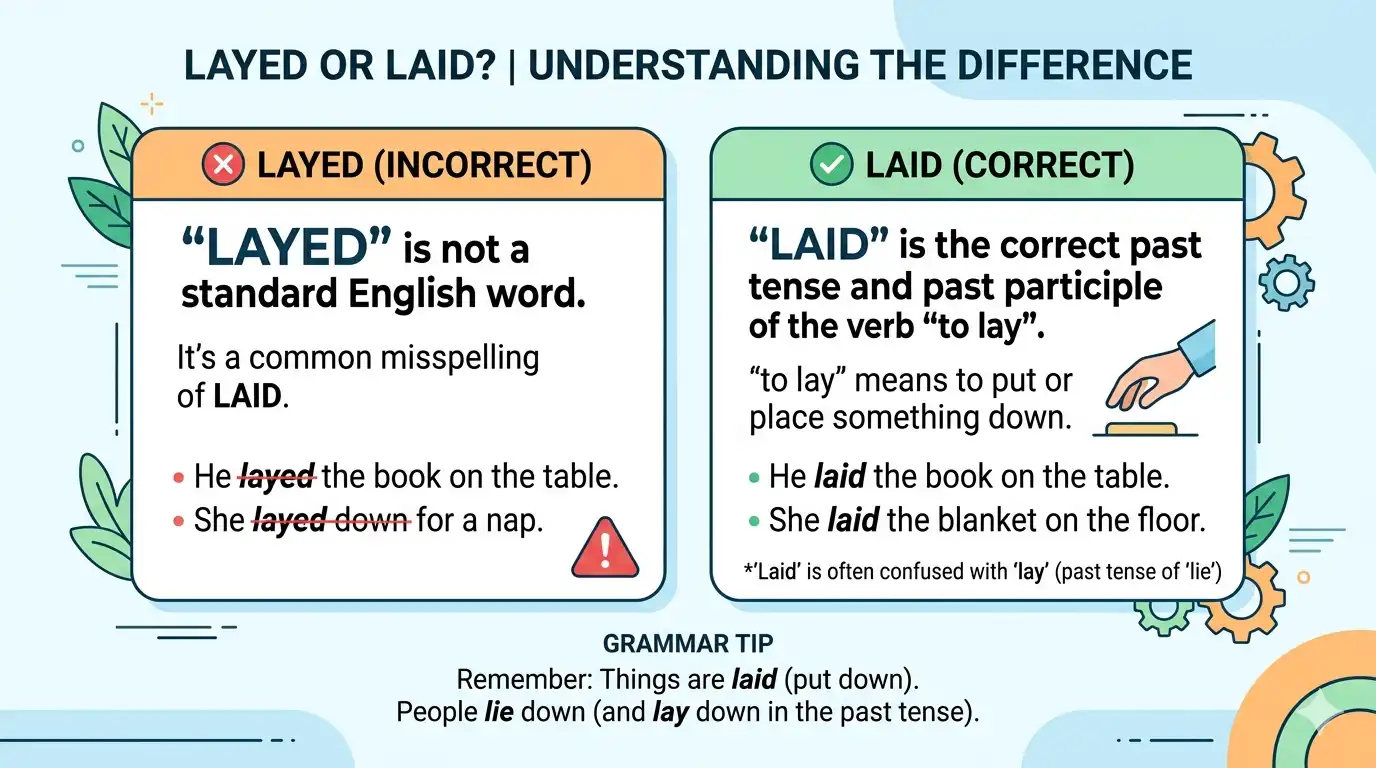
The short answer: “Laid” is always correct. “Layed” is always wrong.
If you typed “layed” in an email and then second-guessed yourself, you are not alone. This is one of the most searched grammar questions in English. Most people assume verbs follow a simple rule — just add “-ed.” But “lay” does not follow that rule. It is an irregular verb.
This guide gives you the full picture. You will learn why “laid” is correct, how to use it in real sentences, how British and American English treat this word, and how to never make this mistake again.
What Does “Lay” Mean?
“Lay” means to put or place something down. It always needs an object — something that placed.
- She lays the keys on the table. (present tense)
- He lay on the couch last night. (past tense of “lie” — different verb)
- I laid the book on the shelf. (past tense of “lay”)
This is where the confusion starts. “Lay” and “lie” are two different verbs. They sound similar. They mean different things. And their past tenses overlap in spelling. More on that below.
Layed or Laid: The Direct Answer
“Layed” does not exist in standard English.
“Laid” is the past tense and past participle of the verb “lay.”
| Form | Word | Example |
| Present | lay | She lays the cards on the table. |
| Past Tense | laid | She laid the cards on the table. |
| Past Participle | laid | The cards have been laid on the table. |
| Present Participle | laying | She is laying the cards on the table. |
There are no exceptions. No regional dialects use “layed.” No style guides accept it. Oxford, Cambridge, and Merriam-Webster all agree — “laid” is the only correct form.
Why Do People Write “Layed”?
English verbs usually form past tense by adding “-ed.” Walk becomes walked. Talk becomes talked. Play becomes played.
So when people see “lay,” they naturally write “layed.”
But “lay” is an irregular verb. It does not follow the “-ed” pattern. Instead, its past tense “laid” — similar to how “pay” becomes “paid” and “say” becomes “said.”
| Present | Past |
| pay | paid |
| say | said |
| lay | laid |
This pattern makes it easy to remember. If “pay” becomes “paid” and not “payed” (except in rare nautical use), then “lay” becomes “laid” and not “layed.”
Lay vs Lie: The Confusion Behind the Confusion
Many people also mix up “lay” and “lie.” This adds another layer of confusion.
Lay = to put something down (needs an object) Lie = to recline (no object needed)
| Verb | Present | Past | Past Participle |
| lay (place something) | lay | laid | laid |
| lie (recline) | lie | lay | lain |
Notice that the past tense of “lie” is “lay.” The two verbs share a form.
Examples:
- I will lay the blanket on the bed. (placing something — lay)
- I laid the blanket on the bed. (past tense — laid)
- I need to lie down for a moment. (reclining — lie)
- He lay on the grass for an hour. (past tense of lie, not lay)
The trick: If something else placed, use “lay/laid.” If a person or animal is reclining, use “lie/lay/lain.”
Real-Life Examples of “Laid” Used Correctly
Here are examples across different contexts.
Professional Writing:
- She laid out the agenda for the meeting.
- The report laid out the company’s risks clearly.
- The architect laid the foundation plans on the table.
Everyday Conversation:
- I laid my phone on the counter and walked away.
- He laid the baby in the crib gently.
- We laid extra tiles in case some broke.
News and Media:
- The government laid out its new economic plan.
- The company laid off 200 workers last quarter.
- Investigators laid out the evidence at the press conference.
Academic Writing:
- The study laid out the methodology in three phases.
- The author laid a clear argument in the opening chapter.
Common Phrases With “Laid” — Used Correctly
Many fixed English phrases use “laid.” Here is a quick reference.
| Phrase | Meaning | Correct Form |
| laid off | made redundant / fired | ✅ laid off ❌ layed off |
| laid out | arranged or explained | ✅ laid out ❌ layed out |
| laid down | established or rested | ✅ laid down ❌ layed down |
| laid to rest | buried / resolved | ✅ laid to rest ❌ layed to rest |
| laid bare | fully exposed or revealed | ✅ laid bare ❌ layed bare |
| laid eyes on | first saw something | ✅ laid eyes on ❌ layed eyes on |
Examples:
- She laid off after the company merged.
- The rules laid down in the employee handbook.
- The mystery finally laid to rest after years of investigation.
UK vs US English: Is There Any Difference?
This is a fair question. British and American English sometimes differ in spelling. Think “colour” vs “color” or “realise” vs “realize.”
But for “laid” and “layed,” there is no difference.
Both the UK and the US use “laid” as the past tense of “lay.” The spelling “layed” is incorrect in both dialects.
| Variant | Correct Past Tense | Accepts “Layed”? |
| American English | laid | ❌ No |
| British English | laid | ❌ No |
| Australian English | laid | ❌ No |
| Canadian English | laid | ❌ No |
Oxford English Dictionary, Cambridge Dictionary, and Merriam-Webster all list “laid” as the only accepted past tense. No major dictionary — British or American — lists “layed” as a valid form.
One small exception worth noting:
“Layed” does appear in very old texts and in specific nautical jargon — for example, “a layed rope” (a rope that twisted in a certain way). This is a specialised technical use from Old English. It is not relevant to everyday writing. Do not use it unless you work in rope manufacturing or historical linguistics.
For all practical purposes: if you are writing an email, essay, report, or social media post — use laid.
A Memory Trick That Always Works
Replace “lay” with “pay.” These two verbs follow the same pattern.
- pay → paid
- lay → laid
If it sounds right with “paid,” then “laid” is correct.
Test it:
- She paid the book on the table. ❌ (wrong — doesn’t make sense)
- She laid the book on the table. ✅ (correct)
- I paid the groundwork last year. ✅ (sounds right — confirms “laid the groundwork” is correct)
This trick works every time. It takes two seconds and removes all doubt.
Why Spellcheck Does Not Always Catch This
Many people trust spellcheck to catch grammar mistakes. But spellcheck has limits.
Most spellcheckers flag obvious misspellings — words that are not in the dictionary at all. “Layed” sometimes passes through because some programs do not recognise it as an error. Other times, autocorrect replaces it without telling you.
The result: people think their writing is correct when it is not.
Tools like Grammarly and ProWritingAid are better at catching this kind of error because they check grammar in context, not just spelling. But the safest method is knowing the rule yourself.
“Laid” in Formal vs Informal Writing
“Laid” works in every register of English.
Formal:
- The committee laid out its recommendations in the final report.
- The treaty laid the groundwork for decades of cooperation.
Informal:
- I just laid my bag on the sofa.
- She laid everything out before the argument even started.
Academic:
- Darwin laid the foundation for modern evolutionary theory.
- The researchers laid out their findings in three stages.
There is no situation where “layed” is more appropriate than “laid.” In every case, “laid” is the safer, more professional, and grammatically correct choice.
Frequently Asked Questions (FAQ)
1. Is “layed” ever correct? No. “Layed” not a standard English word. It is a misspelling of “laid.” The only rare exception is an old nautical term for a type of rope — not relevant to everyday writing.
2. What is the past tense of “lay”? The past tense “laid.” Example: Yesterday, she laid the baby down for a nap.
3. What is the past participle of “lay”? The past participle also “laid.” Example: The foundation has been laid.
4. Is it “layed off” or “laid off”? It always “laid off.” Example: He was laid off during the company restructure.
5. Is it “layed out” or “laid out”? Always “laid out.” Example: She laid out the plan clearly.
6. What is the difference between “lay” and “lie”? “Lay” means to place something. It needs an object. “Lie” means to recline. It does not need an object. Their past tenses are: lay → laid; lie → lay.
7. Does British English use “layed”? No. British English uses “laid” just like American English. There is no regional version of this word that accepts “layed.”
8. Can “laid” be used informally? Yes. “Laid” is correct in all types of writing — formal, informal, academic, and conversational.
9. What is the present participle of “lay”? The present participle is “laying.” Example: She is laying the table for dinner.
10. Why does this mistake happen so often? Because most English verbs form past tense with “-ed.” People apply this rule to “lay” and get “layed.” But “lay” is irregular — it follows the same pattern as “pay → paid” and “say → said.”
Quick Reference Summary
| Question | Answer |
| Correct past tense of lay | laid |
| Is “layed” correct? | No — never |
| Past participle of lay | laid |
| UK English uses | laid |
| US English uses | laid |
| Common phrase | laid off, laid out, laid down |
| Memory trick | pay → paid / lay → laid |
Conclusion
“Layed” is not a word. “Laid” is always correct.
The verb “lay” is irregular. Its past tense and past participle are both “laid.” This rule applies in American English, British English, and every other standard variety of the language.
Whether you are writing an email, a formal report, a school essay, or a social media caption — the answer is always the same. Use laid.
The next time you pause mid-sentence and wonder which form to use, remember this: pay becomes paid, and lay becomes laid. That one trick will serve you well every time.
If this guide helped you, share it with someone who still types “layed” by mistake.

Ibrahim Jhon is an English language editor with over ten years of experience working with writers, publishers, and international businesses. He specialises in word choice, grammar accuracy, and the differences between British and American English.