I remember my first job interview in college. The hiring manager asked how I handle conflicts with teammates. I wanted to say I always try to reconciliate differences — but something felt off. I hesitated, stumbled, and used “fix” instead.
Later that night, I searched for both words. What I found surprised me. One of them barely exists in modern English. If you’ve ever second-guessed yourself between reconciliate vs. reconcile, this guide will give you a clear, permanent answer.
What Does “Reconcile” Mean?
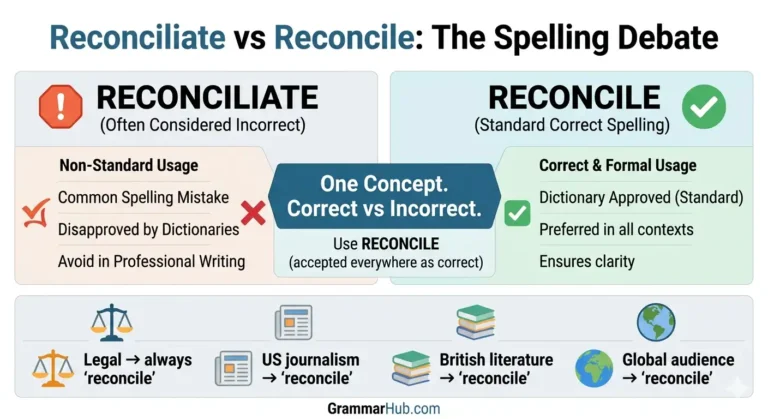
Reconcile is the correct, standard English verb used across all contexts — personal, professional, financial, and legal.
According to Merriam-Webster, reconcile means:
- To restore to friendship or harmony
- To make consistent or congruous
- To settle or resolve a dispute or difference
How to Use “Reconcile” in a Sentence
Here are real-world examples across different contexts:
In relationships:
“After months of silence, the two siblings finally decided to reconcile their differences.”
In finance:
“The accountant needed to reconcile the monthly bank statements before the audit.”
In logic or ideas:
“It’s difficult to reconcile science and religion when both make absolute claims.”
In politics:
“If the two chambers can reconcile their differences, the legislation will pass.”
These sentences show that reconcile works naturally in formal writing, casual speech, academic papers, and everyday conversation.
What Does “Reconciliate” Mean?
Here’s the honest answer: reconciliate is not a standard modern English word.
According to Dictionary.com, reconciliate first appeared around 1715–25 as a back-formation from the noun reconciliation. It was occasionally used in old literary texts, but it never became mainstream.
Today, it has no recognized definition in major dictionaries like Cambridge, Oxford, or Merriam-Webster. WikiDiff lists it as having no English definition and flags it as potentially misspelled.
Is “Reconciliate” Ever Acceptable?
In very rare cases, you might encounter it in:
- Archaic or Victorian-era literature
- Extremely formal or legalistic writing in some non-native English legal documents
- Non-native speaker texts where it is used by analogy from Spanish or Italian
But even in those edge cases, reconcile is always the safer and more correct choice.
Reconciliate vs. Reconcile: Side-by-Side Comparison
| Feature | Reconcile | Reconciliate |
| Standard English? | Yes | No |
| In Merriam-Webster? | Yes | Not defined |
| In Cambridge Dictionary? | Yes | No |
| Accepted in formal writing? | Yes | Avoid |
| Used in everyday speech? | Commonly | Rarely |
| Origin | Latin reconciliare | Back-formed from reconciliation |
The table makes it clear: reconcile wins in every category.
Why Do People Search for “Reconciliate”?
This is a fair question. If the word is wrong, why do thousands of people search for it?
There are a few reasons:
1. Analogy with other verbs English has pairs like negotiate → negotiation and mediate → mediation. People naturally assume reconciliation → reconciliate follows the same pattern. It does not — because reconcile already fills that role.
2. Influence from other languages In Spanish (reconciliar), Italian (riconciliare), and French (réconcilier), the verb forms are slightly closer to reconciliate. Non-native English speakers sometimes carry that pattern over.
3. It sounds authoritative Longer words can feel more formal or impressive. But in English, clarity beats complexity. Reconcile is correct and direct.
Common Phrases Using “Reconcile” (With Examples)
Understanding the word’s full range helps you use it confidently in any context.
Reconcile differences
“The two managers worked hard to reconcile their differences before the product launch.”
Reconcile with someone
“After the argument, he called to reconcile with his best friend.”
Reconcile accounts or finances
“At the end of each quarter, the finance team must reconcile all expense accounts.”
Reconcile oneself to something
“She finally reconciled herself to the fact that the project had failed.”
Hard to reconcile
“His actions were hard to reconcile with the values he claimed to hold.”
These phrases show just how versatile reconcile is — covering emotional, financial, logical, and interpersonal situations without needing reconciliate.
Grammar Deep Dive: How “Reconcile” Is Conjugated
Knowing the conjugations removes any further doubt about which word to use.
| Tense | Form |
| Base form | reconcile |
| Present (3rd person) | reconciles |
| Past tense | reconciled |
| Past participle | reconciled |
| Present participle | reconciling |
Examples in use:
- “She reconciles with her sister every holiday.”
- “They reconciled after a long dispute.”
- “He is reconciling his emotions with the outcome.”
- “The accounts have been fully reconciled.”
There is no standard conjugation for reconciliate in modern grammar guides — another clear sign that the word is not in active use.
Quick Test: Can You Choose the Right Word?
Fill in the blank:
- “The couple tried to _______ after their breakup.” → reconcile
- “The accountant needed to _______ the books.” → reconcile
- “Can logic and emotion ever truly _______?” → reconcile
If you tried to use reconciliate in any of those, it would sound unnatural to native speakers and would likely be flagged as an error by grammar-check tools.
FAQs About Reconciliate vs. Reconcile
Is “reconciliate” a real word?
It appears in some older texts and a few dictionaries as an archaic term, but it is not a recognized or recommended word in modern English. Always use reconcile instead.
Can I use “reconciliate” in formal writing?
No. In academic papers, business documents, or legal writing, reconciliate would be seen as an error. Use reconcile for all formal writing.
What is the noun form of “reconcile”?
The noun form is reconciliation — which is actually more common than the verb in many contexts. Example: “The peace talks led to a full reconciliation between the two parties.”
What is the adjective form of “reconcile”?
The adjective form is reconcilable (e.g., “Their differences are reconcilable”) or irreconcilable in the negative (e.g., “irreconcilable differences”).
Is “reconcile” the same in British and American English?
Yes. Reconcile is used in both British and American English with no spelling or meaning difference.
The Final Verdict
The answer to reconciliate vs. reconcile is simple:
Use reconcile. Always.
Reconciliate is an outdated, non-standard form that does not appear in any major modern English dictionary as a defined word. It may have appeared in archaic literature, but using it today will confuse readers and weaken your writing.
Whether you are writing an email, a report, a formal document, or having a conversation — reconcile is the correct, clear, and universally accepted choice.
Have a question about another confusing word pair? Browse our full list of commonly confused words at WordCorrelation.com.

Ibrahim John is an English language editor with over ten years of experience working with writers, publishers, and international businesses. He specialises in word choice, grammar accuracy, and the differences between British and American English.