
Introduction: A Question Most People Never Think to Ask
You’re watching a crime drama. The detective walks into a cold, sterile room — body on a table, fluorescent lights humming overhead. The show calls it a Morgue . But your neighbor’s funeral home down the street? They call their back room a mortuary. This article explain
Same thing, right?
Actually, no. And the difference matters more than you’d think — especially if you’re ever in a situation where you need to know.
Whether you’re a curious reader, a nursing or forensic science student, someone grieving a loved one, or just someone who stumbled across this question at midnight — you’re in the right place. Let’s break this down clearly, honestly, and without the clinical coldness the topic usually gets.
The One-Line Answer (Then We’ll Go Deeper)
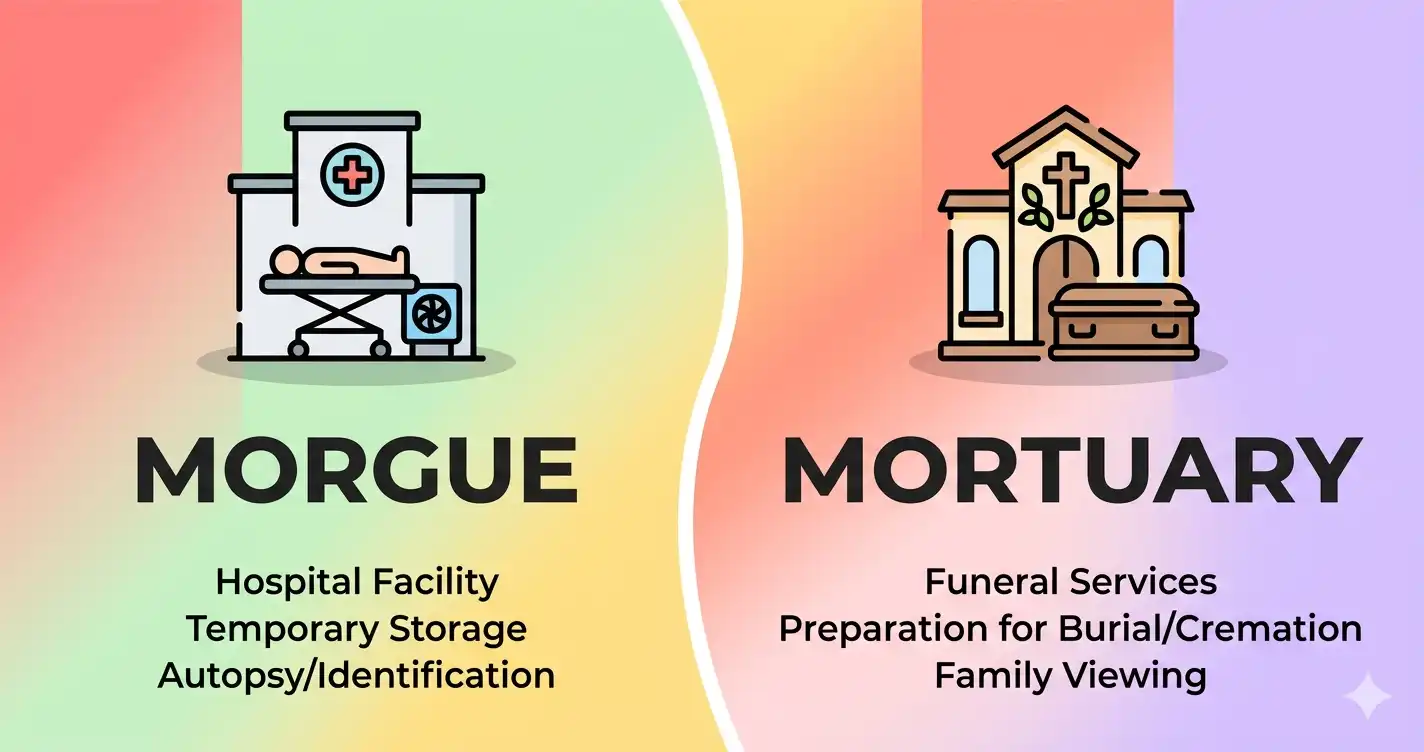
A morgue is where bodies are temporarily stored and examined. A mortuary is where bodies are prepared for burial or cremation.
Simple enough. But the full picture is richer — and surprisingly interesting.
What Is a Morgue?
A morgue (sometimes called a medical examiner’s facility or hospital mortuary in some countries) is primarily a storage and examination space for deceased individuals.
Key functions of a morgue:
- Temporary storage of bodies — especially when identity is unknown or cause of death is unclear
- Autopsies and forensic examinations performed by pathologists or medical examiners
- Legal and judicial purposes — gathering evidence in criminal or suspicious death cases
- Identification of unclaimed or unidentified remains
Morgues are typically found inside:
- Hospitals
- Police departments or government forensic facilities
- Medical examiner or coroner offices
- Crime scene investigation centers
The word morgue itself comes from the French la Morgue — a building in Paris where bodies were publicly displayed so citizens could identify the dead. Grim history, but true.
Who works in a morgue?
- Forensic pathologists — investigate cause and manner of death
- Medical examiners / coroners — legally determine how someone died
- Forensic technicians — assist with autopsies and evidence collection
- Dieners — the unsung professionals who handle body transport and preparation within the morgue
What Is a Mortuary?
A mortuary is where the care of the deceased shifts from clinical to compassionate. It’s focused on preparing the body for its final farewell — whether that’s a funeral, burial, cremation, or other ceremony.
Key functions of a mortuary:
- Embalming — preservation of the body for viewing
- Cosmetic restoration — making the deceased look peaceful and presentable
- Body preparation for viewings, wakes, or open-casket funerals
- Cremation services in many facilities
- Death certificate filing and administrative coordination
- Family guidance through the grief and planning process
Mortuaries are found in:
- Funeral homes (the terms are often used interchangeably in the USA)
- Standalone mortuary services
- Hospital mortuary departments in some countries
Who works in a mortuary?
- Licensed funeral directors — manage the entire process and interact with families
- Morticians / embalmers — prepare the body with specialized techniques
- Grief counselors — support families emotionally
- Administrative staff — handle paperwork, permits, scheduling
Morgue vs Mortuary: Side-by-Side Comparison
| Feature | Morgue | Mortuary |
| Primary purpose | Storage & examination | Preparation & burial/cremation |
| Who uses it | Medical examiners, coroners, police | Families, funeral directors |
| Tone/environment | Clinical, forensic | Compassionate, service-oriented |
| Autopsies performed? | Yes | Rarely (only if licensed) |
| Family access? | Limited / restricted | Yes — central to the process |
| Legal involvement | Often high | Usually low |
| Location | Hospitals, government facilities | Funeral homes, standalone businesses |
| Duration of stay | Short-term (days) | Short-term (days to a week) |
| Primary staff | Forensic pathologists, coroners | Morticians, funeral directors |
Where It Gets Confusing — And Why
Here’s where most people trip up: in everyday American English, “mortuary” and “funeral home” are used interchangeably. A funeral home may call its preparation room a mortuary. Some hospitals call their body storage area a mortuary instead of a morgue.
In the UK and Australia, mortuary is the more common term — even for what Americans would call a morgue.
So context and geography matter.
A useful rule of thumb:
- If investigators and doctors are involve → likely a morgue
- If family and funeral planning are involve → likely a mortuary
A Real-Life Scenario: What Happens After Someone Dies?
Let’s trace a realistic path:
Scenario A — Natural death at home: The body goes directly to a mortuary (funeral home). No autopsy needed. The mortician prepares the body, the family plans the service, and the process is handled with dignity.
Scenario B — Unexpected or suspicious death: The body is transporte to a morgue. A forensic pathologist performs an autopsy. The medical examiner issues a cause-of-death determination. Once released, the body is transferre to a mortuary for final preparation.
See how both facilities can be part of the same journey?
Common Misconceptions
“Morgue” sounds scarier, so it must be more serious. Not necessarily. A hospital morgue is simply a storage and examination space — it’s clinical, not sinister.
“Mortuary” is just a fancy word for morgue. Nope. While they overlap in some contexts, they serve distinctly different functions professionally.
Only murder victims go to the morgue. False. Anyone whose death requires investigation — accidents, unknown causes, sudden deaths — may go through a morgue first.
FAQ: Morgue vs Mortuary
Q: Can a building be both a morgue and a mortuary? Yes. Some hospital facilities handle both temporary storage/examination AND body preparation under one roof, though different departments handle each function.
Q: Is a coroner the same as a mortician? No. A coroner (or medical examiner) investigates the cause of death — a legal and medical role. A mortician prepares the body for burial — a care and service role. Completely different professions.
Q: Which one do families deal with? Primarily the mortuary/funeral home. Unless an autopsy is require, most families never directly interact with a morgue.
Q: How long can a body stay in a morgue? It varies by jurisdiction and circumstances. In standard cases, a few days. In complex forensic investigations, weeks. Unclaimed bodies may stay longer under legal guidelines.
Q: Do mortuaries perform autopsies? Generally no — unless the mortician is also a licensed pathologist, which is rare. Autopsies are a morgue/medical examiner function.
Q: Is embalming required by law? In the USA, embalming is not federally require. It depends on state law, the type of service, and whether the body is being transporte across state lines.
Conclusion: Two Places, One Journey
The morgue and the mortuary represent two very different moments in how we as a society handle death.
The morgue answers how and why — it’s about truth, investigation, and legal clarity.
The mortuary answers what next — it’s about dignity, remembrance, and honoring a life.
Both matter. Neither is something to fear or misunderstand.
Next time you watch that crime drama, or find yourself in the difficult position of making arrangements for a loved one, you’ll know exactly what you’re dealing with — and why the distinction matters.
Found this helpful? If you’re building content around death care, forensic science, or related vocabulary comparisons, explore more word comparisons on WordCorrelation.com — where language meets real-world meaning.

Ibrahim Jhon is an English language editor with over ten years of experience working with writers, publishers, and international businesses. He specialises in word choice, grammar accuracy, and the differences between British and American English.