
You’re typing a message to your teacher. You finish with: “Does that make sence?”
Autocorrect doesn’t flag it. You hit send. Three seconds later, you cringe — because something feels off.
Sound familiar?
You’re not alone. “Since,” “sense,” and “sence” confuse thousands of English learners every single day. These words look similar, sound almost identical in many accents, and appear constantly in everyday writing. One wrong choice and your email, essay, or WhatsApp message loses credibility instantly.
But here’s the truth: once you understand the logic behind each word, you will never mix them up again — not even when you’re typing fast.
This guide explains everything. Meaning, grammar, pronunciation, real examples, common mistakes, and memory tricks. By the time you finish reading, these three words will feel completely clear.
What Does “Sence” Mean? (Spoiler: It Is Not a Word)
Let’s settle the biggest question first — because this is the one most people Google late at night.
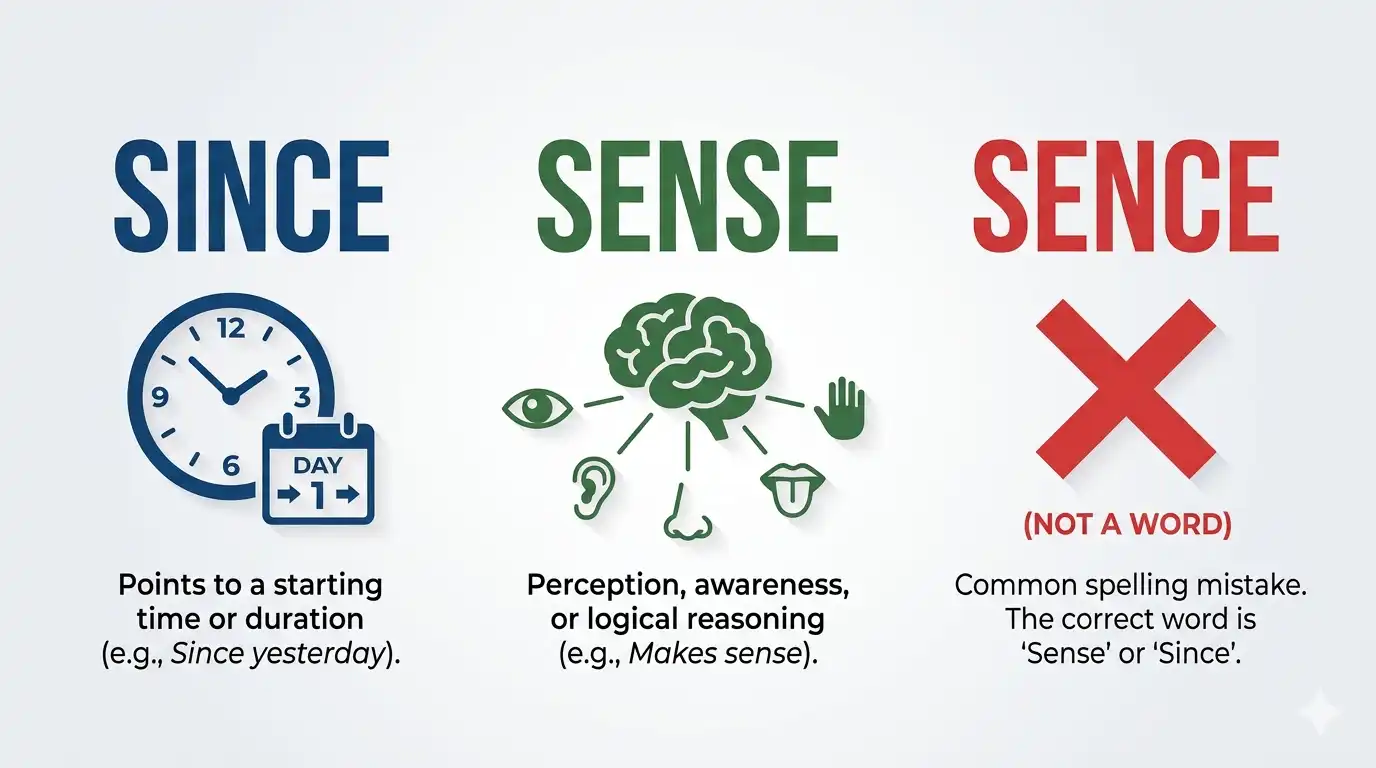
“Sence” does not exist in the English language.
It is not in the dictionary. It is not an old spelling. It is not a regional variation. It is simply a spelling mistake — one of the most common ones on the internet.
People write “sence” because they are unsure whether to write “since” or “sense,” and their brain accidentally creates a blend of both words. It is a phonetic spelling error, not a grammar error.
Here is the rule: every time you feel tempted to write “sence,” stop. Ask yourself — am I talking about time or reason? Use since. Am I talking about feeling, meaning, or perception? Use sense.
There is no situation — ever — where “sence” is correct.
- ❌ That doesn’t make sence. → ✅ That doesn’t make sense.
- ❌ I’ve been waiting sence morning. → ✅ I’ve been waiting since morning.
Now let’s understand the two real words properly.
Since vs Sense: What’s the Real Difference?
Here is the one-line answer before we go deeper:
Since = time or reason. Sense = perception, feeling, or meaning.
They belong to completely different grammatical families. They come from different languages historically. And they serve totally different purposes in a sentence. The only thing they share is a similar sound — and that one similarity is the root of all the confusion.
Think of it this way:
- Since is like a clock — it measures time or explains causes.
- Sense is like a compass — it helps you understand, feel, or perceive something.
Keep that image in mind as you read on.
How to Use “Since” Correctly in a Sentence
Since is one of the most flexible words in English. It can work as a conjunction, a preposition, or an adverb — and its meaning shifts slightly depending on the role.
Since Meaning #1 — Talking About Time
This is the most common use of “since.” It marks a starting point in the past and connects it to the present moment. Something began at a specific time and is still continuing right now.
- I have lived in Karachi since 2018.
- She hasn’t eaten anything since this morning.
- He has been working at that office since he graduated.
Notice something important: “since” used in this way almost always pairs with present perfect tense — have/has + verb. This is a helpful grammar clue.
Quick test: If you can replace the word with “from that time until now,” you are using “since” correctly for time.
Since Meaning #2 — Giving a Reason (Like “Because”)
“Since” also works as a connector that explains why something happens. In this use, it means the same thing as “because” — but it sounds slightly more formal.
- Since it was raining, we decided to stay home.
- Since you are already here, let’s start the meeting.
- Since he studied every night, he passed the exam easily.
Both sentences would work equally well with “because” in place of “since.” The difference is tone — “since” feels slightly more polished in writing.
Since as a Standalone Adverb
Sometimes “since” stands completely alone at the end of a sentence — without connecting to another clause. In this case it means “from that point in time until now.”
- We had an argument last year and haven’t spoken since.
- She left the company in January and has been freelancing since.
- He moved abroad years ago. His family hasn’t heard from him since.
This use is simple but elegant — and native speakers use it constantly.
How to Use “Sense” Correctly in a Sentence
Sense comes from the Latin word sensus, which means perception or feeling. It is primarily used as a noun, but it also works as a verb in many everyday situations.
Sense as a Noun — 5 Different Meanings
1. The Five Physical Senses
The most familiar meaning — referring to sight, hearing, smell, taste, and touch.
- Dogs have an extraordinary sense of smell.
- She slowly lost her sense of hearing after the accident.
- Our five senses are how we experience the world around us.
2. Logic, Meaning, or Understanding
This is the “make sense” use — meaning something is logical, understandable, or reasonable. This is also where most mistakes happen.
- Your explanation finally makes sense — thank you.
- This manual is so complicated it makes no sense at all.
- Read it again slowly. It will start to make sense.
🔴 Important: The correct phrase is always “make sense” — never “make since.” This is one of the top written errors in English. If something is logical or understandable, it makes sense.
3. A Gut Feeling or Awareness
“Sense” can describe something you feel intuitively — a kind of inner knowledge that is hard to explain.
- I had a strong sense that something was wrong.
- There was a strange sense of calm just before the storm.
- She felt a deep sense of pride after finishing the project.
4. Good Judgment or Practical Wisdom
This is the “common sense” meaning — the ability to make sensible decisions in everyday life.
- Use common sense — don’t share your password with anyone.
- He had the good sense to call a doctor immediately.
- A little bit of common sense goes a long way.
5. A Specific Meaning of a Word (Linguistics)
In formal writing and language study, “sense” also refers to the particular meaning of a word in context.
- The word “bank” has multiple senses — financial and geographical.
- In this sense, both arguments are equally valid.
Sense as a Verb — Feeling or Detecting Something
When used as a verb, “sense” means to perceive, detect, or feel something — often without direct visible evidence. It describes intuitive awareness.
- The dog sensed danger long before anyone else did.
- She could sense the tension in the room the moment she walked in.
- I sensed he wasn’t telling the whole truth, even though he smiled.
- The security system sensed movement near the front door.
Notice that “sensed” as a verb carries a feeling of quiet awareness — something your mind or body detects before your conscious brain fully registers it.
Since vs Sense vs Sence: Full Comparison Table
| Feature | Since | Sense | Sence |
| Real word? | ✅ Yes | ✅ Yes | ❌ No |
| Part of speech | Conjunction / Preposition / Adverb | Noun / Verb | — |
| Core meaning | Time or reason | Perception, meaning, feeling | Does not exist |
| Word origin | Old English siþþan | Latin sensus | Spelling mistake |
| Pronunciation | /sɪns/ — rhymes with “mince” | /sɛns/ — rhymes with “fence” | — |
| Common phrase | “Since then” / “Since you asked” | “Make sense” / “Common sense” | Never correct |
| Used as a verb? | ❌ No | ✅ Yes | — |
| Used as a noun? | ❌ No | ✅ Yes | — |
| Pairs with tense? | Present perfect (have/has) | Any tense | — |
Common Mistakes with Since and Sense (And How to Fix Them)
These are the real errors people make every day — in text messages, emails, school assignments, and professional reports.
Mistake 1: Writing “Does that make since?”
This is the most common error on the internet. “Make since” means absolutely nothing in English.
- ❌ Does that make since?
- ✅ Does that make sense?
The correct phrase is always “make sense.” Print this in your memory and never forget it.
Mistake 2: Using “sense” when talking about time
- ❌ I haven’t seen her sense last summer.
- ✅ I haven’t seen her since last summer.
If you are talking about a point in the past — a date, a year, an event — the word you need is since.
Mistake 3: Confusing “since” with “ago”
Both words deal with the past, but they work very differently.
- ❌ He left two years since.
- ✅ He left two years ago. OR It has been two years since he left.
“Ago” counts backward from now. “Since” marks a starting point and connects it forward to the present. They are not interchangeable.
Mistake 4: Writing “sence” as a shortcut
- ❌ That makes sence.
- ❌ I’ve been here sence morning.
- ✅ Always choose either sense or since — never “sence.”
There is no shortcut here. “Sence” is always wrong, in every sentence, in every context.
Memory Tricks to Never Confuse Since and Sense Again
These tricks are simple, visual, and permanent. Use them until the correct spelling becomes automatic.
For SINCE — think of the letter C: The word since contains the letter C. Let C remind you of two things: Clock (time) and Cause (reason). Since = Clock + Cause.
Whenever you are writing about time or giving a reason, the word with the C is your answer — since.
For SENSE — think of the five S’s: The five senses all start with the letter S — Sight, Sound, Smell, Savor (taste), Skin (touch). The word sense also starts with S. If your sentence is about any of these — or about feeling, meaning, understanding — sense is your word.
For SENCE — there is no trick: Because there is nothing to remember. It does not exist. The moment your hand moves toward writing “sence,” stop, choose between since and sense based on meaning, and move on.
Since vs Sense in Formal and Everyday Writing
Getting the right word matters even more when the stakes are higher.
In professional emails:
- ✅ Since the deadline has been moved, please submit your report by Friday.
- ✅ Your feedback makes complete sense and we will act on it immediately.
- ❌ Your suggestion makes complete since. → Instant credibility damage.
In academic writing:
- ✅ Since the data was collected in 2023, the results reflect last year’s trends.
- ✅ In the broader sense, both theories arrive at the same conclusion.
- Avoid vague uses of “sense” in academic work — prefer perception, understanding, awareness where possible.
In everyday conversation and texting:
- ✅ I haven’t talked to him since the argument.
- ✅ That totally makes sense, thanks for explaining.
- ❌ That totally makes sence. → Even in casual writing, this damages your image.
The principle stays the same regardless of context: since = time/reason, sense = perception/meaning.
Frequently Asked Questions About Since vs Sense vs Sence
Is “sence” a real word in any dialect of English?
No. “Sence” is not recognized as a word in any dialect, variety, or historical form of English. It appears only as a spelling error — a blend of “since” and “sense” created by writers who are unsure which word to use.
What is the correct phrase — “make since” or “make sense”?
The correct phrase is always “make sense.” It means something is logical, understandable, or reasonable. “Make since” has no meaning in English and is always a mistake.
Can “since” and “sense” ever be used in the same sentence?
Yes — they can appear together when the sentence naturally calls for both words. “Since you explained it clearly, it finally makes sense.” This sentence is perfectly correct — “since” gives a reason, and “sense” describes understanding.
Why do so many people confuse since and sense?
The confusion happens for two reasons. First, the words sound very similar in many English accents — especially South Asian, American, and some British accents. Second, when people are unsure of the spelling, their brain blends both words into “sence.” It is a phonetic spelling error caused by pronunciation ambiguity.
How do I know which word to use when I’m typing fast?
Ask yourself one quick question: Is this about time or reason? If yes — since. Is this about feeling, understanding, or meaning? If yes — sense. This single question will save you every time.
Is “sense” always a noun?
No. “Sense” functions as both a noun (common sense, five senses) and a verb (she sensed danger). “Since,” however, is never a noun or a verb — it only works as a conjunction, preposition, or adverb.
Which word goes with “common”?
Always sense — common sense. Never “common since.” Common sense means practical wisdom and good judgment.
Conclusion: Three Words, One Clear Rule
Let’s bring it all together.
Since → time or reason → “Since Monday” / “Since you asked” / “We haven’t spoken since”
Sense → perception, meaning, feeling → “Make sense” / “Common sense” / “She sensed danger”
Sence → does not exist → never write it, in any sentence, for any reason
The moment these three facts settle in your mind, your writing becomes sharper, cleaner, and more professional. One small word choice — sense vs since — is the difference between a polished email and an embarrassing one. Between a confident writer and an uncertain one.
English is full of these small traps. The writers who master them are the ones who earn trust and respect — in school, in business, and in every piece of content they produce.
You now know the difference. Use it every time.
Explore more commonly confused English words at WordCorrelation.com — where clear explanations meet real-world examples.

Ibrahim Jhon is an English language editor with over ten years of experience working with writers, publishers, and international businesses. He specialises in word choice, grammar accuracy, and the differences between British and American English.