
I once edited a batch of customer support templates for a software company where nearly every message said, “We are awaiting for your reply.” The meaning was clear, but the phrasing felt off at once. It read like translated English, not polished business English. That kind of line does more damage than many writers realize. In client emails, school papers, and website copy, small word choices can make the whole piece sound less natural.
Here is why this mix-up happens. Waiting and awaiting seem close in meaning, and in many cases they point to the same basic idea: expecting something to happen. The trouble starts with grammar and tone. One usually needs a preposition. The other usually does not. One sounds more neutral and conversational. The other sounds more formal and trimmed down.
By the end of this article, you will know the exact grammar difference, when each word sounds right, where writers lose credibility by mixing them up, and the fastest rule to use when you need a clean sentence on the spot.
waiting vs awaiting – Quick Answer
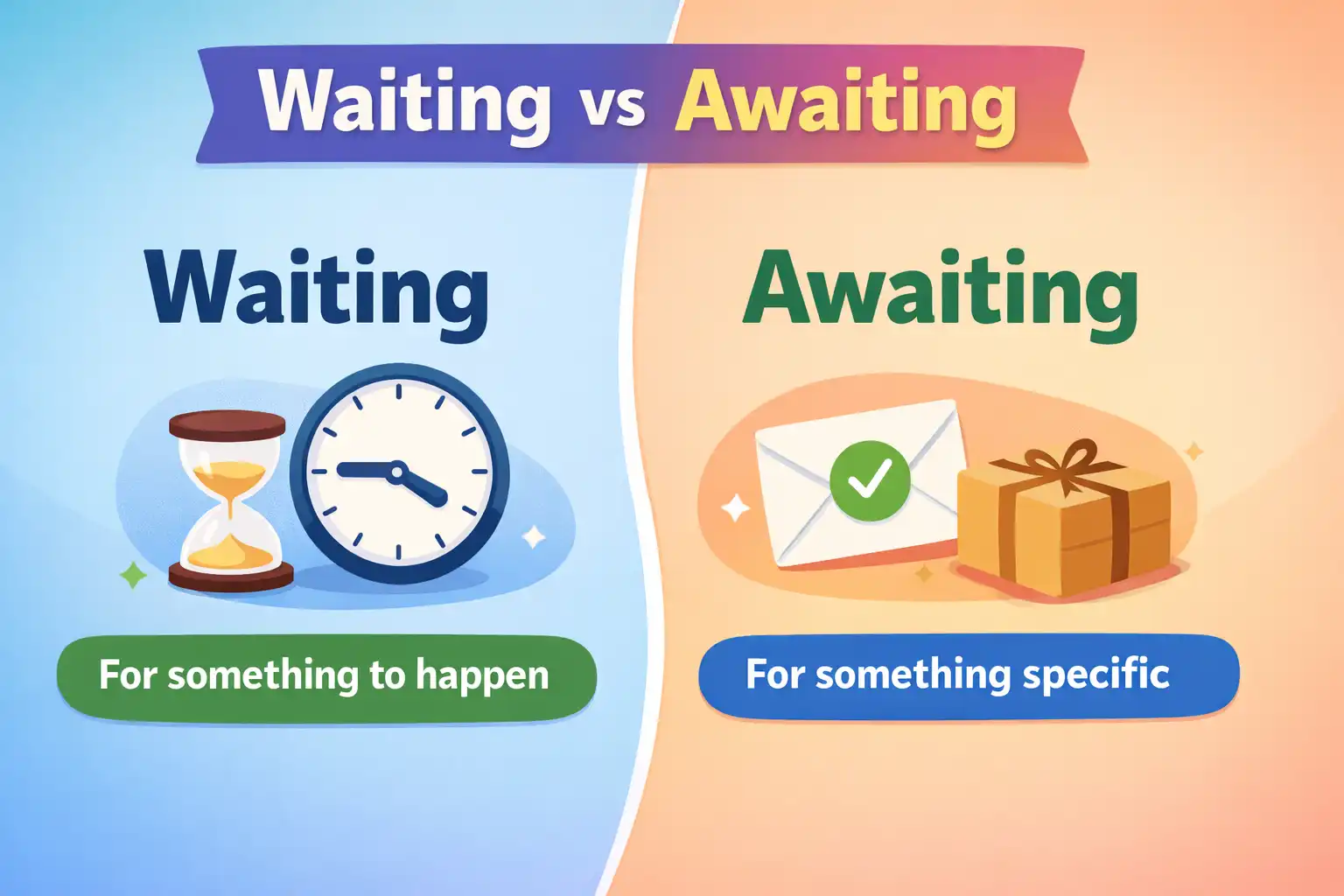
Waiting usually appears as waiting for something. Awaiting usually takes a direct object without for. So you write waiting for a reply but awaiting a reply. Awaiting sounds more formal, while waiting fits everyday English better.
Meaning of waiting
Waiting means staying ready for someone or something, often with for: waiting for the train, waiting for approval.
Meaning of awaiting
Awaiting means expecting or pending something, usually in a more formal tone: awaiting approval, awaiting delivery.
One decision rule
Use waiting for in normal speech and general writing. Use awaiting + noun in formal or compact writing.
The Origin of waiting vs awaiting
The history explains a lot of the confusion.
Wait came into English through Old North French and Old French forms related to watching, guarding, or staying alert. That older sense still lingers in the word today. When you wait, you are not just idle. You are holding for something.
Await formed later by adding the prefix a- to wait. In older English, that prefix often helped create a more fixed verb form. Over time, await developed as a transitive verb, which means it could take a direct object: await news, await instructions, await the outcome.
That old structure is why modern writers get trapped. They assume both words behave the same way in a sentence. They do not.
In my experience editing academic work, this mistake shows up most when a student tries to sound more formal and swaps waiting for awaiting without changing the grammar. I have corrected lines like, “The team is awaiting for the final result” in essays, grant drafts, and press copy. The word choice aimed high. The grammar gave it away.
A useful historical note: await has long appeared in legal, official, and literary writing more often than casual speech. That older formal flavor still sticks to it now. So even when a sentence is grammatically correct, awaiting can sound stiff if the context is too casual.
British vs American English
There is no major spelling difference between British and American English here. Both varieties use waiting and awaiting in the same spellings.
The real difference is not spelling. It is tone and frequency. In both the US and the UK, everyday speakers say waiting for far more often in normal conversation. Awaiting shows up more in formal notices, office emails, legal writing, and official updates.
I have seen British business emails use lines like “We are awaiting confirmation from the supplier,” while US teams often prefer “We’re waiting for confirmation from the supplier.” Both are fine. One just sounds more formal.
| Usage point | British English | American English |
| Spelling | waiting / awaiting | waiting / awaiting |
| Everyday speech | prefers waiting for | prefers waiting for |
| Formal notices | often uses awaiting | often uses awaiting |
| Tone difference | awaiting sounds more official | awaiting sounds more official |
How to Choose the Right Word Fast
For a US audience, use waiting for unless you need a tighter or more formal tone. Most American readers hear it as more natural.
Fast rule for US writing: if it sounds like spoken English, choose waiting for.
For a UK or Commonwealth audience, the same grammar rule applies. You can use awaiting a bit more freely in formal messages, service updates, and business writing without sounding odd.
Fast rule for UK/Commonwealth writing: use awaiting in formal updates, but keep waiting for in everyday copy.
For global or professional writing, choose based on clarity and tone. That matters most when your readers include non-native English speakers. I often replace awaiting with waiting for in international website copy because it sounds simpler and creates less risk.
Fast rule for global writing: if plain English matters most, use waiting for.
Here is the real shortcut:
- waiting for + noun
- awaiting + noun
That is it. When writers remember the preposition rule, most errors disappear.
Common Mistakes with waiting vs awaiting
Editors see this error most often when writers try to sound formal too quickly.
❌ We are awaiting for your response.
✅ We are awaiting your response.
Why: Awaiting already takes the object directly, so for is wrong.
❌ I am waiting your approval before publishing the page.
✅ I am waiting for your approval before publishing the page.
Why: Waiting usually needs for before the thing expected.
❌ The parcel is waiting delivery.
✅ The parcel is awaiting delivery.
Why: In service updates and logistics language, awaiting delivery is the standard formal phrasing.
❌ The editor is awaiting for the writer to send edits.
✅ The editor is waiting for the writer to send edits.
Why: With a full clause after the phrase, waiting for often sounds more natural and clearer.
❌ Status: waiting your payment.
✅ Status: awaiting payment.
Why: I have seen this exact error in e-commerce dashboards. It makes the interface sound unpolished because the verb pattern is broken.
One mistake matters more than the rest: adding for after awaiting. That is the error teachers mark fast, and it is the one editors spot in seconds.
waiting vs awaiting in Real-Life Examples
Real examples show the difference better than bare rules.
In a professional email, I once revised this line in a client support template:
Before: We are awaiting for the signed contract.
After: We are awaiting the signed contract.
That one change made the message sound fluent and professional.
In news writing, a natural example would be:
The council is awaiting the final safety report before reopening the bridge.
News copy often likes awaiting because it sounds compact and formal.
On social media, people usually lean casual:
Still waiting for my food delivery after two hours.
A brand account that wrote awaiting my burger would sound odd, unless it was joking.
In a formal document, such as a school report or company memo, both may appear, but tone matters:
The committee is awaiting budget approval.
That works because the document is formal and the noun comes right after the verb.
I have also seen this in job applications. A candidate wrote, I am awaiting for your positive response. The hiring manager understood it, but it read like a copied template. In hiring, that kind of phrasing can make polished candidates look less polished than they are.
waiting vs awaiting – Word Usage Patterns and Search Trends
The people who search this topic are usually students, ESL learners, office workers, customer support teams, and writers trying to clean up formal English.
The short answer is simple: they are not just checking meaning. They are checking sentence structure.
In the edits I have handled, ESL learners often make the error by copying awaiting into a sentence where waiting for would fit better. Native speakers make a different mistake. They often use awaiting because it sounds more formal, then forget that the grammar has to change too.
That difference matters. ESL learners tend to produce lines like awaiting for your reply because many languages use a structure closer to wait for. Native speakers, by contrast, often over-formalize. They write awaiting your reply in places where a simple waiting for your reply would sound warmer and more natural.
One field where this error does real damage is customer-facing business writing. Product support emails, order notices, and billing updates often rely on stock phrases. When those phrases sound off, customers lose trust. I have seen awkward lines like awaiting for payment confirmation in checkout flows and support portals. The message still works, but it signals weak editing. For a sales page or payment screen, that small crack in credibility matters.
Here is the comparison table that clears up the issue fast:
| Feature | Waiting | Awaiting |
| Meaning | expecting something to happen | expecting something to happen |
| Part of speech | present participle of wait | present participle of await |
| Curved edges possible | not applicable | not applicable |
| Used in formal writing | yes, but more neutral | yes, and more common in formal tone |
| Common mistake | waiting your reply | awaiting for your reply |
| Correct example | We are waiting for your reply. | We are awaiting your reply. |
FAQs — People Also Ask
Is “awaiting” more formal than “waiting”?
Yes. Awaiting usually sounds more formal and more compact. Waiting for sounds more natural in speech and everyday writing.
Can I say “awaiting for”?
No. Standard English does not use for after awaiting when a noun follows.
Is “waiting your reply” correct?
No in most modern English. Write waiting for your reply instead.
Why do emails often use “awaiting your response”?
Because it sounds brief and formal. Companies use it in support, billing, and legal-style communication.
Do native speakers also confuse waiting and awaiting?
Yes. Native speakers often choose awaiting to sound formal, then use the wrong grammar or the wrong tone.
Which is better in a job application email?
Usually waiting for if you want a natural, polite tone. Use awaiting only if the rest of the email is formal and controlled.
Is “awaiting approval” better than “waiting for approval”?
Not always. Awaiting approval sounds more official. Waiting for approval sounds plainer and more human.
Conclusion
Overall, the one distinction that matters most is grammar: waiting usually needs for, while awaiting usually does not. That is the rule that saves writers from the most common error.
The mistake I correct most often is awaiting for. It appears in student papers, order status messages, application emails, and website copy written by teams trying to sound polished. The intent is fine. The structure is not.
In short, choose by tone after you choose by grammar. Use waiting for when you want plain, natural English. Use awaiting when the sentence is formal and the noun can follow directly. That keeps your writing clean and your voice believable.
Finally, remember this line: if you can add “for,” use waiting; if the noun comes right after, use awaiting.

Ibrahim Jhon is an English language editor with over ten years of experience working with writers, publishers, and international businesses. He specialises in word choice, grammar accuracy, and the differences between British and American English.