
A few months ago, I edited a software company’s help page that said, “Users typically receive a reset email within two minutes.” The support team was furious. Their real point was that the email usually arrives in two minutes, not that receiving it in two minutes is a defining trait of users. One word made the sentence sound stiff, slightly off, and less human.
That mix-up happens more often than many writers think. In my experience editing content, typically and usually get swapped in student essays, e-commerce copy, internal reports, and even news drafts. ESL learners often treat them as perfect synonyms because both suggest what happens most of the time. Native speakers, on the other hand, often overuse typically when they want to sound formal.
Here is where most writers go wrong: usually talks about frequency, while typically often points to what is characteristic or expected of a type. By the end of this article, you will know the meaning gap, the tone gap, and the fast rule that helps you choose the right word without second-guessing yourself.
typically vs usually – Quick Answer
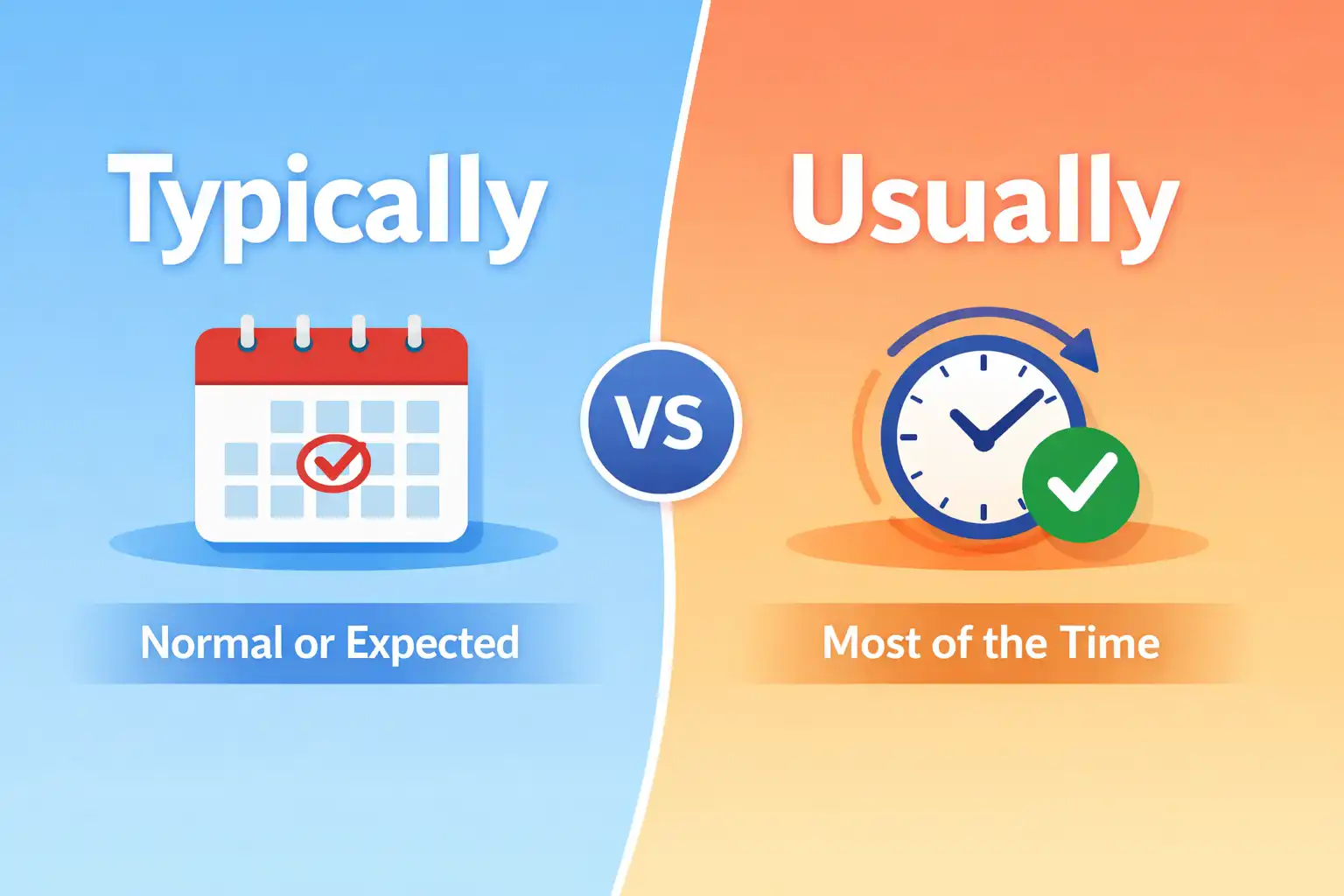
Usually means most of the time. Typically often means in a way that is characteristic of a type, group, or pattern, though it can sometimes overlap with usually. In plain writing, choose usually for routine actions and typically for traits, patterns, or category-based descriptions.
Meaning of typically
Typically means “in a way that shows the usual qualities of a person, thing, or group,” and it can also mean “under normal conditions” or “as a usual example.” That is why it often sounds analytical or descriptive. Editors see it a lot in reports, reviews, and category-based writing. Cambridge notes both senses: characteristic of a type, and what usually happens.
Meaning of usually
Usually means “in the way that most often happens.” It is the more direct frequency word. When I edit school reports, this is the word students often needed but replaced with typically because they thought it sounded smarter. Cambridge defines usually as what happens most often.
One decision rule
Use usually when you mean most of the time. Use typically when you mean that is the normal pattern for this kind of thing.
The Origin of typically vs usually
The history of these words explains a lot of the modern confusion.
Typical comes through Late Latin and Greek roots connected to type. Merriam-Webster traces typical to Late Latin typicalis, from Greek typikos. That root points to the idea of a model, mark, or kind. So typically carries the sense of “as is characteristic of this type.”
Usual comes from Middle English, Anglo-French usuel, Late Latin usualis, and Latin usus, meaning use or custom. That history pulls the word toward habit and repeated practice. So usually naturally fits actions that happen again and again.
That root difference still matters in real editing. In a student paper, “Teenagers typically check their phones before bed” can work if the writer means a broad social pattern. In a personal reflection, “I typically check my phone before bed” often sounds less natural than “I usually check my phone before bed.” One word grew out of type. The other grew out of habit.
There is also a useful historical note here. The phrase as usual is recorded in English by the early 18th century, which helps explain why it feels settled, familiar, and idiomatic in modern speech.
British vs American English
There is no major British-American spelling difference between typically and usually. Both forms are standard in both varieties of English. The real difference is tone, not spelling. Dictionaries on both sides present the same core meanings.
In practice, though, I have noticed a style difference in editing. American business writing often prefers typically in reports, product specs, and marketing copy because it sounds measured. British copy editors often trim it when usually would be clearer and less padded. That is not a grammar rule. It is a tone choice.
| Point | American English | British English |
| Spelling | typically / usually | typically / usually |
| Basic meaning | Same core meanings | Same core meanings |
| Tone in reports | typically appears often in formal or technical copy | typically also appears, but editors may favor plainer wording |
| Everyday speech | usually sounds more natural | usually sounds more natural |
How to Choose the Right Word Fast
For a US audience, use usually when the sentence is about a repeated action. “Customers usually get a reply within one business day” sounds cleaner than “Customers typically get a reply…” unless you are writing a formal support policy.
For a UK or Commonwealth audience, the same rule works. I have seen British school essays lean too hard on typically because students hear it in academic writing. In ordinary prose, usually often reads better.
For global or professional writing, ask one question: Am I describing frequency, or am I describing a pattern or category?
If it is frequency, choose usually.
If it is a characteristic pattern, choose typically.
Here is the fastest rule I use while editing:
People usually do things. Types typically have traits.
That line solves most cases in under five seconds.
Common Mistakes with typically vs usually
❌ I typically wake up at 6:30 every day.
✅ I usually wake up at 6:30 every day.
This is about personal habit, so usually is the more natural frequency word.
❌ This jacket is usually waterproof and has taped seams.
✅ This jacket is typically waterproof and has taped seams.
This sentence describes a product type, so typically fits the category meaning better.
❌ The mayor typically arrived at 8 p.m. for last night’s event.
✅ The mayor arrived at 8 p.m. for last night’s event.
A one-time news report should not use either word unless the writer means a repeated pattern.
❌ Students usually in formal essays avoid contractions.
✅ Students usually avoid contractions in formal essays.
Cambridge notes that usually most often appears in mid position, not dropped awkwardly into the sentence.
❌ Order confirmations are typically sent within five minutes, guaranteed.
✅ Order confirmations are usually sent within five minutes.
I have fixed this exact issue in e-commerce copy. Typically can weaken a promise because it implies a norm, not a reliable routine. The word choice can affect customer trust.
typically vs usually in Real-Life Examples
In a professional email, I would write:
“We usually send revised contracts by Friday afternoon.”
That sounds direct and human. In one client email chain I edited, typically made the team sound evasive, as if they were avoiding a clear commitment.
In news writing, I would write:
“Winter storms typically disrupt travel in this region between January and March.”
Here the writer is describing a recurring regional pattern, not a single repeated habit.
On social media, I would write:
“I usually skip long intros and go straight to the recipe.”
That sounds conversational. Native speakers often force typically into posts to sound polished, but it can make casual writing feel oddly stiff.
In a formal document, I might write:
“Applicants are typically asked to provide two references and proof of address.”
That works because the sentence describes a standard process across many cases. I have seen this phrasing in policy drafts and admissions guides where the focus is the normal pattern, not one person’s routine.
typically vs usually – Word Usage Patterns and Search Trends
The people who search this question are usually students, ESL learners, content writers, teachers, and professionals polishing formal English. Some want a grammar answer. Most want a tone answer.
The real-world consequence shows up fast. I once edited a cover letter that said, “I am typically responsible for preparing weekly sales summaries.” The hiring manager could read that as vague or detached. “I am usually responsible…” was better, and “I am responsible…” was best. That is where this confusion costs credibility: job applications, reports, and customer-facing copy.
I also see a clear pattern difference between ESL learners and native speakers. ESL learners often swap the two because bilingual dictionary definitions overlap. Native speakers make a different mistake: they choose typically to sound more formal, then use it in places where plain usually would sound more natural. That is original, but very real, editorial territory. The error is not always grammatical. Often, it is tonal.
Here is the comparison table that clears up the confusion fast:
| Feature | Typically | Usually |
| Meaning | In a way characteristic of a type; often under normal conditions | Most of the time; as a regular habit |
| Part of speech | Adverb | Adverb |
| Curved edges possible | Not applicable | Not applicable |
| Used in formal writing | Yes, often | Yes, but sounds plainer |
| Common mistake | Used for personal routine when simple frequency is meant | Used where category-based pattern is meant |
| Correct example | “Budget phones typically have fewer camera features.” | “I usually answer emails before 9 a.m.” |
FAQs
Is typically more formal than usually?
Yes. Typically often sounds more formal or analytical. Usually sounds more natural in everyday writing.
Can typically and usually mean the same thing?
Sometimes. Both can point to what happens in normal conditions, but typically often carries a stronger sense of pattern or type.
Which word should I use in an essay?
Use usually for repeated actions and typically for general patterns, categories, or observed traits.
Do native speakers mix these up too?
Yes. Native speakers often overuse typically because they think it sounds more polished.
Is usually too informal for professional writing?
No. It is clear, standard English and often the better choice in reports, emails, and instructions.
Why does typically sound vague in customer copy?
Because it can suggest “in most normal cases” rather than a dependable routine or promise. That weakens certainty.
Can I remove both words entirely?
Often, yes. In editing, I cut both when the sentence is stronger without them: “Applicants submit two references” is tighter than adding a hedge.
Conclusion
Overall, the most important distinction is simple: usually points to frequency, while typically points to a characteristic pattern or type. That is the core difference. Once you see it, most sentences become easier to fix.
The single most common mistake to avoid is using typically for a plain personal habit just because it sounds more formal. I see that all the time in student essays, cover letters, and product copy. In those cases, the word often makes the sentence sound colder, weaker, or less natural.
In short, pick usually when you mean “this happens most of the time.” Choose typically when you mean “this is what this kind of thing is normally like.” Finally, remember the editorial rule that works almost every time: habits usually happen; patterns are typically true.

Ibrahim Jhon is an English language editor with over ten years of experience working with writers, publishers, and international businesses. He specialises in word choice, grammar accuracy, and the differences between British and American English.