Many people search for title or tittle because these two words look almost the same. However, their meanings are very different. As a result, writers, students, and ESL learners often feel confused. Moreover, spellcheck tools do not always explain the difference clearly. Therefore, mistakes keep happening in emails, essays, and even news articles. Title meaning usually refers to the name of a book article movie or a role or position.
In daily writing, people usually want to talk about a title, such as a book name or job role. Meanwhile, they sometimes type tittle by mistake. In contrast, tittle has a rare and specific meaning. Because of this, misuse sounds strange or wrong. Additionally, readers may lose trust in your writing.
This article solves that exact problem. First, you will learn what title and tittle really mean. Next, you will see why people confuse them so often. After that, you will get clear rules, examples, and tables. Finally, you will know which spelling to use every time. Overall, the goal is clarity, confidence, and correct writing. If you searched tittle or title title is what you need in most everyday writing. When two similar-looking words have different meanings, use our word comparison guide.
Title or Tittle – Quick Answer
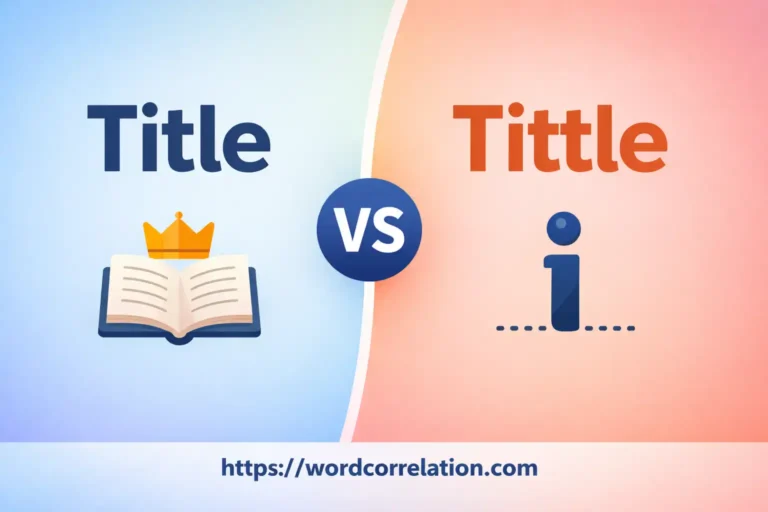
Title is correct in most contexts Tittle is a real word but has a different meaning which refers to a small mark or dot.
- Title means a name, heading, or rank.
Example: The title of the book is short. - Tittle means a very small mark or tiny detail.
Example: The dot on the letter “i” is a tittle.
Use title in almost all cases. Use tittle very rarely.
The Origin of Title or Tittle
The word title comes from the Latin word titulus. It meant a label or inscription. Over time, English adopted it to mean a name, heading, or rank. Therefore, we now use title for books, jobs, and honors.
The word tittle also comes from titulus. However, its meaning changed. Instead of a name, it came to mean a tiny mark. For example, the dot over “i” or “j” became known as a tittle. As a result, the two words stayed similar in spelling but split in meaning.
Confusion happens because both words share history and letters. Moreover, tittle looks like a misspelling of title. In contrast, title appears everywhere. Therefore, writers often assume tittle is wrong or just a typo. This belongs under our word confusion pillar for commonly mixed word pairs.
Meaning of title and tittle
Title meaning is the name given to a piece of work like a book or article or a person’s role.
Title is correct in most contexts while tittle is a different word with a different meaning.
Tittle is a real word but it means a small mark or dot and is rarely used compared to title.
British English vs American English Spelling
There is no spelling difference between British and American English for title or tittle. However, usage frequency is very different.
- Title is common in both UK and US English.
- Tittle is rare in both forms of English.
In contrast to words like color and colour, these spellings never change. Therefore, you do not need to adjust them by region.
| Aspect | Title | Tittle |
| UK English | Common | Very rare |
| US English | Common | Very rare |
| Meaning | Name or heading | Tiny mark |
Which Spelling Should You Use?
The correct choice depends on what you want to say.
For US audiences, always use title when you mean a name or heading. For UK and Commonwealth readers, the same rule applies. Moreover, for global or professional writing, title is almost always correct.
Use tittle only when you talk about tiny marks or small details. For example, grammar experts may use it. However, normal writing rarely needs it.
As a simple rule, ask one question:
Are you naming something? If yes, use title.
Are you describing a tiny dot or detail? If yes, use tittle.
Common Mistakes with Title or Tittle
Many errors happen because of spelling similarity. Below are the most frequent mistakes.
❌ The book tittle is confusing.
✅ The book title is confusing.
Explanation: You are naming the book.
❌ She earned a tittle at work.
✅ She earned a title at work.
Explanation: Job ranks use title, not tittle.
❌ Check the tittle of the article.
✅ Check the title of the article.
Explanation: Headings always use title.
❌ He respected every title of the law.
✅ He respected every tittle of the law.
Explanation: Here, tittle means every tiny detail.
Title or Tittle in Everyday Examples
In emails, people use title all the time.
For example: Please update the email title.
In news writing, headlines always have a title.
For example: The article title grabbed attention.
On social media, captions also act like titles.
For example: This video title is catchy.
In formal or professional writing, job roles use title.
For example: Her title is Marketing Manager.
In contrast, tittle appears mostly in grammar talks.
For example: Do not remove the tittle from the letter “i”.
Title or Tittle – Google Trends & Usage Data
Search data shows that title is extremely popular worldwide. Students, writers, and professionals use it daily. Meanwhile, tittle gets very few searches. As a result, many people do not even know it exists.
By country, title ranks high in the US, UK, Canada, and Australia. In contrast, tittle appears mostly in academic or language-related searches.
By user type:
- Students search for title when writing essays.
- Writers use title for books and articles.
- ESL learners often confuse title and tittle.
- Professionals use title for roles and documents.
Overall, correct usage strongly favors title. If you like these quick clarifications, foul or fowl is another helpful read.
Comparison Table: Title vs Tittle
| Feature | Title | Tittle |
| Meaning | Name or heading | Tiny mark or detail |
| Part of speech | Noun | Noun |
| Context of use | Books, jobs, articles | Grammar, letters |
| Formal vs informal | Both | Mostly formal |
| Common mistakes | Misspelled as tittle | Used instead of title |
| Correct example | The title of the book is clear. | The dot on “i” is a tittle. |
Semantic FAQs (People Also Ask)
Is title the same as tittle?
No. They have different meanings and uses.
Which one is correct in formal writing?
Title is correct in almost all formal writing.
Can they be used interchangeably?
No. Each word has a specific meaning.
Why do people confuse them?
They look similar and share history.
Can grammar tools catch this mistake?
Sometimes. However, context matters.
Is there a British vs American difference?
No. Both use the same spelling.
Conclusion
Overall, title and tittle may look alike, but they serve very different purposes. Title names things like books, articles, and job roles. Meanwhile, tittle refers to a tiny mark or small detail. Because of this difference, confusion happens often. However, the solution is simple.
In short, use title in almost every situation. In contrast, use tittle only when talking about tiny marks or details. Moreover, always check the context before choosing. As a result, your writing will look clear and professional.
Finally, remember one easy rule:
If you are naming something, use “title.” If you are talking about a tiny dot, use “tittle.”
Follow this rule, and you will never make this mistake again. You may also compare intertwined or entwined for a related mix-up.

Daniel Morris writes about English word differences and spelling confusion. His focus is to provide clear, simple explanations with practical usage examples.