You see the phrase “yay or nay” everywhere. It shows up in group chats, online polls, work emails, and even old voting halls. But here is the catch: most people get the spelling wrong. Is it yay or nay, or yea or nay? Both forms exist, and they don’t mean the same thing in every setting.
This confusion is common, and it makes sense. Yay and yea sound exactly the same out loud. You only notice the difference when you see the words written down. That’s why so many people search for a clear answer instead of guessing.
This guide gives you the short answer first, then walks through the full story. You will learn where each word comes from, how the US and UK use them differently, and how to avoid the one mistake that trips up even careful writers.
Quick Answer: Yay or Nay?
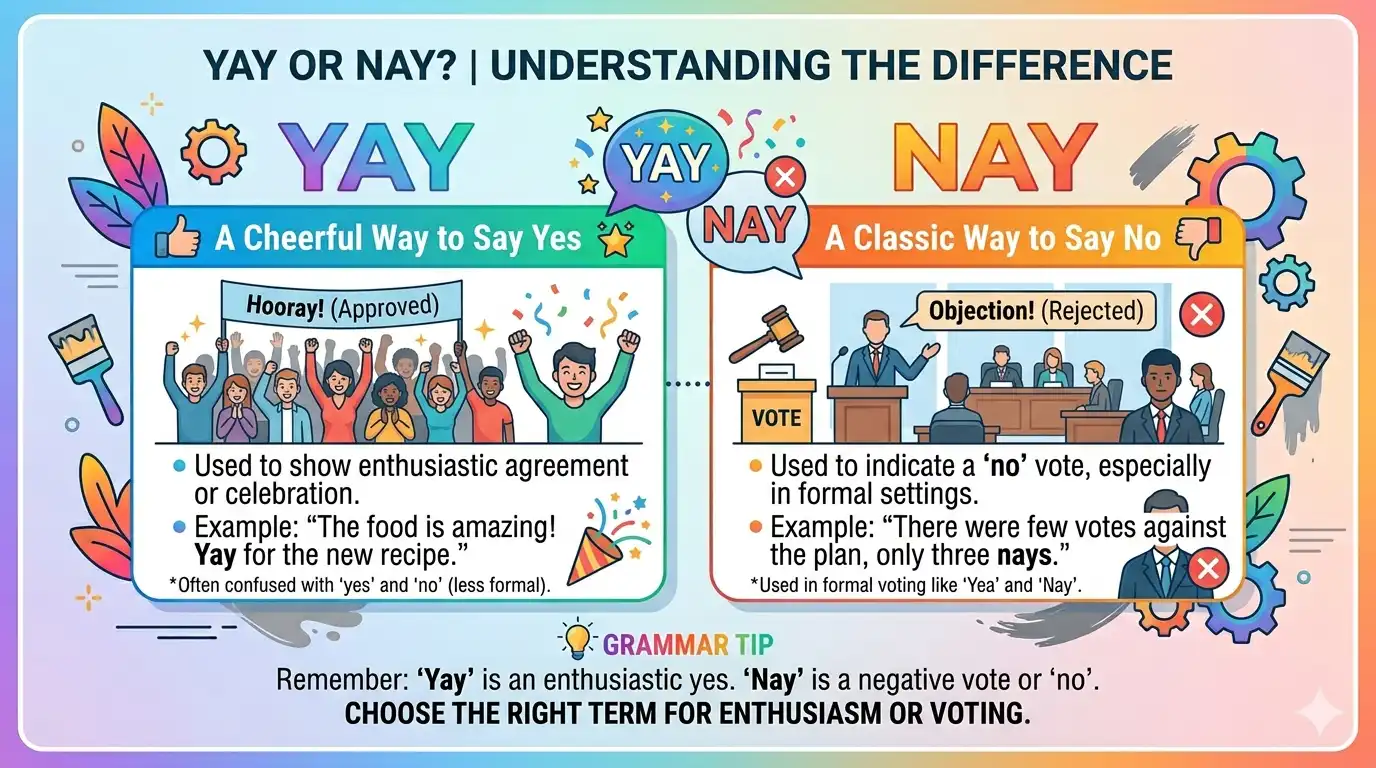
Yay means an excited yes, like cheering for good news. Nay means no, mostly in voting or formal refusal. The mixed phrase “yay or nay” is the casual, modern way to ask for a simple opinion: do you approve, or not?
If you want the strict, traditional pairing used in formal votes, that pair is “yea or nay,” not “yay or nay.” The two phrases look almost the same, but they belong in different settings. One is for everyday chats. The other is for formal decisions.
Keep reading to see exactly when each version fits, and how to never mix them up again.
What Does Yay Mean?
Yay is an interjection. It expresses joy, approval, or excitement, much like “hooray” or “woohoo.” People use it after good news, a win, or anything worth celebrating.
- We got the apartment, yay!
- Yay, it’s finally Friday.
- My sister said yay when she heard the news.
Yay also has a second, smaller use. People say it while holding their hands apart to show size: “The fish was yay big.” This use is informal and mostly spoken, not written.
What Does Nay Mean?
Nay means no. It carries a more formal tone than a plain “no,” which is why you hear it most in voting rooms, debates, and old-fashioned speech.
- The board voted nay on the merger.
- He answered nay without explanation.
- Three members voted yea, two voted nay.
Nay also works as a way to correct yourself mid-sentence, adding emphasis: “I need one, nay, three more days to finish this.” This usage feels old-fashioned but still appears in formal or literary writing.
Yay vs. Yea: The Mistake Almost Everyone Makes
This is where confusion starts. Yay and yea sound exactly the same, but they do different jobs.
| Word | Meaning | Typical Use |
| Yay | Excited yes / celebration | Casual speech, texts, social media |
| Yea | Formal yes | Voting, legal or historic text |
| Nay | No / refusal | Voting, formal disagreement |
Here is the simple rule. In a real vote, the traditional pair is “yea or nay.” In everyday writing, online polls, and casual conversation, “yay or nay” is the accepted modern form. Most native speakers no longer separate yay and yea in casual writing, but a careful editor will still choose yea for anything formal.
Where Do Yay and Nay Come From?
Nay has deep roots. It comes from the Old Norse word “nei,” which also meant no. English speakers had been using some version of nay for hundreds of years before yay even existed. You can find nay in old legal records, religious texts, and early parliamentary debates.
Yea is far older than yay. It traces back to the Old English word “gēa,” meaning yes. You can find yea in old religious texts and early English literature, often centuries before modern spelling settled down. The King James Bible uses yea often, which is why many readers connect the word with formal or old-fashioned tone.
Yay is the newcomer. Language historians trace its written use back to around 1963, when it grew out of the casual word “yeah.” Because it sounds identical to yea, the two got mixed up almost immediately, and that mix-up never fully went away. Today, yay has settled into its own clear role: pure excitement, nothing more formal than that.
Yay or Nay: US vs UK English
If you write for an international audience, this section matters most. The spelling itself does not change between American and British English. Both regions recognize and understand “yay or nay” the same way. The difference is about formality, tone, and where each version feels natural to a native reader.
United States
- “Yay or nay” is common and fully accepted in casual writing, social media, and everyday speech.
- “Yea or nay” still appears in formal settings, including Congress, city councils, and local government votes.
- Most American readers will not notice or mind either form in informal content, blogs, or marketing copy.
- News outlets often use “yea” and “nay” when reporting on real votes, since it matches official record-keeping.
United Kingdom
- British English leans slightly more toward “yea or nay” in anything formal, including parliamentary and council contexts.
- In daily conversation and online writing, “yay or nay” works fine and reads as modern, just like in the US.
- UK style guides treat yea as the traditional, old-fashioned form, similar to how it reads in American English.
- British readers are familiar with both spellings, so there is little risk of confusion either way.
In short: for blogs, social captions, marketing emails, and everyday business writing in both countries, “yay or nay” is the safe, modern, and widely understood choice. Save “yea or nay” for formal, legal, or historical contexts where tradition matters more than casual tone.
How to Use Yay or Nay in a Sentence
The phrase works best when you want a fast, informal decision from someone. It fits casual requests, polls, and light decision-making.
- Give me a yay or nay on the new logo by Friday.
- Quick yay or nay: should we move the meeting to 3 PM?
- I’m still deciding, but I’ll send a yay or nay tonight.
Avoid it in formal writing, legal documents, or academic work. In those cases, use “approve or reject,” “yes or no,” or “in favor or against” instead.
Common Mistakes to Avoid
- Don’t write “yay” when you mean a formal yes vote. Use “yea” instead.
- Don’t confuse “nay” with “neigh.” Neigh is the sound a horse makes.
- Don’t use “yay or nay” in formal reports or contracts. It reads as too casual.
- Don’t assume British and American readers need different spelling. The phrase itself does not change between the two.
Yay or Nay: Frequently Asked Questions
Is it yay or nay, or yea or nay?
Both exist, but they fit different settings. “Yay or nay” is the modern, casual version used in everyday writing. “Yea or nay” is the traditional pairing used in formal votes.
Can I use yay or nay in professional writing?
You can use it in casual business communication, like a quick Slack message or an internal poll. Avoid it in formal reports, contracts, or anything that needs a serious tone.
Is yay the same as yeah?
No. Yeah means yes and works as a casual reply in conversation. Yay expresses excitement or celebration, closer in meaning to “hooray.”
Does British English use a different spelling for yay or nay?
No. The spelling stays the same in both US and UK English. The only difference is that British formal settings, like UK English in general, slightly favor “yea” in traditional voting contexts.
What is the opposite of nay?
In formal voting, the opposite of nay is yea. In casual speech, the opposite of nay is simply yes or yay.
Is “yay or nay” too informal for emails?
It depends on the email. A quick internal message to a teammate is fine. A formal email to a client or a senior leader should use clearer wording, like “could you approve or decline this by Friday?”
Conclusion
“Yay or nay” is the clear, modern way to ask for a quick opinion: a simple choice between approval and rejection. Use yay for excitement, nay for a formal no, and save yea for traditional voting contexts. Once you remember this small but important difference, you will never second-guess your spelling again.
Next time someone asks for your opinion, you will know exactly how to answer: with a confident yay, or a clear nay.
About the Author
This guide was written and reviewed by the WordCorrelation.com editorial team, which specializes in English grammar, word comparisons, and everyday language questions. Every article goes through a fact-check pass against trusted dictionaries and style guides before publishing, and is updated when usage or guidance changes.

Ibrahim Jhon is an English language editor with over ten years of experience working with writers, publishers, and international businesses. He specialises in word choice, grammar accuracy, and the differences between British and American English.