
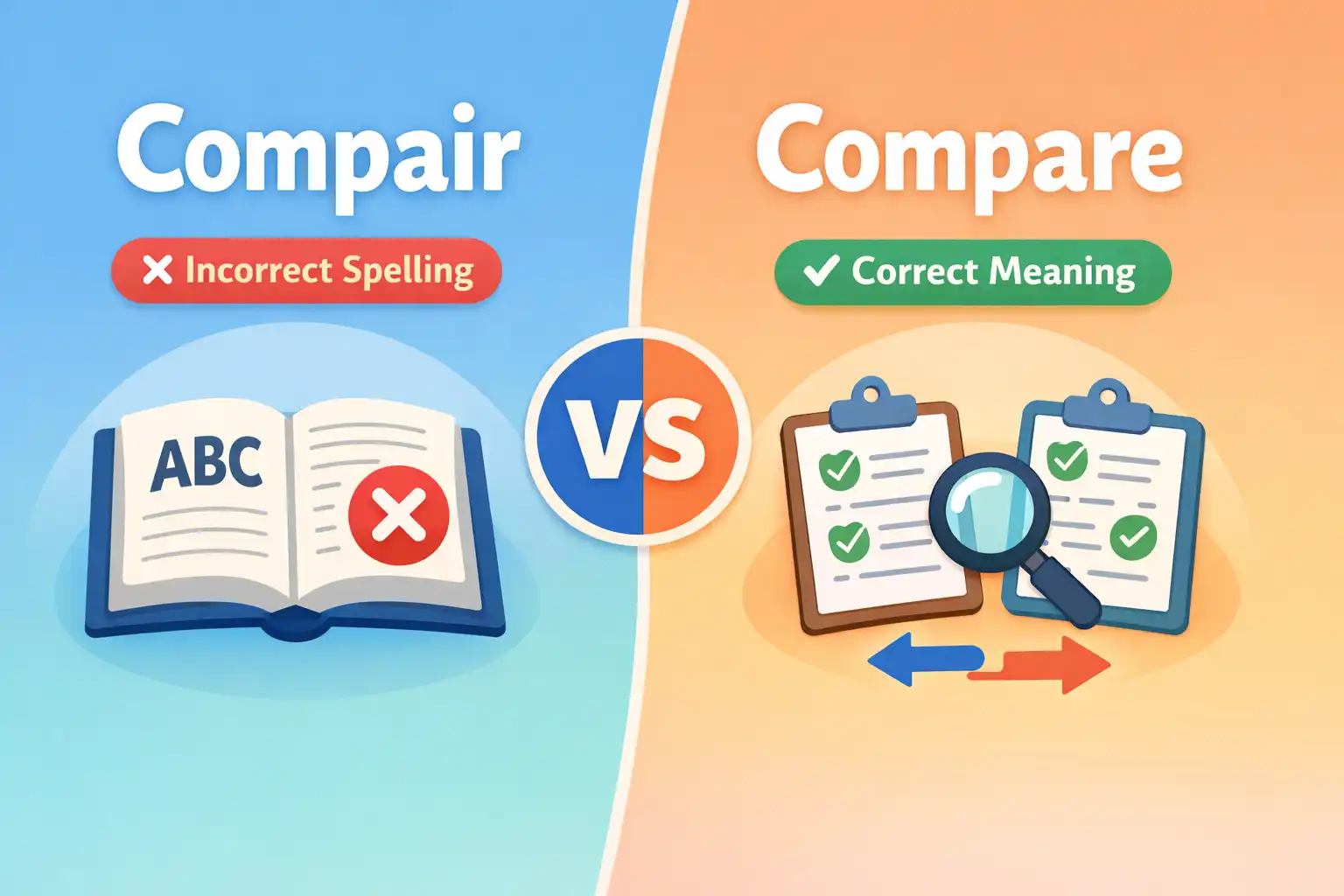
If you have ever typed “compair” and then paused to wonder whether it looked right, you are not alone. This is one of the most common spelling mistakes in English. The confusion happens because the word sounds very similar to “pair,” which tricks many writers into spelling it as “compair.” In this guide, you will learn the correct spelling once and for all, understand why this mistake happens, and find simple tricks to avoid it forever.
What Is the Difference Between Compair and Compare?
Let us start with the most direct answer possible.
Compare is a real English word. It is a verb that means to examine two or more things to find their similarities and differences. It is used in everyday conversations, academic writing, emails, and professional documents all over the world.
Compair is not a real English word. It has no meaning, no history, and no place in any English dictionary. It is simply a misspelling of the word “compare.”
So the difference between compair vs compare is not about meaning or usage. It is only about correctness. One word exists. The other does not.
Why Do People Write Compair Instead of Compare?
This is an excellent question, and the answer lies in how our brains process language.
The Sound Confusion
When people hear the word “compare” spoken out loud, it sounds like “com-pair.” The brain naturally tries to match sounds to spellings, and since we already know the word “pair” (as in a pair of shoes), writing “compair” feels logical and natural.
However, English spelling does not always follow pronunciation. Many English words are spelled differently from how they sound. This is because English borrows heavily from Latin, French, and other languages, each of which brings its own spelling rules.
Fast Typing and Autocorrect Failures
In today’s digital world, people type quickly on phones and keyboards. Phonetic spelling mistakes slip through easily. Autocorrect tools also sometimes fail to catch rare misspellings like “compair” because they are not always recognized as errors by every platform.
Online Repetition
When one person writes “compair” in a blog post or social media comment, others read it and assume it is correct. Mistakes spread online because repetition creates a false sense of correctness. But no matter how many times you see “compair” written, it remains incorrect.
The Correct Spelling — Always Use Compare
The correct spelling is compare, and it is the same in both American English and British English. There is no regional variation here.
Compare comes from the Latin word comparare, which means “to match” or “to bring together.” When you compare two things, you are bringing them together side by side to examine them.
This Latin root has stayed intact through centuries of English usage, which is why the word is spelled “compare” and not “compair.”
Meaning and Definition of Compare
Compare (verb) — to examine two or more things to identify how they are similar or different.
It is used when you want to:
- Find similarities between two ideas, products, or options
- Identify differences between two things
- Analyze choices before making a decision
- Evaluate quality, price, performance, or features
The noun form of the word is comparison. The past tense is compared. The present continuous form is comparing.
Examples of Compare Used in Sentences
Here are clear, everyday examples of how to use the word “compare” correctly:
- Please compare the prices of both products before deciding.
- The teacher asked us to compare and contrast the two stories.
- She compared her test results with her classmate’s answers.
- It is always wise to compare options before making a big purchase.
- Let us compare the features of these two smartphones.
- I compared the two job offers and chose the one with better benefits.
- Scientists often compare data from different experiments.
- The article compares the performance of five different laptops.
In every one of these examples, “compare” is the only correct choice. There is no situation where “compair” would be acceptable or correct.
Common Mistakes Related to Compair vs Compare
Here are the most frequent errors writers make with this word:
Wrong: Compair the two documents before submitting. Correct: Compare the two documents before submitting.
Wrong: I need to compair these two phones. Correct: I need to compare these two phones.
Wrong: Please compair the results. Correct: Please compare the results.
Wrong: She was compairing prices online. Correct: She was comparing prices online.
Always check your spelling before sending an email, submitting an essay, or publishing a blog post. A simple spelling error like “compair” can reduce your credibility as a writer.
Easy Memory Tricks to Always Spell Compare Correctly
If you struggle with this spelling, use these simple and powerful memory tricks.
The “Pair” Trick
The word compare contains the word pair. When you compare, you usually look at a pair of things side by side. So the connection makes sense.
But remember: the spelling is comp + are, not comp + air.
You can think of it this way:
Compare = Com + Pair (in meaning) but Com + Pare (in spelling)
The “-Are” Pattern
The word “compare” ends in -are. Many other common English words follow this same pattern:
- prepare
- declare
- beware
- aware
- share
Once you notice this pattern, the correct spelling becomes much easier to remember. “Compare” fits perfectly into this group. “Compair” does not.
Link It to “Prepare”
Here is a quick rhyme to help you remember:
“I prepare to compare.”
Both words end in “-are” and both are used in similar professional contexts. If you can spell “prepare,” you can spell “compare.”
Compare — Noun, Verb, and Related Word Forms
Understanding the different forms of the word will help you use it correctly in all situations.
| Form | Word | Example |
| Verb | compare | Please compare the two reports. |
| Past Tense | compared | She compared the prices yesterday. |
| Present Participle | comparing | He is comparing two options now. |
| Noun | comparison | The comparison showed clear differences. |
| Adjective | comparable | The two products are comparable in quality. |
| Adverb | comparably | Both candidates performed comparably. |
None of these related words use the spelling “compair.” The entire word family is built on the correct root “compare.”
Compare vs. Contrast — A Related Concept Worth Knowing
Many people use the phrase “compare and contrast” in academic writing. It is important to understand what each word means.
Compare focuses on finding similarities between two things. Contrast focuses on finding differences between two things.
When you compare and contrast, you are doing both — looking at what two things have in common and what makes them different.
For example:
- Compare two phones → what features do they share?
- Contrast two phones → how are they different in price, performance, or design?
This is a useful concept for essays, reports, reviews, and research papers.
Does Google Recognize Compair as a Search Term?
Yes, Google does receive searches for “compair vs compare” because many people type the wrong spelling into the search bar before learning the correct one. This is actually a high-intent informational search. People who type this are actively trying to learn.
Google typically shows results that explain the correct spelling and usage, which is why grammar blogs, spelling guides, and educational sites rank well for this keyword. If you are writing content on this topic, following proper grammar, clear examples, and helpful structure will give your article the best chance of ranking.
Quick Summary Table
| Feature | Compare | Compair |
| Correct spelling | ✅ Yes | ❌ No |
| Real English word | ✅ Yes | ❌ No |
| Found in dictionary | ✅ Yes | ❌ No |
| Correct usage | Always | Never |
| Origin | Latin (comparare) | None |
Frequently Asked Questions (FAQs)
Is compair a word? No, “compair” is not a word in English. It is a common misspelling of “compare.”
What is the correct spelling — compair or compare? The correct spelling is always “compare.” Use it to describe examining similarities or differences between two or more things.
Why do people spell compare as compair? Because the word sounds like “com-pair” when spoken, people mistakenly use the spelling of the word “pair.” However, the correct ending is “-are” not “-air.”
Is the spelling different in British and American English? No. Both British and American English use “compare.” There is no regional difference.
What is the noun form of compare? The noun form is “comparison.” Example: The comparison between the two models was helpful.
Final Answer — Compair or Compare?
The final answer is simple:
✅ Compare is correct. ❌ Compair is incorrect.
Always use “compare” when you want to examine similarities or differences between two or more things. Never use “compair” in any form of writing, whether it is a school essay, a business email, a social media post, or a blog article.
The spelling “compare” ends in “-are,” comes from Latin roots, and is recognized in every English dictionary. The spelling “compair” does not exist in the English language and should always be avoided.
By understanding this simple rule and using the memory tricks shared in this article, you will never make this mistake again.

Ibrahim Jhon is an English language editor with over ten years of experience working with writers, publishers, and international businesses. He specialises in word choice, grammar accuracy, and the differences between British and American English.