
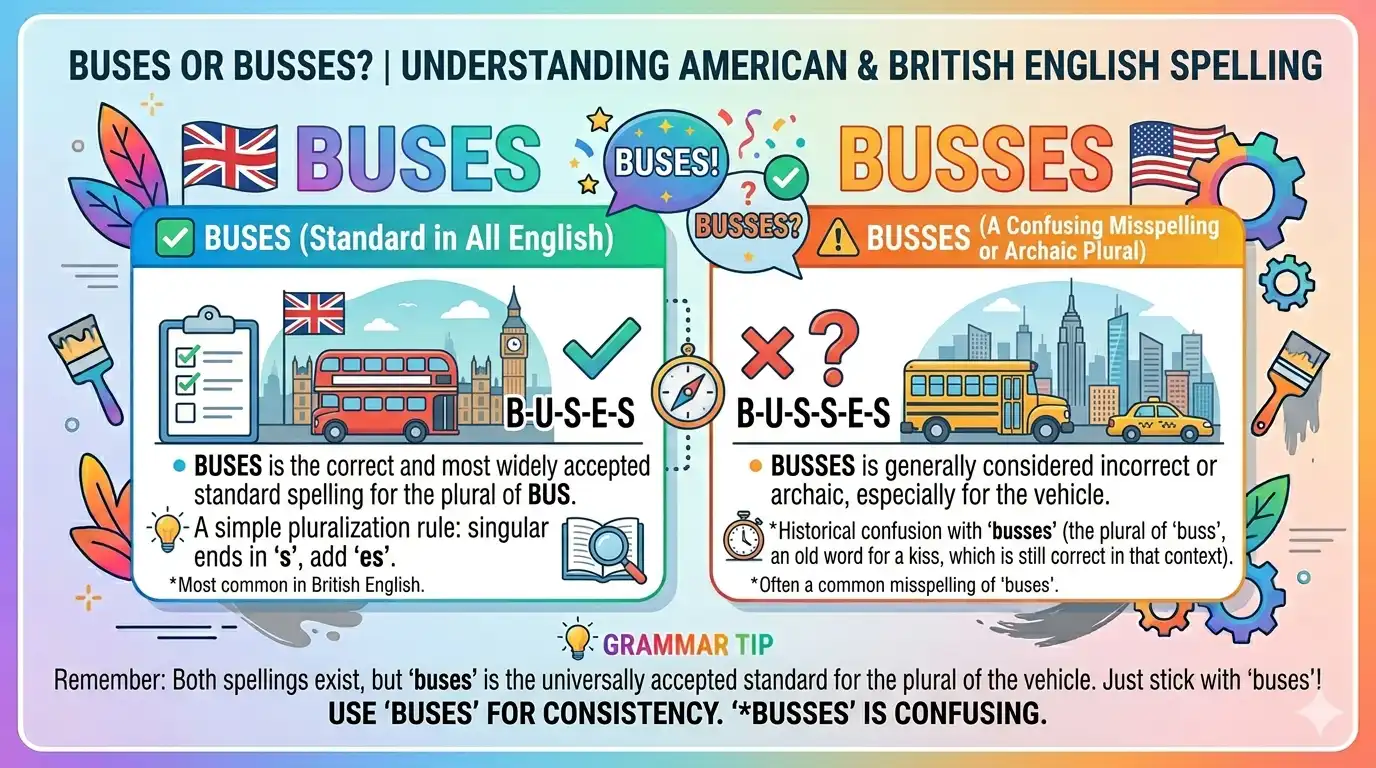
Do you write “busses” or “buses”? Many people are not sure. This mix-up is very common. The short answer is simple: buses is correct. It is the right plural of bus. Every major dictionary agrees on this. Busses is an old spelling. It is rare today. It can also mean something else. Buss means “kiss.” So busses can mean “kisses.” That is why buses is the safer word for vehicles.
In this guide, you will learn the real difference. You will see how US and UK English use each word, You will see clear examples. You will also get easy tips to remember the spelling for good.
Busses or Buses: The Quick Answer
Buses is the correct plural of bus. This is true in American English. It is also true in British English. Busses is old and uncommon now. Most style guides do not recommend it. If you write blogs, school papers, or web pages, use buses. It is the safe and modern choice.
Why does this confusion happen? English often doubles the last letter before -es. Gas becomes gasses. Pass becomes passes. By that rule, bus should become busses. But language changes over time. Buses won out. It broke the old rule. Today, it is the standard spelling.
This small spelling choice matters. A wrong spelling can hurt a school newsletter. It can hurt a business website. It can hurt a resume. Readers often miss correct spelling. But they always notice mistakes. One small fix, buses instead of busses, keeps your writing clean and trustworthy.
Busses vs. Buses: What Each Word Means
Buses (the standard plural)
Buses means more than one bus. A bus is a large vehicle. It carries many passengers. Buses also works as a verb in American English. It means “to move people by bus.” Example: He buses students to school.
Busses (the rare word)
Busses has two different meanings. This is why it confuses people.
- As a noun: an old plural of bus. It is rare today.
- As a verb: it comes from “buss,” an old word for kiss. Example: He busses his grandmother on the cheek.
Because of this, “busses” about vehicles can sound odd. It may even sound like a sentence about kissing. This is one more reason to use buses instead.
Busses or Buses: US vs UK Comparison
Many people think British English uses “busses.” That is not true. Both US and UK English use buses for the plural noun. The real difference is in the verb form, not the noun.
| Form | American English (US) | British English (UK) |
| Plural noun (vehicles) | buses | buses |
| Verb – present | buses (he buses tables) | busses (he busses tables) |
| Verb – past tense | bused | bussed |
| Verb – -ing form | busing | bussing |
So the noun is easy. Buses is correct in both countries. The verb is different. US style guides like AP and Merriam-Webster use one S: bused, busing. Some UK style guides, like The Guardian, use two S: bussed, bussing. This helps the word look different from other confusing words.
How to Say Buses (And Why It Confuses People)
Part of the mix-up comes from sound. Buses sounds like “BUSS-iz.” It has a soft S sound. It sounds like trusses or fusses. Many learners expect it to sound like fuses or abuses. Those words use a Z sound. But buses does not follow that pattern.
Once you know this, the spelling makes more sense. Buses sounds like trusses, not fuses. So one S is enough. Try saying it out loud. It can help you remember the spelling.
What Dictionaries and Style Guides Say
| Source | Preferred Plural |
| Merriam-Webster | buses (busses listed as rare) |
| Oxford Dictionary | buses |
| Cambridge Dictionary | buses |
| AP Style | buses |
| The Guardian Style Guide | buses (noun); busses/bussed for the verb |
All major sources agree. For vehicles, buses is the right word. No major dictionary says busses is the main spelling. This makes the choice easy.
A Short History of the Word
The word bus comes from omnibus. This is a Latin word. It means “for all.” Long ago, omnibus meant a horse-drawn carriage. People could all ride it together. Over time, the word got shorter. It became just “bus.”
When bus became a new word, people were not sure how to make it plural. Many short words double their last letter before -es. So busses seemed like a good guess. In fact, busses was the top choice in Merriam-Webster until 1961.
Things changed over time. By the 1930s, buses was already more common in writing. Today, buses appears far more often than busses. Most dictionaries and style guides now treat buses as the only standard spelling.
Why This Spelling Question Comes Up So Often
People search for “busses or buses” every single day. This happens for a clear reason. The word looks tricky. It does not follow the usual spelling rule. Students ask their teachers. Writers ask editors. Many people just guess and hope it is right.
Search engines and writing tools now help with this. Spell checkers often flag busses as wrong. This makes some writers trust busses less. But the rule is simple once you learn it. Buses is for vehicles. Busses is rare and mostly tied to the word kiss.
This kind of confusion is normal in English. Many words do not follow neat rules. The best way to learn them is through clear examples, not just grammar rules. That is the goal of this guide.
Quick Recap Before the Examples
Let’s pause and recap the main points so far. Buses means more than one bus. It is the correct spelling almost every time you write about vehicles. Busses is old. It is rare. It can also mean kisses, from the word buss. The US and UK both use buses for the noun. They only differ in the verb form.
Keep these points in mind. They will help you as you read the examples below.
Examples of Buses and Busses in Sentences
Correct: Using buses
- The school bought ten new buses this year.
- Two buses arrived at the same stop.
- City buses run every fifteen minutes.
- The airport buses passengers between terminals.
Where busses is used
- Grandpa busses his grandchildren before bed. (this means kisses)
- In UK English: The waiter busses the tables fast. (verb meaning to clear tables)
In almost every case about vehicles, buses is the word you need.
Common Mistakes to Avoid
- Writing “three busses waited outside” for vehicles. Use buses instead.
- Thinking busses is the British spelling for vehicles. It is not. The UK uses buses too.
- Mixing up verb tenses. The noun plural is always buses, in every country.
- Using busses and hoping readers will understand. It often looks like a typo.
Simple Tricks to Remember the Spelling
- Buses rhymes with uses. Both are everyday words.
- Remember: “Busses are for kisses. Buses are for vehicles.”
- Picture a yellow school bus. It has one S on the side. One S, one correct word.
Similar Confusing Words to Know
Busses and buses is not the only tricky pair in English. Some other words follow a similar pattern. Knowing this can help with more than just one word.
- Bus becomes buses, not busses.
- Gas can become gasses or gases. Both are used.
- Focus can become focuses. Some British writers use focusses, but focuses is more common.
- Bias becomes biases. Biasses is not used today.
These small patterns show why English spelling can feel tricky. Many of these words changed simply because more people used one form over time. Dictionaries then followed common use.
Frequently Asked Questions
Is busses or buses correct?
Buses is correct for the plural of the vehicle. Busses is old and rare. It is now mostly linked to the verb “buss,” which means kiss.
Do British people say buses or busses?
British English uses buses for the noun. This is the same as American English. The only difference is in the verb form: bussed and bussing in the UK, versus bused and busing in the US.
Is it ever correct to use busses?
Yes, in a few cases. It can be an old dictionary variant. It can also be the verb form of “buss,” meaning kiss. Some British style guides also use it as a verb meaning to transport or clear tables.
Why doesn’t buses have a double S like other words?
English often doubles the last letter before -es, like gas to gasses. Bus did not follow this rule over time. Buses became the accepted spelling during the twentieth century.
What is the verb form of bus?
In American English, the verb forms are bus, buses, bused, and busing. In British English, some style guides use bus, busses, bussed, and bussing.
Conclusion
So, busses or buses? The answer is clear. Buses is correct for the vehicle. It is correct in both US and UK English. Busses is rare today. It mostly means kisses, not vehicles. Remember this simple guide. You will never be unsure about this spelling again.

Ibrahim Jhon is an English language editor with over ten years of experience working with writers, publishers, and international businesses. He specialises in word choice, grammar accuracy, and the differences between British and American English.