
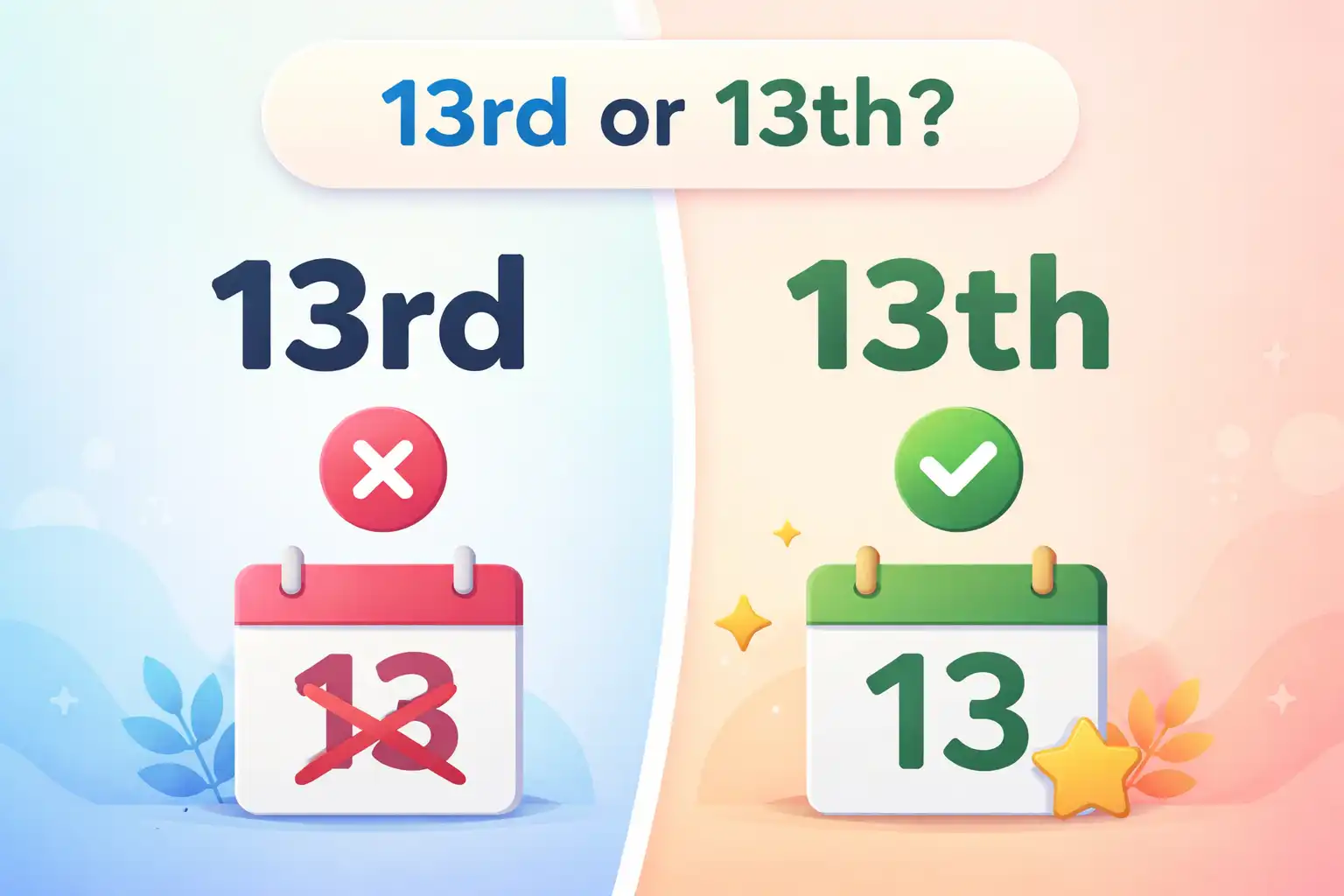
Stop Second-Guessing Yourself
Picture this: you are typing a date in an important email and your fingers suddenly pause. Should it be 13rd or 13th? You glance at 3rd and think — well, 13 ends in 3, so maybe 13rd makes sense? It feels completely logical. But that logic leads you straight into one of the most common ordinal number mistakes in the English language.
You are not alone in this confusion. Millions of people search this exact question every year while writing emails, filling out forms, completing school assignments, or creating online content. The good news is that the answer is simple, the rule behind it is easy to remember, and after reading this guide, you will never have to pause or second-guess yourself again.
This 2026 guide gives you the correct answer immediately, explains the reason behind it, covers British vs American English, walks through real-life examples, and answers the most common questions people have about this topic. For clarity, check this word comparison to understand the correct ordinal form.
Quick Answer: Always Write 13th
There is no debate, no regional variation, and no exception. 13th is correct. 13rd does not exist in standard English.
If you are in a hurry and just need the answer right now, here it is:
| Write This | Never Write This |
| 13th March | ~~13rd March~~ |
| He finished 13th | ~~He finished 13rd~~ |
| The 13th floor | ~~The 13rd floor~~ |
| My appointment is on the 13th | ~~My appointment is on the 13rd~~ |
No matter who your audience is, what country you are writing for, or how informal your tone is — 13th is always the correct choice and 13rd is always wrong.
Why Is It 13th and Not 13rd?
This is the question most people actually want answered. Understanding the reason helps the rule stick in your memory permanently.
The suffix “rd” belongs to 3rd because the spoken word is third, and third ends in the sounds “rd.” When you say it out loud, it sounds natural to write 3rd. Now say the number 13 as an ordinal out loud. The word is thirteenth. Notice what happens — the word naturally ends in “th,” not “rd.” There is no “thirdrteenth.” The “th” ending is built directly into the spoken word itself.
This is not a coincidence. It comes from the history of the English language. Ordinal numbers in English developed from Old English and Latin-based roots. Numbers like 11, 12, and 13 formed their ordinal versions from much older word forms — eleventh, twelfth, and thirteenth — and each one locked in the “th” ending centuries ago. No spelling reform, regional dialect, or informal trend has ever changed this.
The pattern for ordinal suffixes in English works like this:
- A number ending in 1 takes “st” — but only when the last two digits are not 11
- A number ending in 2 takes “nd” — but only when the last two digits are not 12
- A number ending in 3 takes “rd” — but only when the last two digits are not 13
- Numbers ending in 11, 12, or 13 always take “th” — no exceptions
So 3rd follows the pattern. But 13 falls into the exception group. The last two digits are 13, which means the “th” rule overrides everything else. That is why 13th is correct and 13rd never was.
British English vs American English: Is There Any Difference?
Many people assume that British and American English handle this differently, the same way they handle spelling differences like colour vs color or organise vs organize. But for ordinal numbers, both varieties of English follow exactly the same rule.
| Number | British English | American English | Correct Form |
| 1 | 1st | 1st | 1st |
| 2 | 2nd | 2nd | 2nd |
| 3 | 3rd | 3rd | 3rd |
| 11 | 11th | 11th | 11th |
| 12 | 12th | 12th | 12th |
| 13 | 13th | 13th | 13th |
Whether your reader is in London, New York, Toronto, Sydney, Karachi, or Dubai — the answer is the same. 13th is always correct. There is no version of English, no style guide, and no formal or informal context where 13rd becomes acceptable.
Real-World Examples Across Different Contexts
Seeing the correct form in actual sentences helps build confidence. Here are examples from different everyday situations where this rule applies:
Work Email: “Please confirm your availability for the 13th of May.”
Legal Document: “This agreement becomes effective from the 13th day of April, 2026.”
Academic Writing: “The original study was first published on the 13th of March.”
News or Journalism: “The announcement was made on the 13th, just days before the deadline.”
Social Media Post: “The sale starts on the 13th — mark your calendars and spread the word!”
Sports Result: “She crossed the finish line in 13th place after a remarkable final lap.”
School Assignment: “The 13th president of the United States was Millard Fillmore.”
In every single one of these examples, writing 13rd instead of 13th would be an error. It would not change whether readers understand you, but it would signal careless writing and reduce your credibility — especially in professional or academic settings. This guide in UK vs US explains the proper usage across regions.
The One Rule That Covers All Similar Numbers
You do not need to memorize 13 as a unique special case. The rule that explains 13th also explains a much wider group of numbers. Any ordinal number whose last two digits are 11, 12, or 13 will always use “th.”
This means:
- 113th ✅ — not 113rd
- 213th ✅ — not 213rd
- 311th ✅ — not 311st
- 412th ✅ — not 412nd
- 1,013th ✅ — not 1,013rd
The rule scales to every number in the English language. Once you know it, you will never make an ordinal suffix mistake with these numbers again.
A simple way to remember it: if the last two digits form the word “eleventh,” “twelfth,” or “thirteenth” when spoken, the suffix is always “th.”
Common Mistakes People Make
Even educated writers make these errors. Here are the most frequent ones and their corrections:
Mistake 1 — Copying the pattern of 3rd:
- ❌ The conference is on 13rd July
- ✅ The conference is on 13th July
Mistake 2 — Using 13rd in sports or rankings:
- ❌ He finished in 13rd position
- ✅ He finished in 13th position
Assuming informal writing allows 13rd:
- ❌ See you on the 13rd!
- ✅ See you on the 13th!
Thinking the rule changes by country:
- ❌ Americans write 13rd and British write 13th
- ✅ Both write 13th — always
Using 13rd in legal or formal documents:
- ❌ Effective from the 13rd day of the month
- ✅ Effective from the 13th day of the month
Frequently Asked Questions
Is 13rd ever correct in any form of writing? No. 13rd is incorrect in every context — formal writing, casual texting, legal documents, social media, journalism, and academic papers. There is no situation where 13rd becomes acceptable.
If someone writes 13rd, will people still understand what they mean? Most likely yes, but that is not the point. Incorrect grammar reduces your credibility, especially in professional or academic writing. Readers notice these errors even if they say nothing.
How do I pronounce 13th? Say “thirteenth.” Notice how the “th” sound appears naturally at the end of the spoken word. The written form simply follows what you already say out loud.
Does autocorrect or spell check catch 13rd as an error? Usually not. Most spell checkers and grammar tools do not flag ordinal number suffix errors. This is a rule you need to carry in your own knowledge, which is exactly why articles like this one matter.
What about the number 113 or 1013 — do they follow the same rule? Yes. Any number whose final two digits are 13 will always take the “th” suffix. So 113th, 1013th, and 10,013th are all correct. The rule applies infinitely.
Is “thirteenth” better than writing “13th”? Both are correct. Writing out thirteenth in full is preferred in formal documents and academic writing. The numeral form 13th is more common in everyday writing, digital content, and dates.
Does this rule apply to 11 and 12 as well? Absolutely. The full exception group is 11, 12, and 13. So 11th, 12th, and 13th all follow the “th” rule, even though 1, 2, and 3 take “st,” “nd,” and “rd” respectively. You might also find catchup vs catch up helpful for similar writing issues.
Key Takeaways
Before you go, here is everything you need to remember from this guide:
- ✅ 13th is the only correct ordinal form of the number 13
- ❌ 13rd is always wrong — in every country, every style, every context
- The rule comes from the Old English history of the word thirteenth
- Numbers ending in 11, 12, or 13 always use “th” as their suffix
- British and American English agree completely on this rule
- The same logic applies to 113th, 213th, 1013th, and beyond
- Spell checkers usually miss this error, so knowing the rule yourself matters
Final Thoughts
The confusion around 13rd vs 13th is completely understandable. English ordinal numbers have a pattern, and 13 appears to fit that pattern — until you look more closely. Once you understand that the spoken word is thirteenth and that 11, 12, and 13 are historical exceptions, the rule becomes clear and permanent in your memory. See sitted or seated for another common grammar confusion.
Correct writing builds trust. Whether you are sending a work email, submitting an assignment, publishing online content, or signing a legal document, using 13th instead of 13rd shows that you pay attention to detail. It is a small thing, but small things add up to a professional impression.
The next time your fingers pause over the keyboard, do not hesitate. Type 13th with complete confidence. The rule is clear, it is universal, and now it belongs to you.

Ibrahim Jhon is an English language editor with over ten years of experience working with writers, publishers, and international businesses. He specialises in word choice, grammar accuracy, and the differences between British and American English.