
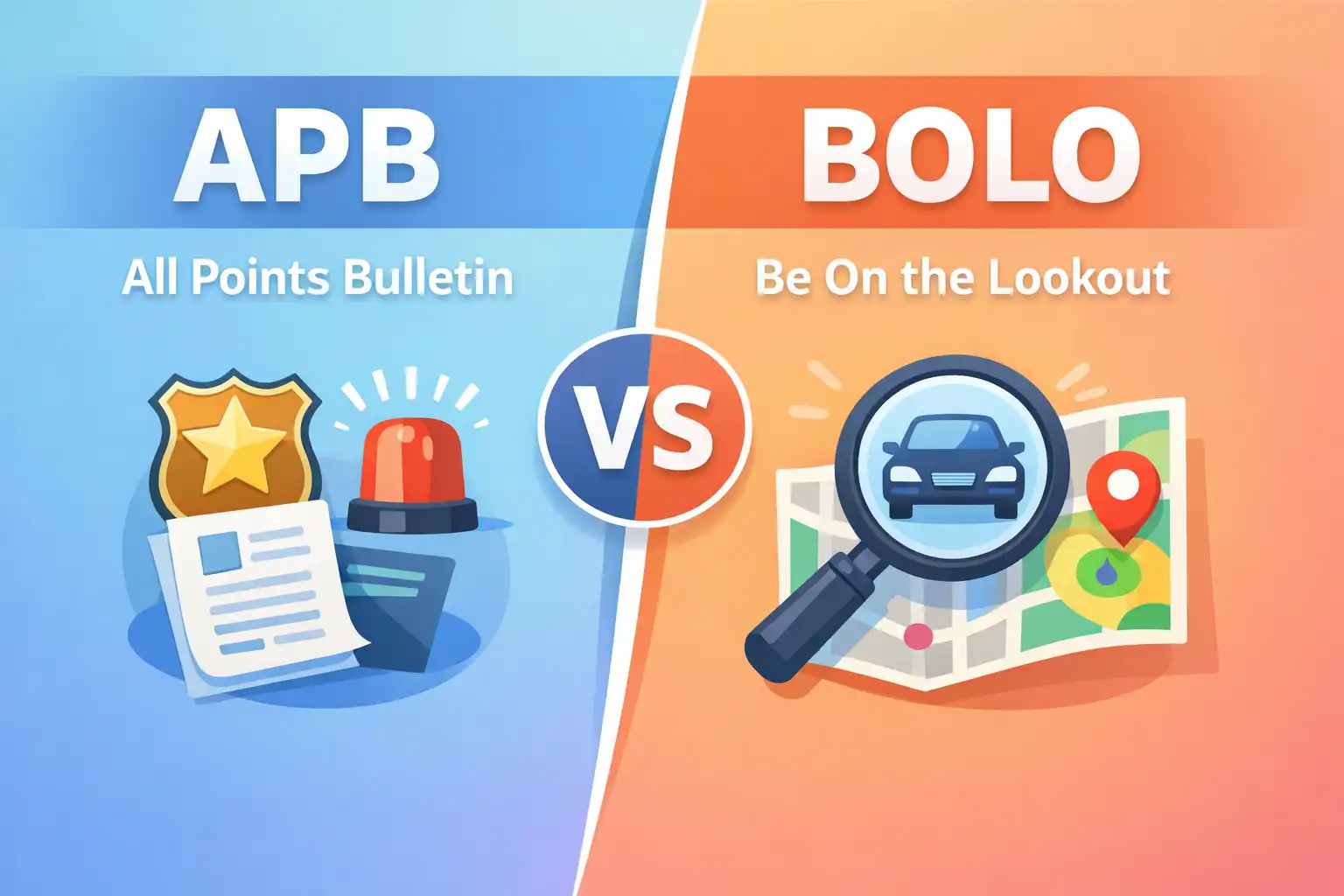
People often search for “apb vs bolo” because both terms appear in crime news, police shows, and social media. At first glance, they seem similar. Both relate to alerts about people or vehicles. But the meaning and use are not exactly the same.
This confusion matters. If you use the wrong term, your message can sound unclear or even incorrect, especially in writing, news, or reports. Many learners, students, and even writers mix them up because both are short forms used by law enforcement.
In this guide, you will learn the exact difference between APB and BOLO. You will also see how each one works in real life. By the end, you will know when to use each term with confidence.
APB vs BOLO – Quick Answer
- APB (All-Points Bulletin): A formal alert sent to all police units about a suspect or crime
- BOLO (Be On the Lookout): A general warning to watch for a person, vehicle, or situation
Examples:
- Police issued an APB for a robbery suspect
- Officers got a BOLO for a stolen car
Easy rule:
Use APB for official alerts, but use BOLO for general watch notices
Meaning of APB
- Full form: All-Points Bulletin
- Used by police agencies
- Formal and official alert
Examples:
- Police sent an APB after the bank robbery
- An APB was issued for the missing suspect
Meaning of BOLO
- Full form: Be On the Lookout
- Used in police and public alerts
- Less formal than APB
Examples:
- Officers received a BOLO for a red car
- There is a BOLO for a missing person
The Origin of APB vs BOLO
APB started in early law enforcement communication systems. Police needed a way to alert all units at once. So, they used “All-Points Bulletin” to share urgent details across regions. Over time, it became common in police reports and radio calls.
BOLO came later. It is more conversational. Officers used it during patrols to quickly tell others to watch for something. It became popular because it is simple and easy to say.
However, confusion grew because both terms involve alerts. Many people now use them as if they mean the same thing. That is not fully correct.
British vs American English Spelling
There is no spelling difference between APB and BOLO in British or American English. Both are acronyms, so they stay the same everywhere.
However, usage differs slightly.
| Region | Common Use |
| USA | APB and BOLO both widely used |
| UK | Less common, but understood in media |
| Global | BOLO more understood in casual use |
In contrast, APB sounds more official and American. Meanwhile, BOLO feels more informal and widely understood.
How to Choose the Right Word Fast
Choosing between APB and BOLO is simple when you focus on context.
In the US:
Use APB for official police alerts. Use BOLO for general watch notices.
In the UK or Commonwealth:
Both terms are less common. Still, BOLO feels easier to understand.
In global or professional writing:
Use APB when you want a formal tone. Use BOLO when clarity and simplicity matter.
If you are unsure, remember this:
APB = formal alert, BOLO = watch notice
Common Mistakes with APB vs BOLO
Writers often confuse these terms because they look similar in use.
❌ Police issued a BOLO bulletin
✅ Police issued an APB
Explanation: APB is already a bulletin
❌ There is an APB lookout for a car
✅ There is a BOLO for a car
Explanation: BOLO fits better for general watching
❌ BOLO is always official
✅ APB is more official
Explanation: BOLO can be informal
APB vs BOLO in Real Life Examples
Emails:
- We received an APB from the police department
- There is a BOLO for a suspicious vehicle
News:
- Authorities issued an APB after the incident
- Police shared a BOLO with nearby cities
Social Media:
- BOLO: Missing dog in the area
- APB: Suspect identified by police
Professional Writing:
- The department released an APB for the suspect
- Officers responded to a BOLO alert
APB vs BOLO – Word Usage Patterns and Search Trends
People search for “apb vs bolo” mainly when they see both terms in crime shows or news reports. Students and ESL learners also look it up when reading articles.
BOLO is more common in casual searches because it sounds simple. APB appears more in formal contexts like news and official reports.
A common real-life issue happens in writing. If someone uses APB when they mean BOLO, the message can sound too formal or incorrect. This small mistake can confuse readers.
APB vs BOLO Comparison Table
| Feature | APB | BOLO |
| Meaning | All-Points Bulletin | Be On the Lookout |
| Part of Speech | Noun (acronym) | Noun (acronym) |
| Context | Official police alert | General warning |
| Formality | Formal | Semi-formal / informal |
| Common Mistake | Used for simple alerts | Used as official bulletin |
| Correct Example | Police issued an APB | Officers got a BOLO |
FAQs About APB vs BOLO
Is APB the same as BOLO?
No. APB is more formal, while BOLO is more general.
Which one is correct in formal writing?
APB is better for formal or official writing.
Can they be used interchangeably?
Not always. Context matters.
Why do people confuse them?
Both relate to alerts about people or vehicles.
Can grammar tools catch this mistake?
Most tools do not catch it because both are correct words.
Is there a British vs American difference?
No spelling difference, but usage is more common in the US.
Which is easier for beginners?
BOLO is easier because it is simple and clear.
Conclusion
APB and BOLO may look similar, but they serve different purposes. APB is a formal alert used by police to inform all units. BOLO is a general notice that tells people to watch for something.
This difference matters in writing and communication. If you use APB in a casual situation, it may sound too official. On the other hand, using BOLO in formal writing can sound less precise.
Overall, the best way to remember is simple. Use APB for official alerts. Use BOLO for general watch notices.
In short, always match the word with the tone and context. That one rule will help you avoid mistakes every time.

Ibrahim Jhon is an English language editor with over ten years of experience working with writers, publishers, and international businesses. He specialises in word choice, grammar accuracy, and the differences between British and American English.