
Have you ever typed “wether or not” and then paused — wondering if that looks wrong? You are not alone. Thousands of writers in the US and UK make this exact mistake every day.
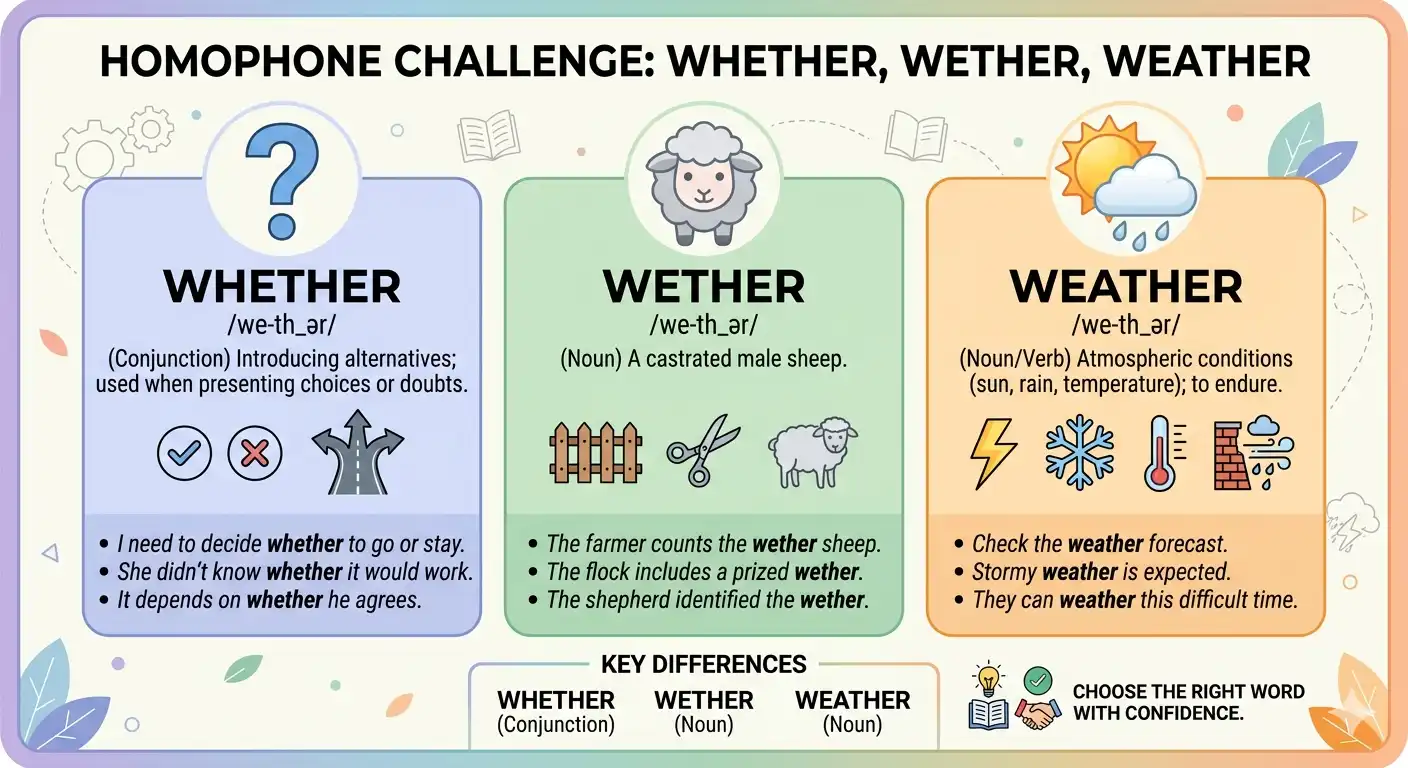
The words whether, wether, and weather all sound exactly the same when spoken aloud. They are called homophones — words that share the same pronunciation but carry completely different meanings and spellings.
Using the wrong one is considered a serious grammar error, especially in formal writing. In this guide, you will learn what each word means, how to use whether correctly, and why wether almost never belongs in everyday writing. By the end, you will never mix them up again.
What Does “Whether” Mean?
Whether is a conjunction. You use it to introduce a choice between two or more alternatives, or to show doubt or uncertainty. Think of it as similar to the word “if.”
Here are some simple examples:
- She could not decide whether to stay or leave.
- Tell me whether you agree with the plan.
- I am not sure whether the store is open today.
- We will finish the project whether or not the funding arrives.
- He asked whether the meeting had been cancelled.
In all of these sentences, whether signals a choice or a question with two possible answers. That is its only job as a conjunction — and it does it very well.
Whether or Not: Do You Need Both Words?
Many writers ask: do you always need to write “whether or not”, or can you drop the “or not”?
The answer is simple. You can drop “or not” in most sentences:
- Correct: I do not know whether she will come.
- Also correct: I do not know whether or not she will come.
However, when you mean “regardless of the fact that,” you must keep “or not”:
- We are going to the park whether or not it rains.
In this case, “or not” carries real meaning. Leaving it out changes the sentence entirely.
Whether vs. If: Which One Should You Use?
Both whether and if can introduce indirect questions. But grammar experts recommend whether in formal writing, especially when two alternatives are clearly present.
| Situation | Use “whether” | Use “if” |
| Two alternatives | ✅ I asked whether he would come or stay home. | ❌ Less formal |
| After a preposition | ✅ The question of whether it works | ❌ Incorrect here |
| General conditions | Can use either | ✅ I will help you if you need it |
In professional documents, emails, and academic writing, whether is almost always the safer choice.
What Does “Wether” Mean?
Here is the word that surprises most people: wether is a real English word. But it has almost nothing to do with grammar.
A wether is a male sheep or goat that has been castrated — usually at a young age. Farmers castrate male livestock so that only the strongest males breed with the females. Most people who are not involved in livestock farming will never need to use this word in daily writing.
Example sentences using wether correctly:
- The farmer sold three wethers at the market last Friday.
- A wether was used to lead the rest of the flock.
You may also recognise the related word “bellwether.” A bellwether is a sheep (originally a wether) that wears a bell and leads the herd. In modern language, we use bellwether to describe something that leads or predicts a trend — for example, a bellwether state in an election signals which way the rest of the country may vote.
Key Point
If you are writing anything other than a farming or livestock article, you almost certainly want “whether,” not “wether.” The word wether without an H is a common misspelling of whether — and spell checkers may not catch it because wether is technically a valid word.
What About “Weather”?
Since these three words are so often confused together, here is a quick breakdown of weather as well.
Weather refers to the atmospheric conditions outside — rain, sun, wind, snow, temperature, and humidity. It works as both a noun and a verb.
- As a noun: The weather in London is famously unpredictable.
- As a verb: The building has weathered many storms over the years.
- As an adjective: She checked the weather forecast before leaving.
Whether, Wether, Weather: A Quick Comparison
| Word | Part of Speech | Meaning | Example |
| Whether | Conjunction | Introduces a choice or doubt | I don’t know whether to go. |
| Wether | Noun | A castrated male sheep or goat | The wether led the flock. |
| Weather | Noun / Verb | Atmospheric conditions; to endure | The weather looks stormy today. |
H2: Whether or Wether in US English vs. UK English
Both American English and British English use the word whether in exactly the same way — there is no difference in spelling or grammar between the two dialects for this word.
However, there are some broader differences between US and UK English that writers should know when publishing content for both audiences.
Spelling Differences
British English sometimes uses spellings that differ from American English. For example:
- UK: colour, honour, organise, travelled
- US: color, honor, organize, traveled
The word whether is spelled identically in both dialects — W-H-E-T-H-E-R — with no variation.
Punctuation Differences
One area where US and UK English differ clearly is punctuation inside quotation marks:
- US English: Commas and periods go inside quotation marks — She said, “I don’t know whether to go.”
- UK English: Commas and periods go outside quotation marks — She said, ‘I don’t know whether to go’.
Verb Agreement With Collective Nouns
Another subtle difference worth noting for writers targeting both markets:
- US English: Collective nouns take singular verbs — The team is deciding whether to proceed.
- UK English: Collective nouns can take plural verbs — The team are deciding whether to proceed.
The Bottom Line for UK and US Writers
If you are writing for a US audience, follow American English conventions for punctuation and spelling — but use whether exactly as you would in any other dialect. If you are writing for a UK audience, the same applies. The word itself does not change.
Easy Memory Tricks to Never Confuse These Words Again
Learning homophones becomes much easier when you attach a strong visual memory to each word.
For “wether”: A wether is a castrated goat or sheep — it is missing something. The word itself is also missing an H compared to whether. So: a wether is missing its H, just like it is missing something else.
For “whether”: Whether starts with W-H, just like other question words — who, what, why, when. Use whether whenever you are introducing a question or a choice.
For “weather”: The word weather contains the letters eat in the middle — W-eat-her. When the weather is bad, all you want to do is stay indoors and eat.
Real-World Examples: Whether in Formal and Informal Writing
Formal Writing (Business and Academic)
- The committee has not yet decided whether to approve the proposal.
- The study examined whether regular exercise reduces anxiety levels.
- Please confirm whether you will attend the conference by Friday.
- The question of whether social media affects teen mental health remains debated.
Informal Writing (Everyday Conversation)
- I haven’t figured out whether I want pizza or pasta tonight.
- Can you tell me whether the package has arrived yet?
- She didn’t know whether to laugh or cry.
Common Mistakes to Avoid
❌ Wrong: I am not sure wether she will join us. ✅ Right: I am not sure whether she will join us.
❌ Wrong: We need to decide weather to continue. ✅ Right: We need to decide whether to continue.
❌ Wrong: Tell me wether or not you agree. ✅ Right: Tell me whether or not you agree.
Frequently Asked Questions
Q: Is “wether” a real word? Yes, wether is a real English word. It refers to a castrated male sheep or goat. However, it is almost never used in everyday writing. If you find yourself writing “wether,” you most likely meant to write “whether.”
Q: What is the difference between “whether” and “if”? Both can introduce indirect questions, but whether is preferred in formal writing — especially when two clear alternatives are present. After a preposition (such as “the question of…”), only whether is correct.
Q: Can I write “whether or not” or just “whether”? In most cases, you can drop “or not” without changing the meaning. However, when the sentence means “regardless of whether,” you must keep “or not” — for example: We will proceed whether or not the funding comes through.
Q: Is “whether” spelled differently in British English? No. The spelling whether is identical in both American and British English.
Q: How do I remember which word to use? Think of it this way: wether is missing an H, just like the animal is missing something else. If you are not talking about livestock, always choose whether.
Q: What is a bellwether? A bellwether is a word that comes from the practice of putting a bell on a lead wether (sheep) in a flock. In modern usage, a bellwether describes something that signals or leads a trend — such as a bellwether state in an election or a bellwether stock in the market.
Conclusion
The difference between whether and wether is straightforward once you know it. Whether is a conjunction you use every day to introduce choices, conditions, and indirect questions. Wether is a farming term for a castrated male sheep — useful if you write about livestock, but almost never needed in standard writing.
Here is the simplest rule you need: if you are not writing about farming, use “whether.”
Whether you are writing for a US or UK audience, the word is spelled and used the same way. Apply the memory tricks from this guide, keep the comparison table handy, and you will never second-guess yourself again.
Did this guide help you? Share it with anyone who writes in English — because confusing “whether” and “wether” is more common than most people think.

Ibrahim Jhon is an English language editor with over ten years of experience working with writers, publishers, and international businesses. He specialises in word choice, grammar accuracy, and the differences between British and American English.