
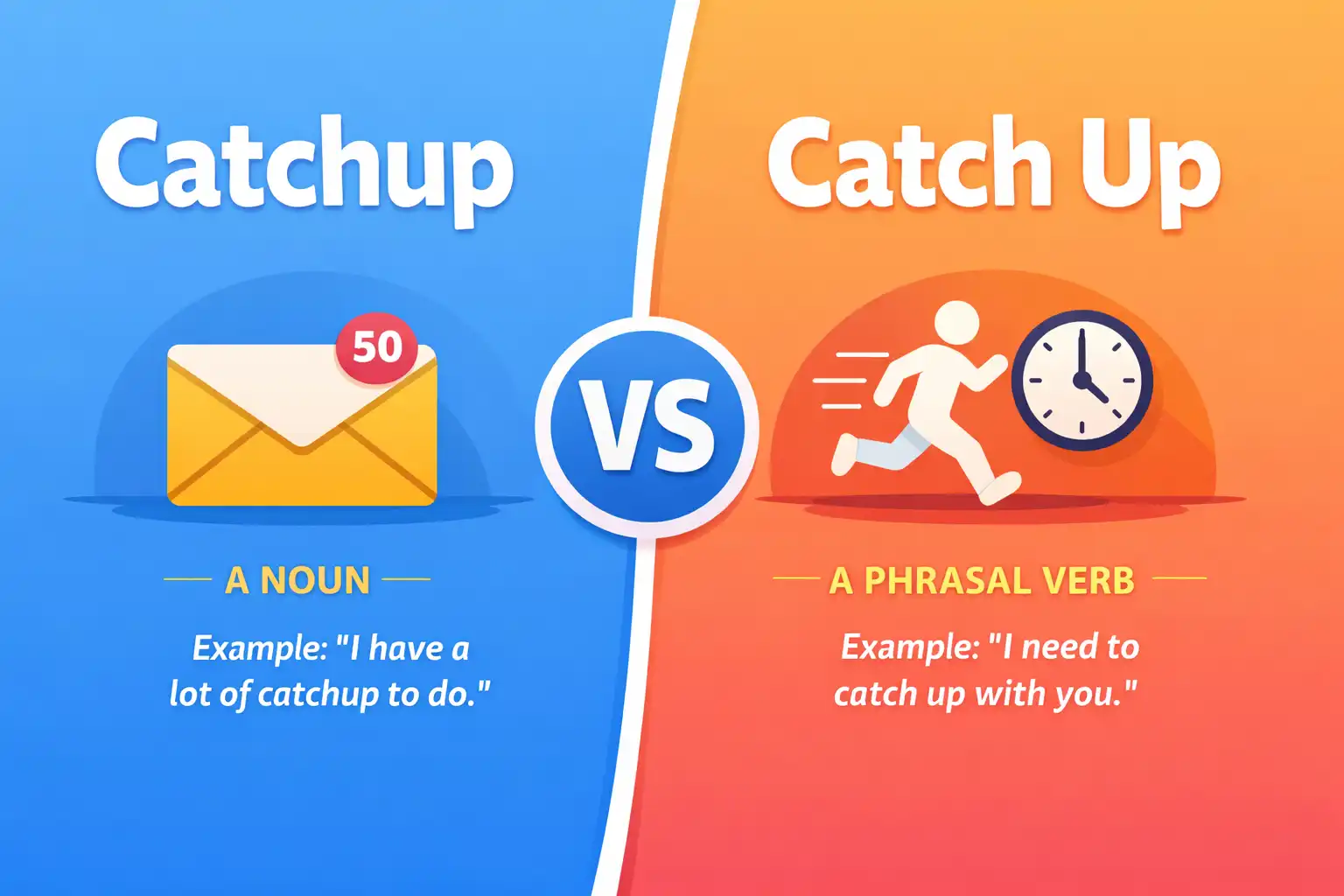
Many learners stop and think when they see catchup vs catch-up. Both forms look almost the same. Yet, they do not always work the same way. This small change can affect meaning, tone, and clarity.
Writers often mix them in emails, essays, and posts. Also, grammar tools do not always fix this mistake. So confusion stays. This matters because wrong usage can sound odd or unprofessional. It can even change what you mean.
In this guide, you will learn the clear difference. You will see when to use each form. You will also get simple rules, real examples, and quick tips. By the end, you will not guess anymore. You will choose the right word with ease. This word comparison helps clarify hyphen usage.
catchup vs catch-up – Quick Answer
Meaning of catchup
- A noun or brand name (like sauce)
- Often used in American English
- Example: “I like tomato catchup.”
Meaning of catch-up
- A verb or noun (to reach same level)
- Used in daily speech and writing
- Example: “I need to catch up on work.”
Quick rule:
Use catch-up for actions or meetings. Use catchup only for food or brand style.
The Origin of catchup vs catch-up
The word catchup has an interesting past. It comes from an old Chinese word “ke-tsiap.” This word meant a type of fermented sauce. Later, traders brought it to Europe. Over time, the spelling changed into ketchup and catchup.
However, catch-up comes from a different idea. It formed from two words: “catch” and “up.” Together, they mean reaching the same level as others. This meaning became common in the 18th century.
So, these words look similar but have different roots. That is one big reason for confusion today. Writers see the same sound and assume the same use. But history shows they are not the same.
British vs American English Spelling
Spelling can vary based on region. Still, in this case, the difference is more about meaning than region.
| Form | Region Usage | Meaning Type |
| catchup | US (less common) | Food or noun |
| ketchup | US & UK (common) | Food (preferred) |
| catch-up | US & UK | Action or noun |
In contrast, ketchup is more common than catchup worldwide. So most people prefer ketchup for food.
However, catch-up stays the same in both US and UK English. There is no spelling change for this form.
How to Choose the Right Word Fast
Choosing the right word can feel tricky at first. But a simple method can help.
For US users
Use catch-up when you talk about progress or meetings. Use ketchup for food. Avoid “catchup” unless you follow a brand style.
For UK and Commonwealth users
Use catch-up for actions. Use ketchup for sauce. The spelling stays simple and clear. Learn more about regional differences in UK vs US usage.
For global or professional writing
Always choose catch-up for verbs and nouns like meetings. Use ketchup for food. This keeps your writing clear for everyone.
If you remember one thing, remember this:
If it is about progress, use a hyphen.
Common Mistakes with catchup vs catch-up
Writers often make small but important mistakes. Here are the most common ones:
❌ I need to catchup on emails
✅ I need to catch up on emails
Explanation: As a verb, it must stay two words.
❌ Let’s have a catchup tomorrow
✅ Let’s have a catch-up tomorrow
Explanation: As a noun, use a hyphen.
These small fixes improve clarity fast.
catchup vs catch-up in Real Life Examples
Here is how these forms appear in daily writing.
Emails
“I need to catch up on pending tasks.”
“Let’s schedule a quick catch-up next week.”
News
“The team is trying to catch up after a slow start.”
“Leaders held a catch-up meeting after the event.”
Social Media
“Time to catch up with old friends!”
“Quick catch-up over coffee today.”
Professional Writing
“The company plans a catch-up session.”
“Employees must catch up on training modules.”
Food Context
“Add ketchup to your fries.”
These examples show how context changes the word.
catchup vs catch-up – Word Usage Patterns and Search Trends
Many users search this keyword because of confusion in writing. Students, ESL learners, and office workers often ask about it.
In general, catch-up is far more common in daily language. It appears in emails, meetings, and reports. Meanwhile, catchup is rare. Most people use ketchup instead.
One real-life issue happens in work emails. For example, writing “catchup meeting” can look incorrect. It may affect how professional your message sounds. Editors often fix this mistake quickly. You can also explore 13rd or 13th for ordinal mistakes.
So understanding this difference helps in both casual and formal writing.
Comparison Table: catchup vs catch-up
| Feature | catchup | catch-up |
| Meaning | Sauce or noun form | Action or meeting |
| Part of Speech | Noun | Verb or noun |
| Context of Use | Food or brand style | Work, study, daily life |
| Formal Usage | Rare | Common and accepted |
| Common Mistake | Used as verb | Hyphen used in verb form |
| Correct Example | “I like catchup.” | “Let’s have a catch-up.” |
This table helps you decide quickly.
Semantic FAQs
Is catchup the same as catch-up?
No. Catchup refers to sauce or a rare noun. Catch-up refers to progress or meetings.
Which one is correct in formal writing?
Catch-up is correct for meetings and actions.
Can they be used interchangeably?
No. Their meanings differ.
Why do people confuse them?
They sound the same but come from different origins.
Can grammar tools catch this mistake?
Sometimes, but not always. You still need to know the rule.
Is there a British vs American difference?
No major difference. Both use catch-up the same way.
Should I ever use catchup?
Only for sauce or brand style. Otherwise, avoid it.
Conclusion
The difference between catchup vs catch-up is simple once you see it clearly. Catchup relates to food or rare noun use. Catch-up relates to action, progress, or meetings.
Many writers mix them because they sound the same. However, the meaning changes based on form. This can affect clarity, especially in professional writing. Related confusion is explained in sitted or seated.
Overall, the safest choice is easy. Use catch-up when you talk about work, study, or meeting someone. Use ketchup for food. Avoid “catchup” unless needed.
In short, remember this rule:
If it shows action or progress, always use catch-up.

Ibrahim Jhon is an English language editor with over ten years of experience working with writers, publishers, and international businesses. He specialises in word choice, grammar accuracy, and the differences between British and American English.