
If you’ve ever typed “judgement” and then paused — wondering whether that extra “e” is a typo or totally fine — you’re not alone. This is one of the most commonly searched spelling questions in English, and the answer surprises most people: both spellings are correct, but the right choice depends entirely on where you are and what you’re writing.
Let’s settle this once and for all.
What Is the Difference Between Judgement and Judgment?
At their core, judgement and judgment are the same word. They share the same meaning, the same pronunciation, and the same grammatical function. The only difference is a single letter — the “e” after the “g.”
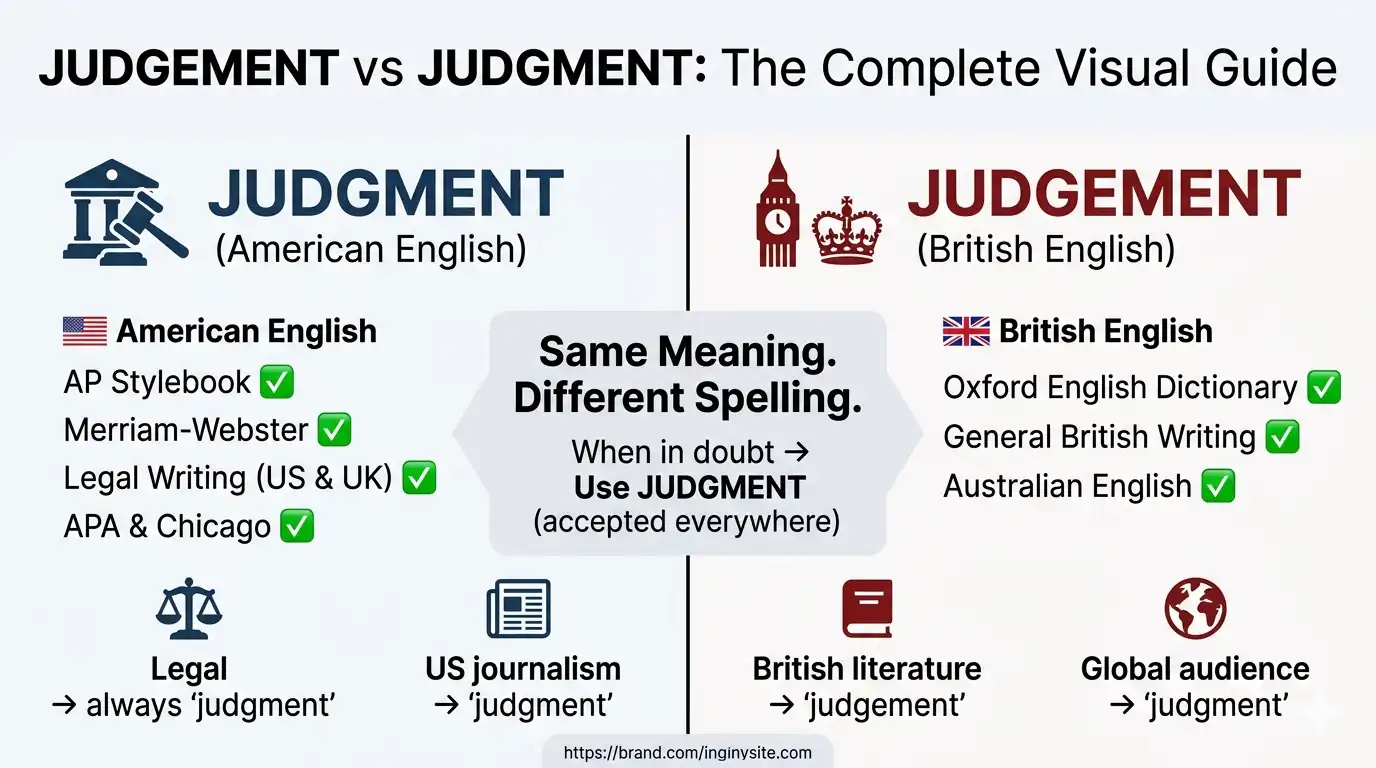
- Judgment (no “e”) = Standard American English spelling
- Judgement (with “e”) = Standard British English spelling
Neither is wrong in everyday usage. But context, style guides, and geography determine which one you should use.
Judgement vs Judgment: American English vs British English
This is where the clearest rule exists.
In American English, “judgment” (without the middle “e”) is the only accepted standard spelling. Every major American reference — Merriam-Webster, AP Stylebook, The American Heritage Dictionary, Chicago Manual of Style, and APA — recommends “judgment.” If you’re writing for a US audience, a US publication, or US legal documents, always drop the “e.”
In British English, “judgement” (with the “e”) is the standard spelling in everyday and formal writing. Publications like The Guardian and BBC News use “judgement” regularly. However — and this is critical — even in the UK, legal documents use “judgment” without the “e.” British courts and lawyers follow the same no-“e” rule as their American counterparts.
| Context | Correct Spelling |
| American English (general writing) | judgment |
| American English (legal) | judgment |
| British English (general writing) | judgement |
| British English (legal) | judgment |
| Academic writing (APA/Chicago style) | judgment |
| Oxford English Dictionary preference | judgement |
Quick rule: If you’re unsure, use “judgment.” It’s accepted everywhere — in the US, UK, legal contexts, academic writing, and international publishing.
Which Spelling Do Style Guides Recommend?
Style guides are the final authority for professional writers, editors, and content creators. Here’s where each one stands:
Merriam-Webster Dictionary
Merriam-Webster lists “judgment” as the primary spelling and “judgement” as a variant. For American English writers, this makes “judgment” the clear default.
Oxford English Dictionary (OED)
The OED actually lists “judgement” as the preferred spelling — a fact that surprises many people. However, this preference reflects historical British usage, and modern British publications increasingly accept both forms.
AP Stylebook
The AP Stylebook, used by journalists and content writers globally, recommends “judgment” with no exceptions.
APA and Chicago Manual of Style
Both APA and Chicago follow American English conventions and recommend “judgment.”
Bryan Garner’s Modern American Usage
Garner explicitly states that “judgment” is preferable in American English and should be used consistently in legal and formal writing.
The History Behind the Two Spellings
You might be wondering: how did two spellings of the same word come to exist in the first place?
“Judgement” is actually the older spelling. Samuel Johnson used it in his 1755 English dictionary. For centuries, both spellings coexisted in print. The shift toward “judgment” in American English gained momentum when Noah Webster — the man behind the original American dictionary — popularized simplified spellings in North America. Webster didn’t invent “judgment,” but he helped standardize it as the preferred American form.
Over time, the spelling diverged across the Atlantic. American English standardized around “judgment,” while British English retained “judgement” — though not exclusively, especially in legal writing.
Judgement vs Judgment in Legal Contexts
This is the one area where the rule is crystal clear, regardless of geography: legal writing always uses “judgment.”
In the United States, using “judgement” in a court filing, legal brief, or official document is considered an error — one that can signal inexperience to judges and opposing counsel. American courts, statutes, and legal databases consistently use the no-“e” spelling.
In the UK, the same applies in formal court settings. Despite British English’s general preference for “judgement,” the country’s judiciary uses “judgment” in official rulings, court orders, and legal documents.
Examples in legal sentences:
- The court entered a judgment in favor of the plaintiff.
- The judgment creditor may now proceed to enforcement.
- Summary judgment was granted after the hearing.
How to Use Judgment (and Judgement) in a Sentence
Both words can be used in multiple ways:
1. As the ability to make good decisions:
She has excellent judgment when it comes to hiring. His judgement in difficult situations has always been sound.
2. As a formal decision or ruling:
The Supreme Court’s judgment was unanimous. The tribunal passed its judgment on the matter.
3. In idiomatic expressions:
He acted against his better judgment. Don’t pass judgment without knowing all the facts. She reserved judgment until all the evidence was presented.
Note that common phrases like “pass judgment,” “reserve judgment,” and “against my better judgment” work with both spellings — but “judgment” is the safer, more universal choice.
Common Mistakes and How to Avoid Them
Mistake 1: Mixing spellings within the same document Switching between “judgment” and “judgement” in a single piece of writing looks inconsistent and unprofessional. Pick one and stick with it throughout.
Mistake 2: Using “judgement” in American legal writing In US court documents, contracts, or legal correspondence, “judgement” is simply wrong. Always use “judgment.”
Mistake 3: Assuming “judgement” is always British “Judgement” is the British preference in general writing, not an absolute rule. British legal writing uses “judgment.”
Mistake 4: Thinking one spelling changes the meaning The spelling does not change the meaning of the word in any context. This is purely a regional and stylistic distinction.
GEO Context: Which Spelling Should You Use Based on Your Audience?
If you’re writing for a specific geographic audience, here’s how to choose:
- United States audience → judgment (always)
- United Kingdom audience → judgement (general writing) / judgment (legal)
- Australian English → judgement (follows British conventions)
- Canadian English → judgment (follows American more closely in formal writing)
- International / global audience → judgment (safest choice, universally accepted)
For SEO content writers targeting the US market, “judgment” is the correct keyword form and the spelling that will align with dominant search intent and American English content standards.
Frequently Asked Questions (FAQ)
Q1: Is “judgement” a spelling mistake? No. “Judgement” is a valid alternate spelling, widely accepted in British English. However, in American English and in legal writing globally, “judgment” (without the “e”) is the correct and preferred form.
Q2: Which spelling does Google prefer? Google understands both spellings as the same concept. However, your target audience’s regional preference matters. If you’re writing for a US audience, use “judgment.” For a UK audience, “judgement” is fine in general content.
Q3: Can I use “judgement” in academic papers? If you’re following APA, Chicago, or MLA style — all of which follow American English conventions — use “judgment.” If your institution follows Oxford style or British English, “judgement” is acceptable.
Q4: What’s the plural form? Both “judgments” and “judgements” are correct — same regional rule applies. American English: judgments. British English: judgements.
Q5: Which form does Merriam-Webster list first? Merriam-Webster lists “judgment” as the primary entry and “judgement” as a variant spelling.
Quick Summary: Judgement vs Judgment
| Feature | Judgment | Judgement |
| Regional use | American English | British English |
| Legal writing | ✅ Both US & UK | ❌ Avoid in legal contexts |
| Style guides (APA, AP, Chicago) | ✅ Preferred | ❌ Not recommended |
| Oxford English Dictionary | Variant | ✅ Preferred |
| Safe for global use | ✅ Yes | ⚠️ Mostly UK/Australian |
The verdict? Use “judgment” unless you have a specific reason to use the British spelling. It’s universally safe, professionally preferred, and the standard in nearly every formal writing context.
Have a question about another commonly confused word pair? Explore more spelling guides on our site.

Ibrahim Jhon is an English language editor with over ten years of experience working with writers, publishers, and international businesses. He specialises in word choice, grammar accuracy, and the differences between British and American English.