
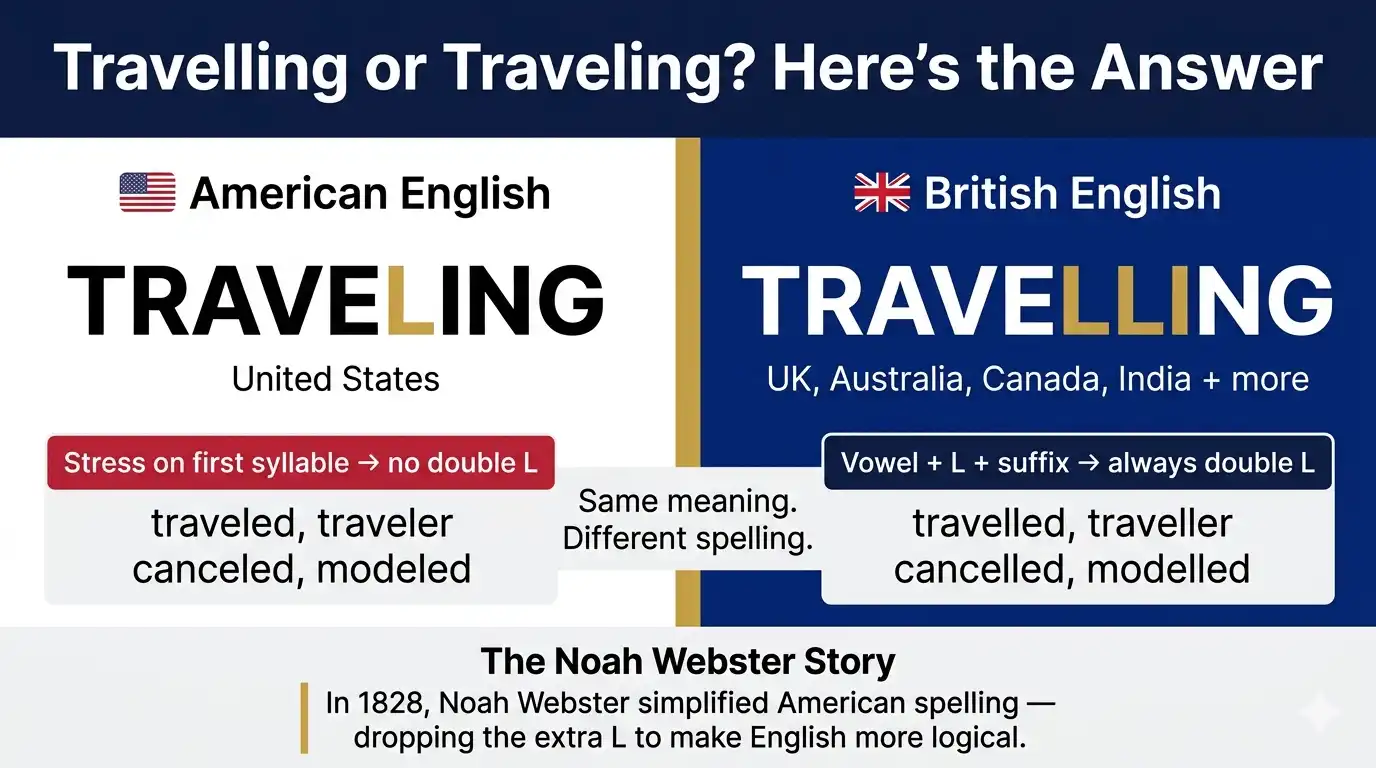
If you have ever typed “travelling or traveling” into Google, you are not alone. This is one of the most searched spelling questions in the English language — and the good news is, both spellings are correct. The one you should use depends entirely on where you are writing for.
Let’s settle this once and for all.
Quick Answer: Travelling or Traveling?
| Spelling | Used In |
| Traveling (one L) | American English (USA) |
| Travelling (two Ls) | British English (UK, Australia, Canada, India) |
Neither spelling is wrong. Neither is old-fashioned. They mean exactly the same thing. The only difference is geography.
Why Does the Spelling Differ? The Real Reason
The story behind “travelling vs traveling” goes back to the early 1800s — specifically to one man: Noah Webster.
Webster was an American lexicographer who believed English spelling should be simpler and more logical. He published Webster’s Dictionary in 1828, which proposed dropping what he saw as unnecessary letters from many words. His goal was not just grammar — it was cultural. He wanted American English to have its own identity, separate from British influence.
Under Webster’s reforms, “travelling” became “traveling.” “Cancelled” became “canceled.” “Labelling” became “labeling.” The pattern was consistent: if a suffix like -ing or -ed was added to a word, American English would not double the final consonant unless the stress fell on the last syllable.
Meanwhile, the United Kingdom kept the older spelling. British English preserved the double-L as part of its traditional rules — and that is why the two versions still exist today.
The Grammar Rule Behind the Spelling
To truly understand “travelling or traveling,” you need to understand the consonant doubling rule.
American English Rule (One L)
In American English, you double the final consonant before adding a suffix only when:
- The word ends in a single vowel + single consonant, AND
- The stress falls on the last syllable
The word “travel” is stressed on the first syllable: TRAV-el.
Because the stress is not on the final syllable, American English does NOT double the L. Result: traveling.
Compare this with the word “control” (con-TROL) — stress is on the last syllable, so Americans correctly write “controlling.”
British English Rule (Two Ls)
British English applies the doubling rule more broadly. When a verb ends in a vowel + L, the L is doubled whenever any vowel suffix (-ing, -ed, -er) is added — regardless of which syllable carries the stress.
So “travel” → travelling, “cancel” → cancelling, “label” → labelling.
This is why British English consistently uses the double L across all similar words.
Which Countries Use Which Spelling?
This is where many people get confused. Here is a clear breakdown:
Traveling (one L) — American English:
- United States
Travelling (two Ls) — British English:
- United Kingdom
- Australia
- New Zealand
- India
- Pakistan
- South Africa
- Most of Africa and Asia
Canada is an interesting case. Although geographically close to the US, Canada follows British English conventions and uses travelling with two Ls.
If you are writing for an international or global audience without a specific regional focus, “travelling” (British spelling) is actually more widely used worldwide, since British English is the standard in most Commonwealth countries.
Travelling or Traveling: Related Word Forms
The same rule applies to all related forms of the word “travel”:
| American English | British English |
| Traveling | Travelling |
| Traveled | Travelled |
| Traveler | Traveller |
| Traveled roads | Travelled roads |
The double-L pattern in British English is completely consistent across all these forms. If you pick one spelling style, all related words should follow the same rule.
Does It Matter for SEO and Online Writing?
If you are a blogger, content writer, or website owner, this question matters more than you might think.
Search engines are smart — Google understands that “traveling” and “travelling” mean the same thing and treats them as equivalent for most searches. However, audience targeting still matters:
- Writing for a US audience? Use “traveling” for a more natural, locally resonant tone.
- Writing for a UK, Australian, or Indian audience? Use “travelling.”
- Writing for a mixed global audience? Pick one, state it clearly, and stay consistent throughout.
Switching between both spellings in the same article is the one mistake to avoid. Inconsistency signals carelessness to both readers and editors.
Common Questions About Travelling vs Traveling
Is “travelling” wrong in America?
Not technically wrong, but it looks unusual to American readers. In a US-focused publication, “travelling” may stand out as a typo or foreign spelling. Stick to “traveling” for American audiences.
Is “traveling” wrong in the UK?
Similarly, “traveling” with one L will look like an error to British readers and editors. UK publications — from The Guardian to the BBC — consistently use “travelling.”
Which spelling does Google prefer?
Google does not prefer one over the other for ranking purposes. Both spellings appear in Google’s search results for the same query. However, for your specific audience, using their expected spelling helps with user trust and readability signals.
What about “travelled” vs “traveled”?
The same rule applies. In American English, the past tense is traveled (one L). In British English, it is travelled (two Ls).
Do spell-checkers accept both?
Yes. Microsoft Word, Google Docs, and Grammarly all accept both spellings — but only if your language settings match. Set your spell-checker to “English (US)” for American English or “English (UK)” for British English to get consistent suggestions.
Other Words That Follow the Same Pattern
“Travelling vs traveling” is not unique. Many other English words follow this exact same American vs British spelling pattern:
| American English | British English |
| Canceled | Cancelled |
| Labeled | Labelled |
| Modeling | Modelling |
| Fueling | Fuelling |
| Signaling | Signalling |
| Counselor | Counsellor |
All of these follow the same Noah Webster-inspired logic: American English drops the extra consonant, British English keeps it.
How to Remember the Difference
Here is a simple memory trick:
One L for the Land of the Free (USA), Two Ls for the rest of the world.
Or think of it this way: Americans like to travel light — even in spelling.
Final Verdict
Both “travelling” and “traveling” are correct English spellings. The choice between them is not about grammar rules — it is about your audience.
- Writing for Americans? → Traveling
- Writing for everyone else? → Travelling
- Most important rule? → Stay consistent. Pick one spelling and use it throughout your entire document, article, or website.
Understanding this distinction makes you a more precise, professional writer — whether you are drafting a blog post, a visa application, or a travel guide.

Ibrahim Jhon is an English language editor with over ten years of experience working with writers, publishers, and international businesses. He specialises in word choice, grammar accuracy, and the differences between British and American English.