
You typed a caption, finished a blog post, or drafted an email — and then you stopped. Is it glamour or glamor?
Both spellings look right. Both feel natural. But which one actually is?
Here is the short answer: both are correct, but they are used in different regions and writing contexts. In this guide, you will learn exactly which one to use, when to use it, and why this small spelling difference matters more than you think.
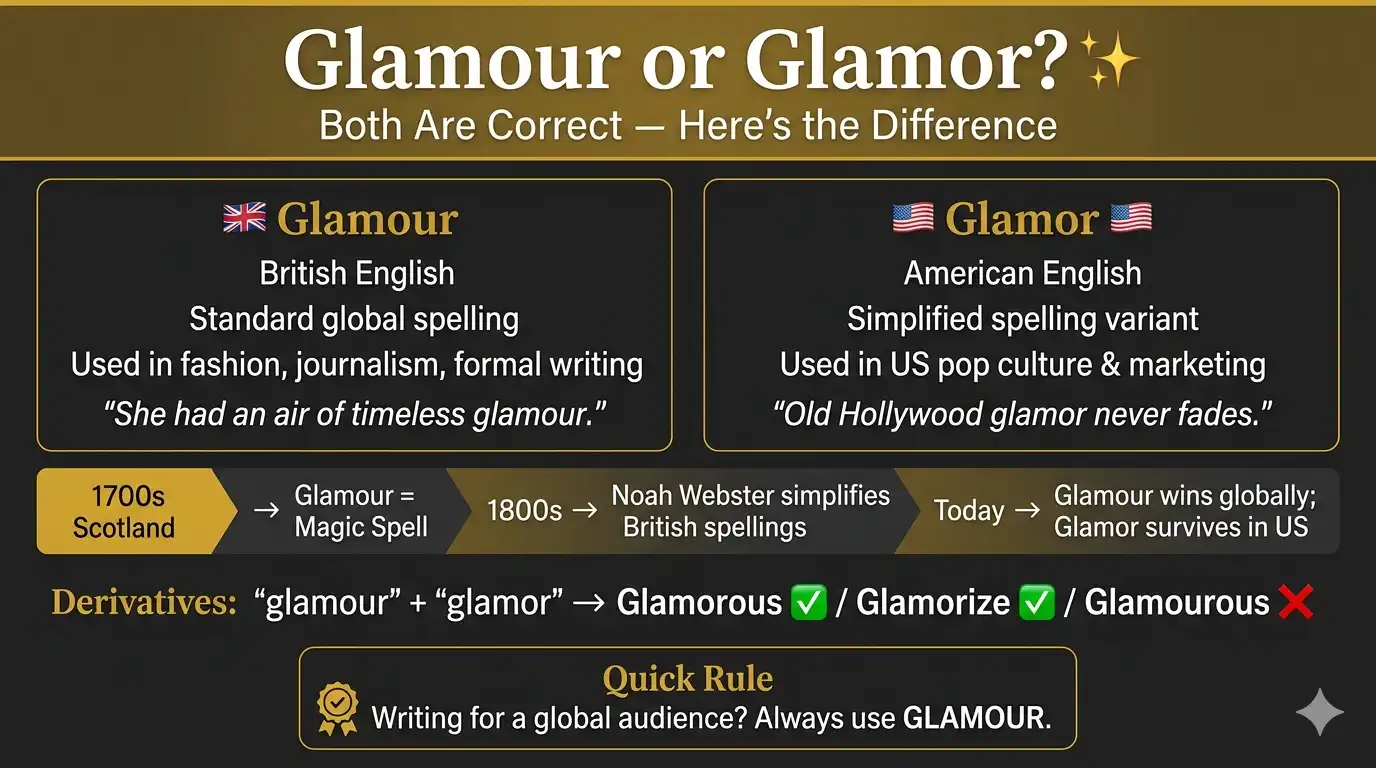
Glamour or Glamor — What Is the Quick Difference?
| Feature | Glamour | Glamor |
| Region | British English (UK, AU, Canada) | American English (US) |
| Frequency | Far more common globally | Less common overall |
| Usage in media | Fashion magazines, formal writing | Marketing, pop culture, US blogs |
| Correct? | Yes | Yes |
The core meaning of both words is identical: beauty, charm, allure, and a magnetic sense of elegance.
The only difference is spelling — shaped by geography and the history of the English language.
Why Do Two Spellings Exist for the Same Word?
This is the part most articles skip — but it is the answer your reader actually wants.
After the American Revolutionary War, Noah Webster set out to create a distinctly American form of English. He published An American Dictionary of the English Language in 1828, simplifying many British spellings. Words that ended in -our in British English were often shortened to -or in American English.
That is why you have:
- colour → color
- honour → honor
- labour → labor
- favour → favor
Naturally, you might expect glamour → glamor to follow the same rule — and in American English, it does. However, glamour is a special case. Even in American publications, glamour is about five times more common than glamor, and is considered the standard spelling even in the United States.
So while glamor is technically correct in American English, the word glamour never fully gave up its u — even on American soil.
How to Use Glamour Correctly in a Sentence
Glamour is a noun. It describes a quality — the irresistible charm or luxurious appeal of a person, place, or thing.
Example sentences using glamour:
- The old Hollywood era was defined by its timeless glamour.
- She walked into the room and brought an undeniable sense of glamour with her.
- Las Vegas is a city built entirely on glamour and spectacle.
- The fashion week in Milan overflowed with international glamour.
Common mistake to avoid: Do not use glamour as a verb. You cannot say “she glamoured the audience.” Instead, use it as a noun or use its adjective form — glamorous.
How to Use Glamor Correctly in a Sentence
Glamor follows the same rules — it is still a noun. The only difference is the spelling, not the grammar.
Example sentences using glamor:
- The film captured the old-world glamor of 1940s New York.
- He was drawn to the glamor of professional sports.
- Her personal brand is built around everyday glamor, not celebrity excess.
When glamor makes sense: If you are writing exclusively for a US audience, especially in informal content, social media captions, or pop culture writing, glamor fits naturally.
Glamorous, Glamorize — How Derivatives Are Spelled
Here is something that confuses even native speakers: when forming derivatives such as glamorous and glamorize, the u is dropped regardless of whether you are using the British or American spelling.
That means:
- glamour → glamorous ✅ (not glamourous)
- glamour → glamorize ✅ (not glamourize)
- glamor → glamorous ✅
- glamor → glamorize ✅
Both spellings lead to the same derivatives. This is one of the few cases in English where both regional variants converge at the word-building stage.
Which Spelling Should You Use — Glamour or Glamor?
This is the practical question. Here is how to decide:
Use Glamour if:
- You are writing for a global or UK-based audience
- You are creating formal content, journalism, or editorial pieces
- You are writing for fashion, beauty, or lifestyle brands
- You want to match the standard used by major style guides (AP, Chicago)
- You are unsure which audience will read your content
Use Glamor if:
- You are writing specifically for an American audience
- You are writing casual blog content, social media posts, or marketing copy
- You are following a US-specific style guide that prefers simplified spellings
- Your brand identity leans into American pop culture aesthetics
The safest choice for most writers: Use glamour as the main keyword and standard spelling. It is the form most widely recognized across all English-speaking regions and feels more formal and stylish, which is why it is often used in branding and media.
The Origin of the Word Glamour — A Fascinating History
The story behind glamour is one of the more surprising in the English language.
The word glamour traces back to early 18th-century Scotland, where it originally meant “enchantment” or “magic spell.” It was introduced into English literature by novelist Sir Walter Scott. The word itself is a Scottish variant of grammar, used generally to mean “learning” or “occult learning,” because at the time, a student’s schooling did include astrology and magic.
Acoustically, L and R are very similar sounds, and this similarity resulted in grammar morphing into an entirely new word: glamour. Today, glamour no longer means magic, but the sense of something almost spellbinding metaphorically lives on — think of the “glitz and glamour” of Las Vegas or New York City.
This etymology also explains related words like charm (from Latin carmen, meaning spell), enchanting, and captivating — all rooted in the language of magic. Glamour is genuinely one of the most beautifully layered words in the English language.
Common Mistakes People Make With Glamour and Glamor
Mistake 1: Spelling the adjective as “glamourous” Incorrect: The event was glamourous. Correct: The event was glamorous.
Mistake 2: Using glamour as a verb Incorrect: She glamoured the crowd. Correct: She added glamour to the event. / She captivated the crowd.
Mistake 3: Assuming glamor is wrong Glamor is mostly used in the US, particularly in marketing, entertainment, and pop culture. It is not incorrect — just regional.
Mistake 4: Mixing spellings in one document Choose one spelling and stay consistent throughout your writing. Switching between glamour and glamor in the same piece looks like a proofreading error, even if both are technically valid.
Quick Reference — Glamour vs Glamor at a Glance
- Same meaning? Yes — beauty, allure, charm, elegance
- Both correct? Yes — depends on regional preference
- More common globally? Glamour
- Used in the US? Both, but glamour dominates even in America
- Adjective form? Glamorous (same for both)
- Verb form? Glamorize (same for both)
- Best choice for global writing? Glamour
Frequently Asked Questions
Is glamor or glamour correct? Both are correct. Glamour is the standard spelling worldwide and is preferred in British English, global media, and formal writing. Glamor is the American English variant but is used less frequently than glamour, even in the United States.
Which spelling do most dictionaries use? Most major dictionaries — including Merriam-Webster, Oxford, and Cambridge — list glamour as the primary spelling. Glamor is listed as an accepted American English variant.
Is glamourous a word? No. The correct adjective form is glamorous — without the extra u. This applies whether you spell the base word as glamour or glamor.
Why does glamour keep its U even in American English? Unlike other -our words (colour, honour, favour), glamour resisted full Americanization. It entered the American lexicon through fashion and entertainment industries where the British spelling was already established, and it stuck.
What is the plural of glamour? Glamour is typically used as an uncountable noun and does not have a standard plural form. You would not say “glamours.” Instead, you would say “different types of glamour” or “many forms of glamour.”
Final Answer — Glamour or Glamor?
Both spellings are correct. But if you want to play it safe, write it with the u: glamour.
It is the spelling recognized globally, preferred by major style guides, and used overwhelmingly in professional media — from Vogue to The New York Times. The extra letter is worth keeping.
If you are writing specifically for an American lifestyle or pop culture audience and prefer simplified spellings, glamor works just fine.
The most important rule: pick one and stay consistent.
Was this guide helpful? You might also enjoy our articles on honour vs honor, colour vs color, and favour vs favor — more commonly confused British vs. American spelling pairs.

Ibrahim Jhon is an English language editor with over ten years of experience working with writers, publishers, and international businesses. He specialises in word choice, grammar accuracy, and the differences between British and American English.