
You’re writing an important email. You type: “I spent the weekend pouring over the report.”
Looks fine, right?
Wrong. You just poured liquid all over your report — at least grammatically speaking.
This exact mistake appears in published books, professional emails, and even newspaper articles written by native English speakers. Pore and pour are two of the most commonly confused words in the English language — and the confusion runs deeper than most people realize.
In this guide, you’ll learn exactly what each word means, why writers keep mixing them up, and how to remember the difference forever. We’ll also cover their sneaky cousin — poor — so you never make this mistake again.
What Are Homophones and Why Do Pore, Pour, and Poor Confuse Everyone?
Before diving in, let’s address the root of the problem.
Pore, pour, and poor are homophones — words that sound identical when spoken but have completely different spellings and meanings. All three are pronounced /pɔːr/ in standard American and British English.
This is why spellcheck won’t save you. Every one of these words is spelled correctly in isolation. The mistake only becomes visible when a human reader processes the meaning — not just the letters.
The confusion is especially common in:
- Academic writing
- Professional emails
- Creative writing
- ESL (English as a Second Language) learners
- Even native speakers writing quickly
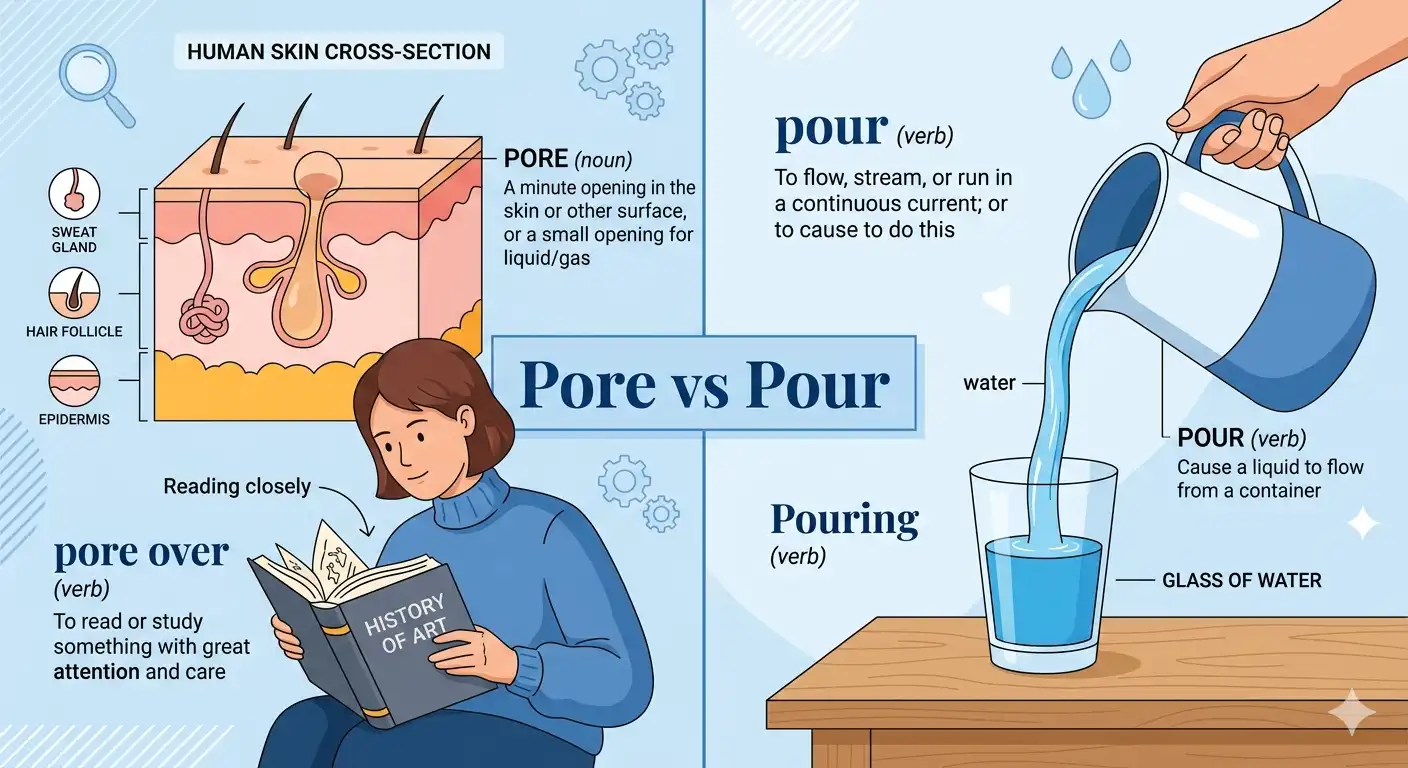
Pore vs Pour: The Core Difference
Here is the clearest, most direct answer:
Pore = a tiny opening (noun) OR to study something closely (verb) Pour = to cause liquid to flow (verb) OR to express something freely (verb)
Simple on the surface. But let’s go much deeper — because this is where most articles stop, and where most confusion still lives.
What Does “Pore” Mean? (Both Uses Explained)
Pore as a Noun — Tiny Openings in Surfaces
As a noun, a pore is a microscopically small opening or hole in a surface — most commonly the skin, but also found in plants, rocks, soil, and manufactured materials.
Examples in sentences:
- Sweat exits the body through thousands of tiny pores in the skin.
- The sandstone’s pores allow it to absorb and store water underground.
- After exercise, your pores open up as your body temperature rises.
- A surgical mask works because its pores are too small for certain particles to pass through.
You’ll often hear this word in skincare — “minimizing pores,” “clogged pores,” “open pores.” In geology, the word porosity (derived from pore) describes how much empty space exists within a rock or soil structure.
Pore as a Verb — To Study Intensely
This is where 99% of confusion happens.
As a verb, to pore means to read, examine, or study something with deep focus and careful attention. It almost always appears with the word over or occasionally through.
Examples in sentences:
- She pored over every line of the contract before signing.
- Detectives pored over the crime scene photographs for hours.
- He pored through medical journals trying to find an answer.
- The students pored over their notes the night before finals.
Why does this confuse people?
Most people know pore as a noun — those little holes on your face. Using it as a verb feels unnatural, almost wrong. So the brain automatically reaches for pour, which is a more familiar, active verb. The visual of someone “pouring” their attention over something even makes logical sense — which is exactly why the mistake keeps happening.
What Does “Pour” Mean? (All Uses Covered)
Pour as a Verb — Flowing Liquid
Pour is almost always a verb. Its primary meaning is to cause a liquid — or sometimes granular material — to flow steadily from one place to another.
Examples in sentences:
- Pour the batter evenly into the cake tin.
- She poured herself a glass of cold water after the run.
- He carefully poured the chemicals into the beaker.
- Rain was pouring down in heavy sheets all morning.
Pour — Figurative and Extended Uses
Pour also works beyond literal liquids. It expresses the idea of something flowing freely in large quantities — whether that’s people, emotions, money, or effort.
Examples:
- Donations began pouring in after the charity appeal aired.
- She poured her heart into every lyric she wrote.
- Thousands of fans poured into the stadium before kickoff.
- The government has been pouring money into infrastructure.
Notice the pattern: whenever something moves or flows continuously in large quantities — literal or figurative — pour is your word.
A Special Case: Pour-Over Coffee
You may have seen pour-over as a coffee brewing method. This is entirely correct — it literally involves pouring hot water over coffee grounds. This is not the same as “poring over” something. The hyphenated pour-over is a culinary term, not a grammar trap.
Pore Over vs Pour Over — The Most Common Mistake in Writing
This single phrase is responsible for the majority of pore/pour confusion in published writing.
| Phrase | Correct? | Meaning |
| Pore over a document | ✅ Yes | To study it carefully and attentively |
| Pour over a document | ❌ No (in most contexts) | To spill liquid over it |
| Pour over coffee | ✅ Yes | A specific brewing method |
| Poured over the evidence | ❌ Incorrect usage | Should be pored over |
The Merriam-Webster ruling: Pore over is the grammatically correct phrase when describing focused study or reading. Pour over is only correct when actual liquid is flowing over something.
Real-world example of the mistake:
- ❌ The lawyer poured over the case files all weekend.
- ✅ The lawyer pored over the case files all weekend.
What Does “Poor” Mean? (The Third Homophone)
Since poor sounds identical to both pore and pour, it deserves its own space here.
Poor is an adjective only — it is never a verb. It has two main meanings:
- Lacking money or financial resources
- The family was too poor to afford heating that winter.
- Low quality, inadequate, or below standard
- That was a poor decision made under pressure.
- The team gave a poor performance in the second half.
Common mistakes involving poor:
- ❌ Poor me a cup of tea → ✅ Pour me a cup of tea
- ❌ She came from a pour background → ✅ She came from a poor background
- ❌ He has poor skin with large poors → ✅ He has oily skin with large pores
Pore vs Pour vs Poor — Full Comparison Table
| Feature | Pore | Pour | Poor |
| Part of speech | Noun / Verb | Verb | Adjective only |
| Primary meaning | Tiny opening; to study closely | To flow liquid; to express freely | Lacking money; low quality |
| Used with “over”? | Yes — pore over (study) | Yes — pour over (liquid flows) | Never |
| Skincare context | ✅ Yes (clogged pores) | ❌ No | ❌ No |
| Cooking context | ❌ No | ✅ Yes (pour-over coffee) | ❌ No |
| Academic writing | ✅ Yes (pored over research) | Rarely | ❌ No |
| Describes poverty? | ❌ No | ❌ No | ✅ Yes |
| Pronunciation | /pɔːr/ | /pɔːr/ | /pɔːr/ |
Memory Tricks to Never Confuse These Words Again
Most articles skip this part. These tricks will stick with you permanently.
For Pore (noun):
The O in pore looks like a tiny hole. A pore IS a tiny hole. Picture it.
For Pore (verb — “pore over”):
Pore = Paying close attention. Both start with P-O. When you pore over something, you’re giving it your total focus.
For Pour:
The U in pour is shaped like a cup or a jug. You pour liquid FROM a jug. The U reminds you of the container.
For Poor:
Poor has two O’s — like two empty pockets. Double O = nothing inside = lacking money.
The Single Best Trick:
Ask yourself: Is liquid involved?
- Yes → use pour
- No, it’s about studying or a skin opening → use pore
- No, it’s about quality or money → use poor
Real-Life Writing Scenarios — Which Word Is Correct?
Test yourself with these before reading the answers:
1. She spent hours _____ over her grandfather’s old letters. 2. Could you _____ me some orange juice, please? 3. The researcher _____ through thousands of data points. 4. Sweat was coming through every _____ of his skin. 5. It started to _____ with rain just as the match began. 6. The family lived in _____ conditions after the factory closed. 7. This skincare toner is designed to minimize enlarged _____s.
Answers:
- Poring (studying intently)
- Pour (liquid flowing)
- Pored (examined carefully)
- Pore (tiny skin opening)
- Pour (heavy rain)
- Poor (lacking resources)
- Pore (skin openings)
Pore and Pour in British vs American English
Both pore and pour are used identically across British English, American English, and Australian English. The spelling, meaning, and pronunciation do not change by region.
However, poor has a slight pronunciation variation:
- American English: poor rhymes with tour — /pʊər/
- British English (RP): poor sometimes rhymes with more — /pɔː/
In British English, this means poor and pour sound slightly different in careful speech, which reduces confusion. In American English, all three are often pronounced identically — which is why the mistake is especially common among American writers.
Why This Mistake Appears Even in Professional Writing
You might think only beginners make this error. You’d be wrong.
The pore/pour confusion has appeared in:
- Published novels by experienced authors
- Major newspaper articles (before editorial correction)
- University academic papers
- Marketing copy by professional agencies
- Legal documents (before proofreading)
The reason is simple: the mistake feels natural. “Pouring over” something evokes a powerful mental image — your attention washing over the page like water. The brain accepts it. Only grammatical awareness catches it.
This is precisely why human proofreading still matters in an age of AI writing tools. Spellcheck passes all three words every single time.
Quick-Reference Guide — When to Use Each Word
Use PORE when:
- Referring to tiny openings in skin, rocks, plants, or membranes
- Describing studying, reading, or examining something with deep focus
- Using the phrase pore over or poring through
Use POUR when:
- Liquid, powder, or granular material is flowing
- Describing something moving in large quantities (people, donations, rain)
- Describing expressing emotions freely (pour your heart out)
- Referring to pour-over coffee
POOR when:
- Describing someone or something lacking money
- Describing low quality, performance, or condition
- The word could be replaced with “inadequate” or “unfortunate”
FAQ: Pore vs Pour
Q: Is it “pore over” or “pour over” when studying? Always pore over. “Pour over” only applies when liquid is literally flowing over something. When you’re reading or studying intensely, the correct phrase is pore over.
Q: Can “pour” ever be a noun? Rarely in standard English. Pour is used as an informal noun in phrases like “a steady pour of rain,” but this is uncommon. In everyday writing, treat pour as a verb only.
Q: Why do people write “pour over” instead of “pore over”? Because most people know pore as a noun (skin pores) and rarely use it as a verb. The brain defaults to pour — a familiar, active verb — especially since figuratively “pouring” your attention over something feels visually logical.
Q: What is the past tense of “pore over”? The past tense is pored over. Example: She pored over the documents all evening.
Q: Do pore and pour have the same etymological root? Interestingly, yes — Merriam-Webster notes that pore (verb) and pour actually share historical roots, which adds another layer to why they’ve been confused for centuries. This is not a modern mistake. It’s been happening since Middle English.
Q: Is “pour over coffee” spelled correctly? Yes, pour-over coffee (often hyphenated) is a recognized culinary term. It refers to a brewing method where hot water is poured over coffee grounds. This is a completely separate and correct usage.
Q: How do I remember which is which? The simplest trick: If liquid is involved, use POUR. If studying is involved, use PORE. If money or quality is involved, use POOR.
Conclusion: One Letter, One Big Difference
Here’s the truth — pore, pour, and poor are three completely different words that just happen to share the same sound. One wrong choice doesn’t just look unprofessional; it changes the entire meaning of your sentence.
The good news? Now you know the difference cold.
The three rules to remember:
- PORE = tiny hole, or studying deeply (pore over)
- POUR = liquid flowing, or something expressed freely
- POOR = lacking money or quality
Whether you’re writing a professional report, crafting a creative story, or simply texting a friend — these distinctions matter. They’re the difference between a writer who knows their craft and one who sounds uncertain.
Exploring English word pairs that confuse even native speakers? Browse more comparisons at WordCorrelation.com — clear, expert explanations for every confusing word in the language.

Ibrahim Jhon is an English language editor with over ten years of experience working with writers, publishers, and international businesses. He specialises in word choice, grammar accuracy, and the differences between British and American English.