
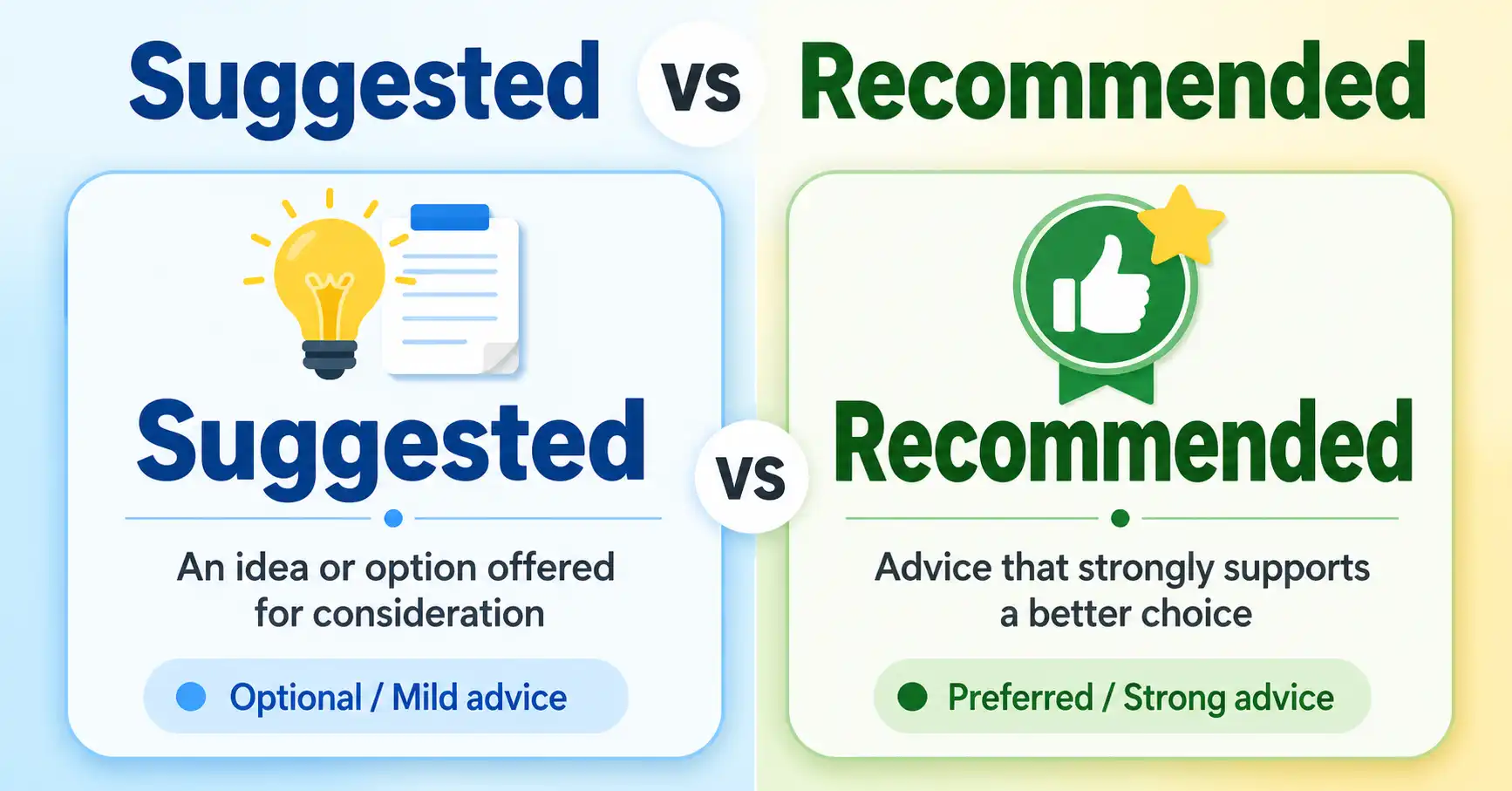
When it comes to making decisions, we often hear the terms “suggested” and “recommended” used interchangeably. But are they really the same? In this article, we’ll explore the subtle yet important distinctions between these two words. By the end, you’ll be able to use them correctly in your writing and daily conversations, ensuring you’re always communicating clearly. Let’s dive into the confusion that often arises between “suggested” and “recommended,” and clarify when each word is most appropriate.
Suggested vs Recommended – Quick Answer
The key difference between “suggested” and “recommended” lies in the level of authority and certainty. Suggested implies a more casual or optional idea, whereas recommended carries a stronger sense of endorsement or advice. Both can be used to guide others, but “recommended” often implies a more authoritative or professional opinion.
Meaning of Suggested
Suggested is a verb used when you offer an idea or a course of action without pushing someone to follow it. It’s more like a gentle nudge toward a possibility, often based on personal experience, opinion, or a casual observation.
Examples:
- “I suggested going to the beach for the weekend.”
- “She suggested trying the new restaurant in town.”
Decision Rule: Use “suggested” when you are offering something casually, without strong conviction.
Meaning of Recommended
Recommended, on the other hand, is a stronger term, often used when you’re advising someone with a bit more authority or expertise. This word implies that the action or choice is the best or most suitable one, according to the speaker’s knowledge.
Examples:
- “The doctor recommended taking this medicine twice a day.”
- “He recommended visiting the museum for the best cultural experience.”
Decision Rule: Use “recommended” when you are providing a more authoritative or expert suggestion, implying it’s the best option.
The Origin of Suggested vs Recommended
Understanding the origins of both terms helps explain why they have different levels of authority and use.
- Suggested comes from the Latin word suggerere, meaning “to bring to mind” or “to offer.” It has evolved over time to indicate a light, non-pressuring proposition.
- Recommended comes from the Latin recommendare, meaning “to entrust” or “to speak favorably of.” It has a stronger connotation of trust and advice.
Reason for Confusion Today
Many English learners or even native speakers confuse “suggested” and “recommended” because they both seem to indicate some form of advice. The confusion happens because these words both express the idea of offering an option, but “recommended” carries more weight and urgency than “suggested.”
For example:
- “He suggested reading this book” sounds casual and optional.
- “He recommended reading this book” sounds like it’s the best choice and carries more weight.
British vs American English Spelling
In both British and American English, the spelling of “suggested” and “recommended” remains the same. There’s no difference in spelling between the two versions of English. However, the usage of the terms can vary slightly based on context and the strength of the advice being given.
How to Choose the Right Word Fast
US English:
- Use “suggested” when you’re offering an option without strong backing.
- Use “recommended” when you’re providing expert advice or guidance.
UK / Commonwealth:
- The rules are quite similar in the UK. However, “recommended” is often used in more formal contexts like professional advice or medical suggestions.
Global / Professional Writing:
- In professional and formal writing, “recommended” is more common, especially when implying a best course of action or expert advice.
- “Suggested” might be used in more casual, conversational, or collaborative settings.
Common Mistakes with Suggested vs Recommended
❌ Incorrect → ✅ Correct
- “I suggested to him that he should start exercising regularly.” → “I recommended to him that he should start exercising regularly.”
- “She recommended going to the movie” → “She suggested going to the movie.”
These mistakes happen because people confuse the level of authority or certainty implied by each word.
Suggested vs Recommended in Real-Life Examples
Emails:
- Suggested: “I suggested a few dates for our meeting next week.”
- Recommended: “I recommended the conference as the best option for networking.”
News:
- Suggested: “The article suggested some potential solutions to the issue.”
- Recommended: “The article recommended the latest policy as the most effective way to tackle the crisis.”
Social Media:
- Suggested: “I suggested we check out this new show.”
- Recommended: “She recommended following these 10 accounts for business advice.”
Formal or Professional Writing:
- Suggested: “The committee suggested a review of the policies.”
- Recommended: “The research team recommended adjusting the experiment parameters.”
Suggested vs Recommended – Word Usage Patterns and Search Trends
When looking at how people use “suggested” vs “recommended,” you’ll notice that the term “recommended” sees more frequent use in professional settings, especially in healthcare, business, and academic advice. “Suggested” tends to be used in more informal contexts, like casual conversations or emails between friends or colleagues.
Example of Misuse:
- In formal writing, one might incorrectly say, “The professor suggested you submit the paper by Friday.” This sounds too casual and not authoritative enough. The correct word here is “recommended.”
Comparison Table
| Aspect | Suggested | Recommended |
| Meaning | Offering an option casually | Advising the best course of action |
| Part of Speech | Verb | Verb |
| Context of Use | Informal, conversational | Formal, professional, authoritative |
| Formal vs Informal | More informal | More formal and expert-driven |
| Common Mistakes | Used when stronger advice is needed | Used casually when advice is needed |
| Correct Example | “I suggested we go hiking.” | “She recommended hiking for beginners.” |
SEMANTIC FAQs (People Also Ask)
Is “Suggested” the same as “Recommended”?
- No, “suggested” is a gentler, optional offering, while “recommended” implies stronger advice or endorsement.
Which one is correct in formal writing?
- “Recommended” is more appropriate in formal or professional writing, where authority and certainty are needed.
Can they be used interchangeably?
- Generally, no. “Suggested” is softer, while “recommended” has a more authoritative tone.
Why do people confuse them?
- Both words suggest guidance, but “recommended” is often mistakenly used where a lighter suggestion is intended.
Can grammar tools catch this mistake?
- Grammar tools may not always distinguish between the two unless context is carefully considered.
Is there a British vs American difference?
- No significant difference. The usage patterns are similar in both British and American English.
Conclusion
In short, “suggested” and “recommended” may seem like synonyms, but they serve different purposes in language. Suggested is used for casual, optional advice, while recommended implies stronger, more authoritative guidance. To avoid confusion, remember that “recommended” is used when there is more trust or expertise behind the advice.
The one mistake to always avoid: Don’t use “suggested” in a formal context when you mean to give strong advice or endorse something with authority. “Recommended” is your go-to for that!
Finally, use “suggested” when you’re offering something lightly, and “recommended” when you want to sound confident and expert.

Ibrahim Jhon is an English language editor with over ten years of experience working with writers, publishers, and international businesses. He specialises in word choice, grammar accuracy, and the differences between British and American English.