Many learners feel confused when they see uncompleted vs incomplete. Both words look very similar. Both also relate to something not finished. So, people often use them in the wrong way.
This confusion happens in writing, emails, school work, and even exams. For example, a student may write “uncompleted assignment” when “incomplete assignment” is correct. That small mistake can change how natural your English sounds. This word comparison clarifies adjective usage.
Now, this article solves that problem in a simple way. You will learn the real meaning, correct usage, and key differences. You will also see clear examples, common mistakes, and an easy rule to remember.
Uncompleted vs Incomplete – Quick Answer
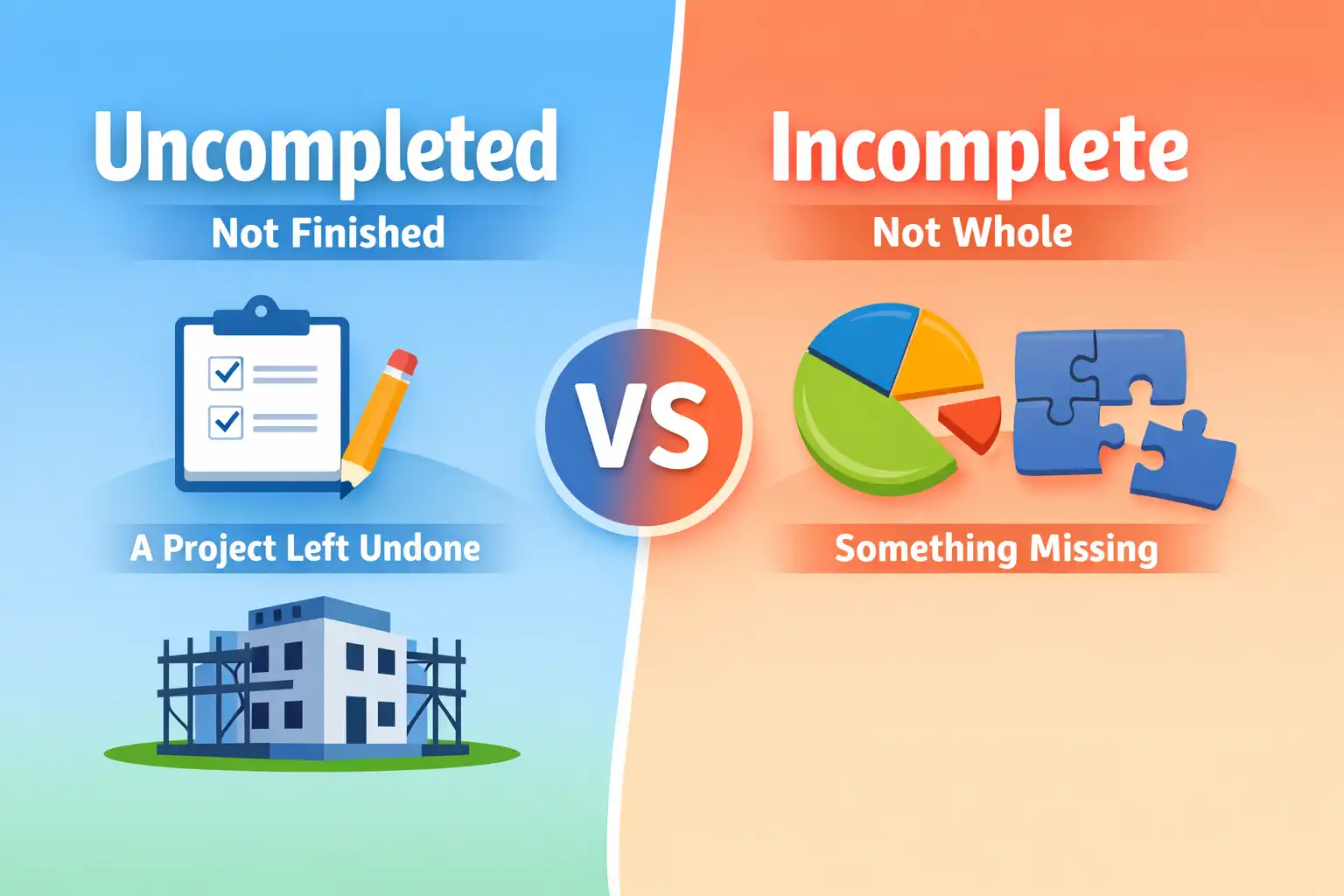
Meaning of Uncompleted
- Something not finished yet
- Focus on the action not done
Examples
- The project is uncompleted.
- He left the task uncompleted.
Meaning of Incomplete
- Something missing parts
- Focus on lack or missing elements
Examples
- The form is incomplete.
- Your answer is incomplete.
Easy Rule:
Use uncompleted for actions not finished.
Use incomplete for things missing parts.
The Origin of Uncompleted vs Incomplete
The words uncompleted and incomplete come from different roots, even though they look alike.
Incomplete comes from Latin. The word completus means “filled or finished.” When we add “in-,” it means “not finished” or “not whole.” This word has been used in English for a long time and is very common.
Uncompleted is formed in English. It comes from “complete” with the prefix “un-.” This form is newer and less common. Writers use it mostly in specific contexts, especially formal or technical writing. Check UK vs US grammar differences here.
So, the confusion today happens because:
- Both words mean “not finished” in some way
- But they focus on different ideas
- One is common, while the other is rare
Writers often confuse them because they think both are equal. But in real usage, incomplete is much more natural.
British vs American English Spelling
There is no major spelling difference between British and American English for these words.
Both forms use:
- Incomplete (same in US and UK)
- Uncompleted (same in US and UK)
So, spelling is not the issue here. The real difference is usage.
Small comparison:
| Word | US English | UK English |
| Incomplete | Common | Common |
| Uncompleted | Rare | Rare |
However, in contrast, usage matters more than spelling. Incomplete appears far more in both regions.
How to Choose the Right Word Fast
Choosing between uncompleted vs incomplete becomes easy with a simple approach.
For US users:
- Use incomplete in almost all cases
- Use uncompleted only when you stress an unfinished action
For UK / Commonwealth users:
- Same rule applies
- Incomplete sounds more natural
Global or professional writing:
- Always prefer incomplete
- It is clear, common, and widely accepted
If you feel unsure, choose incomplete. It fits most situations and avoids confusion.
Common Mistakes with Uncompleted vs Incomplete
Writers often mix these two words. Here are common errors:
❌ The form is uncompleted
✅ The form is incomplete
→ Forms usually lack information, not action
❌ Your homework is uncompleted
✅ Your homework is incomplete
→ Homework is missing parts
These mistakes happen because people focus only on “not finished.” But meaning matters more than appearance.
Uncompleted vs Incomplete in Real Life Examples
Now let’s see how these words work in daily use.
Emails
- The report is incomplete. Please add the missing data.
- He left the task uncompleted due to time limits.
News
- The investigation remains incomplete.
- The project was left uncompleted after funding stopped.
Social Media
- My profile is incomplete. I need to update it.
- I left the challenge uncompleted yesterday.
Professional Writing
- The application is incomplete and cannot be processed.
- The contract remains uncompleted due to delays.
In real life, incomplete appears more often, especially in formal writing.
Uncompleted vs Incomplete – Word Usage Patterns and Search Trends
When people search for uncompleted vs incomplete, they usually want clarity. They feel unsure which word is correct.
General trends show:
- Incomplete is very common
- Uncompleted is rarely used
- Students and ESL learners search this topic often
- Writers and editors also check this difference
A common real-world issue:
A student submits an “uncompleted form.” The teacher may think the student means unfinished work. But the real issue is missing details. So, the correct word should be “incomplete.”
That small mistake can cause confusion. Also see stary or starry.
Comparison Table: Uncompleted vs Incomplete
| Feature | Uncompleted | Incomplete |
| Meaning | Not finished action | Missing parts or not whole |
| Part of Speech | Adjective | Adjective |
| Context of Use | Action-focused | Result or condition |
| Formal vs Informal | Rare, formal | Common in all contexts |
| Common Mistake | Used for missing info | Used correctly in most cases |
| Example | Task left uncompleted | Form is incomplete |
This table makes the difference clear at a glance.
FAQs: Uncompleted vs Incomplete
Is uncompleted the same as incomplete?
No. Both mean not finished, but incomplete means missing parts, while uncompleted focuses on action.
Which one is correct in formal writing?
Incomplete is correct in most formal situations.
Can they be used interchangeably?
No. They have slightly different meanings and usage.
Why do people confuse them?
They look similar and both relate to “not finished.”
Can grammar tools catch this mistake?
Sometimes, but not always. Context matters.
Is there a British vs American difference?
No. Both regions use the same spelling and meaning.
Which word is more common?
Incomplete is far more common.
Conclusion
Understanding uncompleted vs incomplete becomes simple when you focus on meaning. Both words relate to something not finished. However, they are not the same in usage.
Incomplete describes something missing parts. It is common, clear, and widely accepted. On the other hand, uncompleted describes an action that was not finished. It appears less often and feels more formal.
Writers often make one key mistake. They use “uncompleted” when they should use “incomplete.” This mistake can make writing sound unnatural or unclear. You may explore discard or disgard.
Overall, the best approach is simple. Use incomplete in most situations. Use uncompleted only when you want to highlight an unfinished action.
In short, remember this rule:
If something lacks parts, use incomplete. If an action is not finished, use uncompleted.

Ibrahim Jhon is an English language editor with over ten years of experience working with writers, publishers, and international businesses. He specialises in word choice, grammar accuracy, and the differences between British and American English.