Using updated or update looks easy, but many people still mix them up. You may see both words in emails, apps, and websites. Still, the meaning changes based on how you use them. That is where confusion begins.
Writers often ask: “Should I say update or updated?” This mistake shows up in student writing, office emails, and even social posts. It matters because wrong usage can make your message unclear. For example, “I update the file” and “I updated the file” do not mean the same thing. This word comparison explains verb forms.
So, this guide will make things simple. You will learn the exact difference, when to use each word, and how to avoid common mistakes. By the end, you will feel confident using both forms in real life.
Updated or Update – Quick Answer
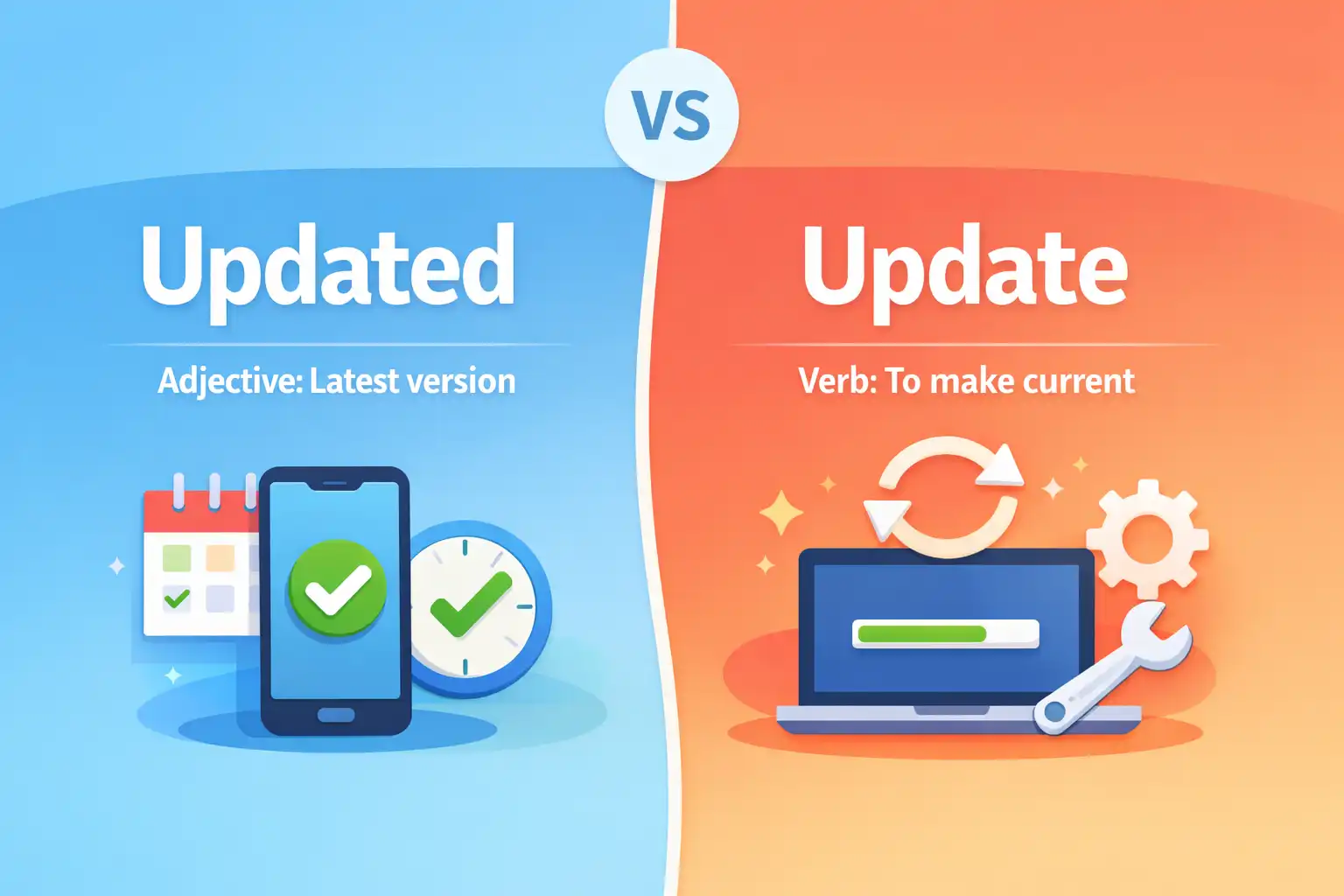
Meaning of Update
- A verb (action word)
- Means to make something current
- Example: I update my app every week.
Meaning of Updated
- Past form or adjective
- Means something is already current
- Example: The app is updated.
Easy Rule:
Use update for action now. Use updated for something already done.
The Origin of Updated or Update
The word update comes from English words “up” and “date.” It first appeared in the 20th century. At that time, it meant bringing information to the present time.
Later, as technology grew, the word became more common. People started using it for software, news, and records. Then, the past form updated became common in writing and speech.
Today, both forms are used daily. However, confusion happens because both look similar but serve different roles. Many learners do not notice the verb tense change. That small difference leads to big errors.
British vs American English Spelling
There is no spelling difference between British and American English for update or updated. Both forms stay the same.
| Form | US English | UK English |
| Update | Update | Update |
| Updated | Updated | Updated |
However, usage style may vary slightly.
- In US English, people often use short sentences
- In UK English, writing may sound slightly more formal
Even so, the meaning stays the same in both regions.
How to Choose the Right Word Fast
Choosing between update and updated is simple once you focus on time and action.
For US users
- Use update for present or future actions
- Use updated for completed actions
For UK / Commonwealth users
- Same rule applies
- Tone may sound more formal in writing
Global or professional writing
- Follow tense rules clearly
- Avoid mixing verb forms in one sentence
Quick Tip:
If the action is happening now → use update
If the action is done → use updated
Common Mistakes with Updated or Update
Writers often confuse tense and sentence structure. Here are common mistakes:
❌ I updated the file now
✅ I update the file now
Explanation: “Now” needs present tense.
❌ Please updated the document
✅ Please update the document
Explanation: After “please,” use base verb.
❌ The system update yesterday
✅ The system updated yesterday
Explanation: Past time needs past tense.
❌ I will updated it later
✅ I will update it later
Explanation: “Will” uses base verb.
These small errors can change meaning. So, always check the time of action. See unpure or impure for prefix correctness.
Updated or Update in Real Life Examples
Let’s see how people use these words daily.
Emails
- I will update the report tomorrow.
- The report is already updated.
News
- The team will update fans about the match.
- The article was updated this morning.
Social Media
- I update my status daily.
- My profile is updated now.
Professional Writing
- Please update the system before launch.
- The system has been updated successfully.
These examples show how context changes usage. The difference is always about time and completion.
Updated or Update – Word Usage Patterns and Search Trends
People search for updated or update because of confusion in grammar. Students, ESL learners, and office workers often face this issue.
In recent years, the word update became more popular due to technology. Apps, software, and websites use it daily. As a result, people see both forms often but do not always understand the difference. UK vs US usage can differ slightly.
One real-world problem happens in work emails. For example:
- “I update the file yesterday” sounds wrong and unprofessional.
This mistake can confuse readers and reduce clarity. So, correct usage helps in both writing and communication.
Comparison Table: Updated vs Update
| Feature | Update | Updated |
| Meaning | To make current | Already made current |
| Part of Speech | Verb (base form) | Past verb / adjective |
| Context of Use | Present or future action | Completed action |
| Formal vs Informal | Used in all contexts | Used in all contexts |
| Common Mistake | Used instead of past form | Used instead of base verb |
| Correct Example | I update the file daily | The file is updated |
This table makes the difference clear at a glance.
FAQs About Updated or Update
Is updated the same as update?
No. Update is present tense. Updated is past tense or an adjective.
Which one is correct in formal writing?
Both are correct. Use the right tense based on context.
Can they be used interchangeably?
No. They have different meanings based on time.
Why do people confuse them?
They look similar, but the tense difference is easy to miss.
Can grammar tools catch this mistake?
Yes, most tools can detect tense errors.
Is there a British vs American difference?
No, spelling and meaning stay the same.
Is updated an adjective?
Yes, it can describe something current, like “updated version.”
Conclusion
Understanding updated or update is simple once you focus on time. The word update shows action happening now or later. On the other hand, updated shows the action is already done.
Many writers make mistakes because they ignore verb tense. This leads to unclear sentences. However, once you learn the difference, you can fix these errors quickly.
Overall, always check your sentence timing. Ask yourself: Is the action happening now or already finished? That question will guide your choice. You may also check ironic vs unironic.
In short, remember this rule:
Use update for action. Use updated for results.

Ibrahim Jhon is an English language editor with over ten years of experience working with writers, publishers, and international businesses. He specialises in word choice, grammar accuracy, and the differences between British and American English.