
A few years ago, I edited a school report where a student wrote that a story character was “a fat little boy with a kind smile.” The teacher’s margin note was not about grammar. It was about tone. The student had meant “round-faced” or “slightly plump,” but the word choice made the sentence sound blunt and harsh. I have seen the same problem in product copy, news drafts, and even internal brand notes where one wrong word changed the feel of the whole piece.
Here is why this confusion happens. Both words relate to body size, but they do not work the same way in tone, context, or reader reaction. One often sounds direct, neutral, or offensive depending on use. The other usually sounds softer, but it can also sound childish or imprecise. Writers mix them up when they focus only on dictionary meaning and ignore tone.
By the end, you will know the literal difference, the tone difference, where each word breaks trust, and how to choose the safer option in real writing.
fat vs chubby – Quick Answer
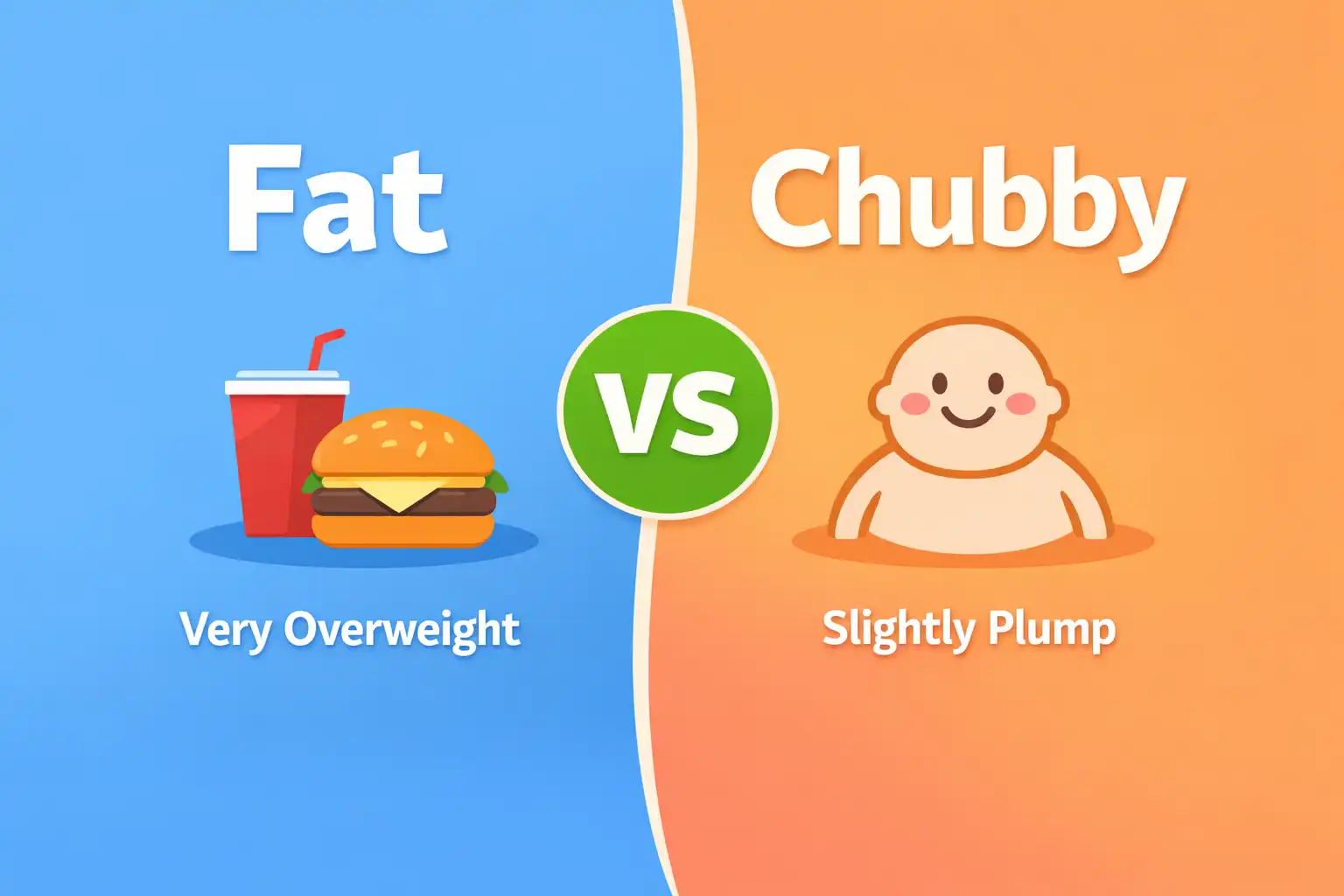
Fat usually means having more body fat and can sound direct, neutral, or rude depending on context. Chubby usually means slightly plump in a softer, often more informal way. In most professional writing, neither is the best first choice unless the context clearly requires it.
Meaning of fat
Fat is an adjective and a noun. As an adjective, it describes a person, animal, or thing with a lot of fat. In body description, it is the more direct word. In editing work, I often see it used by writers who want plain language but forget that plain language can still feel sharp.
Meaning of chubby
Chubby is an adjective. It usually means slightly fat in a rounded, soft, or fuller way. Writers often use it for children, cheeks, hands, or pets. In real copy edits, I have seen “chubby” used in fashion text for adults, and it almost always sounds awkward or patronizing.
One decision rule
Use fat only when directness is necessary and the tone is clearly appropriate. Use chubby only for soft, informal description. In most formal writing, choose a more precise alternative instead.
The Origin of fat vs chubby
The history of these words explains a lot of the modern confusion.
Fat comes through Old English and has very old Germanic roots. It has long carried a basic physical meaning: thick, full, or oily. Older writing used it for animals, food, land, and people without much softening. That blunt history still shows today. The word feels short, hard, and direct because it has always done a direct job.
Chubby is much newer in feel. It likely developed from earlier English forms linked to roundness or lumpiness. Even when the exact path gets messy, the pattern is clear: the word grew in friendly, visual description rather than formal classification. That is why it often feels softer, more domestic, and more child-centered.
This history matters in editing. I once revised an e-commerce draft for children’s winter wear that described a model as having “fat cheeks.” Grammatically, the line worked. Commercially, it did not. We changed it to “chubby cheeks” because the brand voice aimed for warmth, not bluntness. A small shift fixed the tone.
One historical note also helps: older texts often used fat more openly than modern lifestyle or media writing does. Today, writers tend to weigh social tone much more carefully.
British vs American English
There is no major spelling difference between fat and chubby in British and American English. Both varieties use the same forms. The real difference lies in tone, frequency, and what sounds acceptable in context.
In my experience editing UK-facing and US-facing content, American copy often avoids both words in polished public writing unless the topic is clearly about body image, identity, or direct quotation. British writing can also avoid them, but it sometimes tolerates more dry bluntness in opinion or tabloid-style phrasing. Even then, tone control matters.
| Feature | American English | British English |
| Spelling | fat, chubby | fat, chubby |
| Basic meaning | Same | Same |
| Tone of fat | Often more sensitive in public-facing copy | Can sound blunt or plain, depending on register |
| Tone of chubby | Softer, often child-focused | Softer, often informal or slightly old-fashioned |
| Best practice | Prefer precise neutral wording in formal writing | Prefer precise neutral wording in formal writing |
A newsroom draft I reviewed from a US-based client removed “chubby actor” and replaced it with a neutral physical description tied to the story. A UK lifestyle draft kept “chubby toddler hands” because the tone was affectionate and informal. Same words. Different editorial tolerance.
How to Choose the Right Word Fast
For a US audience, ask one question first: Will this sound judgmental? If yes, avoid both. In American professional writing, body-related terms carry strong tone weight. A safer rule is this: if the body description is not essential, cut it.
For a UK or Commonwealth audience, the faster question is: Does this sound too blunt for the publication? British English may allow more dry phrasing in some settings, but brand, school, and workplace writing still needs care. If the line sounds sharper than the rest of the piece, revise it.
For global or professional writing, the best question is: Do I need a body-shape word at all? In most reports, bios, product pages, and formal documents, a more exact phrase works better. Use terms tied to fit, shape, age group, or context instead of broad body labels.
Here are the fastest rules.
US guidance: If you are describing a person in public-facing writing, avoid both unless the person self-identifies that way or the context requires direct wording.
UK/Commonwealth guidance: If the sentence sounds casual or affectionate, chubby may work. If the sentence is formal, step back and choose something more precise.
Global/professional guidance: When in doubt, replace both with a factual description such as “fuller face,” “plus-size fit,” or “stocky build,” depending on context.
Writers I have worked with often make this mistake in HR emails and profile drafts. They think softer equals safer. It does not always. “Chubby” can sound childish when the subject is an adult professional.
Common Mistakes with fat vs chubby
❌ The candidate looked chubby and confident in the interview photo.
✅ The candidate looked confident in the interview photo.
Body size adds nothing here, so the word damages professionalism.
❌ Our jackets are perfect for fat women.
✅ Our jackets are designed for plus-size women.
An apparel listing needs audience-appropriate language, not blunt labeling.
❌ The article described the minister as chubby during a policy speech.
✅ The article described the minister’s appearance only when it was relevant to the story.
News writing should avoid casual body commentary unless it matters.
❌ My son drew a fat puppy with a red collar.
✅ My son drew a chubby puppy with a red collar.
For soft, visual, informal description, chubby fits better.
❌ She has chubby proportions in this formal assessment report.
✅ The report should use a precise, relevant physical description or none at all.
“Chubby” sounds vague and childish in formal documents.
I once edited a student essay that called a novel character “chubby and poor,” which made the analysis sound careless and biased. The grade issue was not only vocabulary. The wording made the whole paragraph feel immature.
fat vs chubby in Real-Life Examples
In a professional email, you might write: “The child in the ad has round cheeks and a bright expression.” I changed a client line like this after they wrote “a chubby kid with winter gloves.” The original felt too casual for a retailer’s campaign review.
In news writing, a stronger sentence would be: “Witnesses described the man as medium height, wearing a navy coat.” I have removed both fat and chubby from local news drafts when clothing or movement gave a more useful description.
On social media, people often write things like, “My cat is getting so chubby this winter.” That sounds natural because the setting is casual and affectionate. The same tone would fail in a veterinary note.
In a formal document, you should avoid both unless the wording is medically or legally required and supplied by the proper source. A school incident report should not say “a fat parent approached the gate.” It should identify the person by role, clothing, or another relevant feature.
fat vs chubby – Word Usage Patterns and Search Trends
The people who search this term are usually students, ESL learners, content writers, teachers, and professionals fixing tone problems at the last minute. Some want a dictionary answer. Most actually want a social answer: which word sounds rude, childish, neutral, or safe.
Here is where many competitors stop too early. The real problem is not meaning alone. It is risk.
An ESL learner often treats fat and chubby as simple size levels, almost like choosing between “big” and “small.” Native speakers usually know the literal difference, but they still misuse tone. They reach for chubby thinking it sounds kind, then end up sounding patronizing. That pattern shows up a lot in school reports, parenting blogs, and lifestyle copy.
I have seen the consequence in job-related writing. One junior marketer drafted audience notes for a plus-size clothing brand and used “chubby women” in a planning document that later got shared outside the team. The issue was not only style. It damaged credibility because the wording showed poor audience judgment.
This is also one of the most damaging errors in fashion, education, and media writing. In those fields, tone is part of competence. Choose the wrong word, and readers do not just question the sentence. They question the writer.
Comparison Table
| Feature | Fat | Chubby |
| Meaning | Having a lot of body fat; direct description | Slightly fat; soft, rounded, fuller-looking |
| Part of speech | Adjective; also noun | Adjective |
| Curved edges possible | Not really a shape-based nuance | Yes, often suggests rounded softness |
| Used in formal writing | Rarely, unless context clearly requires it | Rarely; usually too informal |
| Common mistake | Used too bluntly in public-facing copy | Used to sound “nicer” but ends up childish |
| Correct example | “The term appeared in a direct quote and was left unchanged.” | “The baby had chubby cheeks in the family photo.” |
FAQs
Is chubby less offensive than fat?
Usually yes, but not always. It sounds softer, yet it can also sound childish or patronizing, especially for adults.
Can I use fat in formal writing?
Only when the context clearly requires direct wording, such as a quote, identity-based discussion, or source language you should not alter.
Is chubby a good word for adults?
Usually not in professional writing. It often sounds casual, old-fashioned, or condescending.
What is the best neutral alternative?
That depends on context. Try “plus-size,” “fuller face,” “stocky,” or remove the body description entirely.
Do native speakers confuse fat and chubby?
Yes, but usually in tone, not meaning. They often know the difference yet still choose the wrong level of softness.
Why do ESL learners make this mistake so often?
Many learn the words as simple synonyms with different strength levels, without the cultural tone that native readers hear.
Should news articles avoid both words?
Most of the time, yes. Report only appearance details that are relevant, specific, and necessary to the story.
Conclusion
Overall, the most important distinction is this: fat is more direct, while chubby is softer but less precise. That does not mean one is always right and the other always wrong. It means tone decides everything.
The single most common mistake is choosing chubby as a “safe” replacement for fat in professional writing. I see that error more than the reverse. Writers think they are softening the line, but they often make it sound childish, vague, or patronizing instead.
In short, do not treat these words like simple dictionary swaps. Ask what the sentence needs to do. If the body description is unnecessary, remove it. If the description matters, choose the most precise term for the context, audience, and tone. Finally, remember this rule: the kinder word is not always the better word; the better word is the one that fits the job.

Ibrahim Jhon is an English language editor with over ten years of experience working with writers, publishers, and international businesses. He specialises in word choice, grammar accuracy, and the differences between British and American English.