
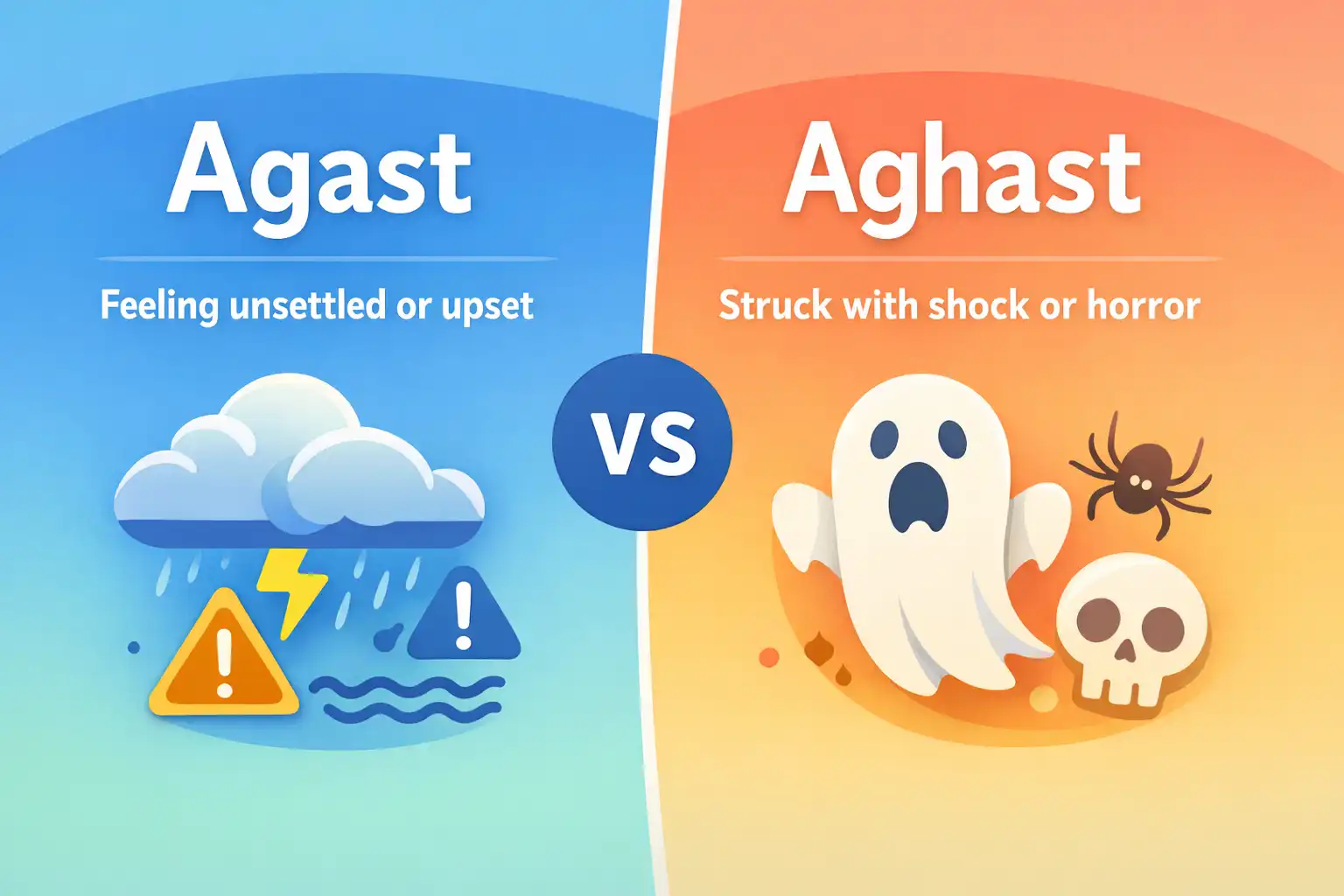
Many learners stop and think when they see agast or aghast. The words look almost the same, so confusion is very common. Also, spell check tools may not always help because both look like real words. As a result, people often pick the wrong one in writing.
Now, this mistake matters because one word is correct in modern English, while the other is not used at all. Writers, students, and ESL learners often mix them in emails, essays, and even social posts. That can affect clarity and credibility.
In this guide, you will learn the real meaning, the correct spelling, and how to use the right word with confidence. You will also see simple examples and an easy rule that helps you decide fast.
Agast or Aghast – Quick Answer
Meaning of Aghast
- Feeling shock or strong surprise
- Often used in emotional situations
- Example: She was aghast at the news
Meaning of Agast
- Not a correct English word
- It is a common misspelling of “aghast”
Easy Rule:
Always use aghast. Never use agast in correct English.
The Origin of Agast or Aghast
The word aghast has an old history. It comes from Middle English and Old English roots. It is linked to the idea of fear, shock, or being filled with strong emotion. In older texts, it sometimes meant “terrified” or “struck with fear.”
Over time, the meaning became softer. Today, people use it mostly to show shock or surprise rather than fear.
Now, why do people write agast? The reason is simple. When we speak, the “h” in aghast is silent. So, it sounds like “agast.” Because of this, many learners drop the “h” when writing. That leads to a spelling mistake.
Writers often confuse words that sound the same. Editors usually see this mistake in essays and emails, especially from new English learners.
British vs American English Spelling
There is no difference between British and American English for this word. Both use aghast as the correct spelling.
| Variant | Correct Spelling | Notes |
| British English | Aghast | Same meaning and use |
| American English | Aghast | No change at all |
| Common mistake | Agast | Incorrect everywhere |
However, the confusion still happens in both regions. That is because pronunciation stays the same in both accents.
So, you do not need to worry about regional spelling here. Just remember that aghast is always correct.
How to Choose the Right Word Fast
Choosing between agast or aghast is very easy once you know one fact.
First, understand that only one word exists in standard English.
- In the US: Use aghast in all writing
- In the UK and Commonwealth: Use aghast as well
- In global or professional writing: Always choose aghast
There is no case where “agast” is correct.
So, instead of thinking about choice, focus on avoiding the mistake.
A quick tip helps here. If you think of the word “ghost,” you will remember the silent “h” sound. That can help you recall the correct spelling aghast.
Common Mistakes with Agast or Aghast
Many writers make small but clear mistakes with this word. Let’s look at the most common ones.
❌ She was agast when she heard the result
✅ She was aghast when she heard the result
Explanation: “Agast” is not a valid word.
❌ He looked agast at the sudden noise
✅ He looked aghast at the sudden noise
Explanation: Always include the “h” after “g”.
❌ I felt agast after reading the message
✅ I felt aghast after reading the message
Explanation: The correct spelling carries the meaning of shock.
Another mistake is using the word in the wrong tone.
❌ I was aghast at the tasty food
✅ I was delighted by the tasty food
Explanation: “Aghast” shows shock, not happiness.
So, the key is not just spelling but also correct emotional use.
Agast or Aghast in Real Life Examples
Let’s see how aghast works in daily life.
Emails
- I was aghast to see the error in the report
- She felt aghast after reading the client complaint
News
- The public was aghast at the sudden policy change
- Viewers were aghast at the shocking event
Social Media
- I am aghast at what just happened
- Fans were aghast after the match result
Professional Writing
- The team was aghast at the unexpected outcome
- Management seemed aghast at the data findings
These examples show that the word fits strong reactions. It works best when something surprising or shocking happens.
Agast or Aghast – Word Usage Patterns and Search Trends
The word aghast is not used every day, but it appears often in formal and emotional writing. News articles, reports, and storytelling use it more than casual speech.
Students and ESL learners search for agast or aghast because they hear the word first and then try to write it. That leads to confusion.
Writers also search this term when editing their work. They want to confirm the correct spelling before finalizing content.
A common real-life issue happens in professional emails. If someone writes “agast,” it can look careless. That may affect how others view the message.
So, even a small spelling mistake can create a big impression.
Comparison Table: Agast vs Aghast
| Feature | Aghast | Agast |
| Meaning | Shock or strong surprise | No meaning |
| Part of Speech | Adjective | Not a word |
| Context of Use | Emotional reactions | Never used |
| Formal vs Informal | Works in both | Incorrect everywhere |
| Common Mistake | Misspelling confusion | Wrong spelling |
| Correct Example | She was aghast at the news | ❌ She was agast |
This table makes the answer simple. Only one word is valid.
Semantic FAQs
Is agast the same as aghast?
No. Only “aghast” is correct. “Agast” is a spelling mistake.
Which one is correct in formal writing?
Always use “aghast” in formal writing.
Can they be used interchangeably?
No. “Agast” should never be used.
Why do people confuse them?
They sound the same when spoken, so learners drop the silent “h”.
Can grammar tools catch this mistake?
Most tools catch it, but not all. Manual checking still helps.
Is there a British vs American difference?
No. Both use “aghast” with the same spelling.
Is aghast still used today?
Yes, but mostly in formal or expressive writing.
Conclusion
Overall, the confusion between agast or aghast is easy to fix once you know the truth. Only aghast is a real English word, and it shows strong surprise or shock. On the other hand, “agast” is just a common spelling error.
This mistake often happens because of pronunciation. People hear the word without the “h” sound, so they write it incorrectly. However, correct spelling matters, especially in formal writing and professional communication.
Now, the key takeaway is simple. Always use aghast when you want to express shock or surprise. Avoid “agast” completely.
Finally, remember this rule:
If the word means shock, it must include the silent “h” — aghast.

Ibrahim Jhon is an English language editor with over ten years of experience working with writers, publishers, and international businesses. He specialises in word choice, grammar accuracy, and the differences between British and American English.