
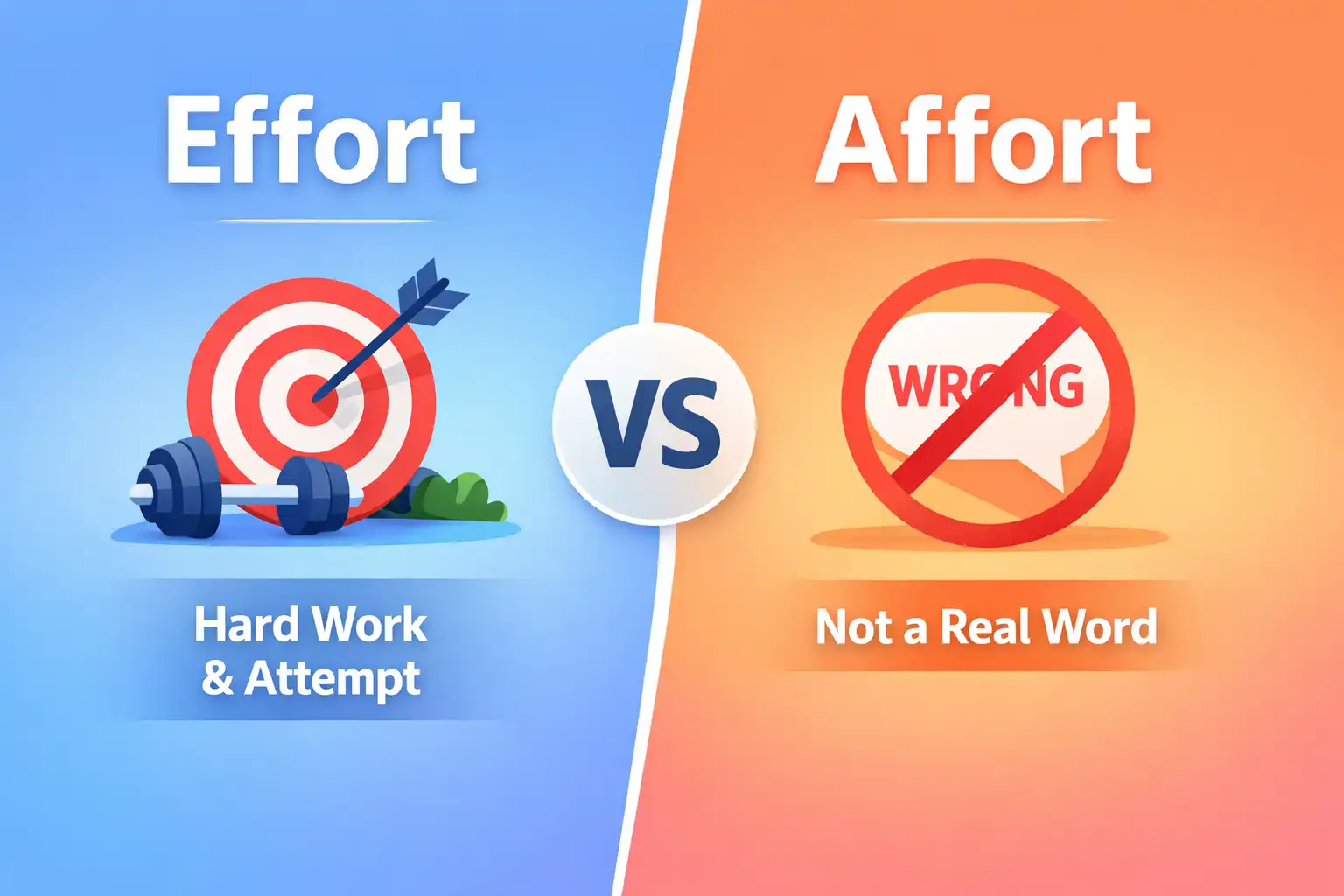
Many learners type effort vs affort because both words look similar. However, only one is real English. This small spelling mistake can change how your writing feels. It may also confuse readers or make your message look less clear.
Writers often face this issue in emails, school work, and even social media posts. The problem happens because English spelling does not always match sound. So, people guess and sometimes choose the wrong form. In this guide, you will learn the correct word, why the confusion exists, and how to avoid this mistake forever.
Effort vs Affort – Quick Answer
Effort is the correct English word.
Affort is not a real word and is always incorrect.
- Effort means hard work or energy used
- Affort has no meaning in standard English
Examples:
- She put a lot of effort into her work
- This project needs more effort
Easy rule: If you mean “hard work,” always use effort
Meaning of Effort
- A noun
- Means physical or mental work
- Shows energy used to do something
Examples:
- He made a strong effort to win
- Learning English takes effort
- Her effort helped the team succeed
Meaning of Affort
- Not a valid English word
- No meaning in modern usage
- Considered a spelling mistake of effort
Examples (incorrect):
- ❌ He made an affort
- ❌ This needs more affort
The Origin of Effort vs Affort
The word effort comes from old French and Latin roots. It links to the idea of “forcing out strength” or “trying hard.” Over time, it became common in English writing and speech.
On the other hand, affort does not come from any real language root used in modern English. It may look similar to words like “afford,” so people mix them up. That is one reason confusion still exists today.
Writers often confuse these forms because English has many double consonants like effect, offer, and effort. So, learners guess the spelling and sometimes choose “affort” by mistake.
British vs American English Spelling
There is no difference between British and American English here. Both use the same spelling: effort.
| Type | Correct Form | Notes |
| American English | effort | Standard usage |
| British English | effort | Same spelling |
| Incorrect form | affort | Not accepted |
So, unlike words like color/colour, this word stays the same in all regions.
How to Choose the Right Word Fast
Choosing the correct word is simple because only one option exists.
- US users: Always write effort
- UK users: Always write effort
- Global writing: Use effort in all cases
There is no style or tone difference. The only rule is spelling accuracy.
Quick tip: If you think of “hard work,” spell it with eff- not aff-
Common Mistakes with Effort vs Affort
Many learners make the same errors. Here are clear examples:
- ❌ He made an affort → ✅ He made an effort
- ❌ This task needs affort → ✅ This task needs effort
- ❌ Your affort is great → ✅ Your effort is great
These mistakes happen because of sound confusion. The words effort and afford sound close, so people mix spellings.
Editors usually see this error in beginner writing or fast typing. So, careful proofreading helps fix it.
Effort vs Affort in Real Life Examples
Understanding real use makes learning easier.
Emails:
- Thank you for your effort on this project
- We appreciate your effort and time
News writing:
- The team showed great effort during the match
- Government efforts aim to improve education
Social media:
- Big effort today at the gym
- Respect the effort, not just the result
Professional writing:
- This report reflects strong effort from the team
- Your effort improved overall performance
In all these cases, effort works clearly and correctly.
Effort vs Affort – Word Usage Patterns and Search Trends
The word effort is very common in daily English. Students, professionals, and writers use it often. It appears in school essays, workplace reports, and casual conversations.
Search trends show that many users type “affort” by mistake. This happens mostly with ESL learners or fast typists. So, search engines suggest “effort” as the correct form.
A real-world issue can happen in job applications. If someone writes “affort” in a CV, it may look unprofessional. That small error can affect how others judge the writing quality.
Effort vs Affort Comparison Table
| Feature | Effort | Affort |
| Meaning | Hard work or energy | No meaning |
| Part of Speech | Noun | Not a real word |
| Context of Use | Formal and informal | Never used |
| Formal Usage | Correct | Incorrect |
| Common Mistake | Rare | Very common spelling error |
| Example | She made an effort | ❌ She made an affort |
This table shows clearly that only one word is valid.
FAQs
Is effort the same as affort?
No. Effort is correct, while affort is a spelling mistake.
Which one is correct in formal writing?
Only effort is correct in all formal contexts.
Can they be used interchangeably?
No, because affort has no meaning.
Why do people confuse them?
People mix them due to similar sound and spelling patterns.
Can grammar tools catch this mistake?
Yes, most grammar tools flag affort as incorrect.
Is there a British vs American difference?
No, both use effort with the same spelling.
Is affort used anywhere in English?
No, it is not used in standard English at all.
Conclusion
The confusion between effort vs affort is simple but important. Only one word is correct, and that word is effort. It means hard work, energy, or trying to do something well.
This mistake often happens because of spelling patterns in English. However, once you know the rule, it becomes easy to avoid. Writers, students, and professionals all need to use the correct form to keep their writing clear and strong.
Overall, remember that affort is not a real word. Using it can make your writing look careless. So, always check your spelling before you send or publish anything.
Final rule to remember:
If you mean “hard work,” always write effort with eff- at the start.

Ibrahim Jhon is an English language editor with over ten years of experience working with writers, publishers, and international businesses. He specialises in word choice, grammar accuracy, and the differences between British and American English.