
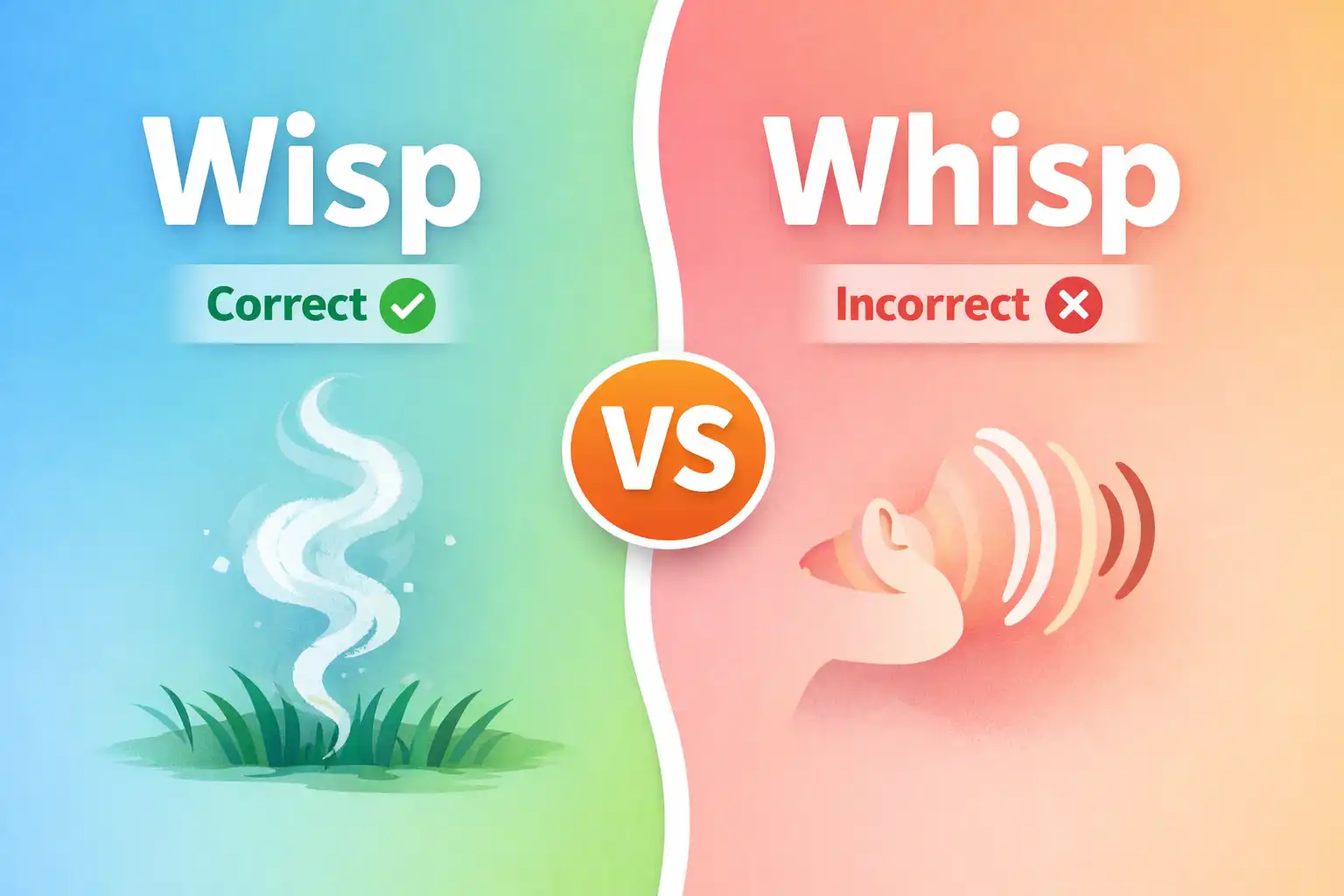
Many people search for “wisp or whisp” because they are unsure which spelling is correct. You may have seen both forms online, in messages, or even in casual writing. So the confusion feels real. But here is the key point: only one spelling is actually correct in standard English.
Writers often make this mistake when they rely on sound instead of spelling rules. The word sounds soft, so some people assume it may include an “h.” Also, autocorrect tools do not always fix this error. That is why the confusion keeps growing, especially among students and ESL learners.
In this article, you will learn the correct spelling, the meaning, and how to use the word in real life. You will also see why “whisp” appears sometimes and why it is wrong. By the end, you will feel confident using the correct form every time.
Wisp or Whisp – Quick Answer
Meaning of Wisp
- A small, thin piece or amount of something
- Often used for smoke, hair, or cloud
- Examples:
- A wisp of smoke rose in the air
- She moved a wisp of hair from her face
Meaning of Whisp
- Not a correct English word
- Considered a spelling mistake of “wisp”
Easy Rule:
Use “wisp” always. Avoid “whisp” in all cases.
The Origin of Wisp or Whisp
The word Old English gives us the origin of “wisp.” It comes from the word wispa, which meant a small bundle of straw or grass. Over time, the meaning changed. Now, it refers to anything thin, light, or delicate.
However, the spelling never included an “h.” So “whisp” has no historical base. It likely appeared because some English words begin with “wh,” like what or when. So learners sometimes assume “wisp” follows the same pattern.
Editors often see this mistake in early drafts. It happens more in informal writing, where people type fast and do not check spelling. Still, in correct English usage, “whisp” does not exist.
British vs American English Spelling
In this case, there is no difference between British and American English.
Both forms use the same spelling:
- Correct: wisp
- Incorrect: whisp
However, many learners expect differences because other words change between regions. For example, color vs colour. But “wisp” stays the same everywhere.
Here is a simple comparison:
| Version | Spelling |
| American English | wisp |
| British English | wisp |
| Common Mistake | whisp |
So, no matter where you write, the correct form remains the same.
How to Choose the Right Word Fast
This choice is simple because only one option is correct.
For US users
- Use “wisp” in all writing
For UK / Commonwealth users
- Also use “wisp”
Global or professional writing
- Stick with “wisp” to avoid errors
There is no variation based on audience. So you do not need to adjust your spelling at all.
Common Mistakes with Wisp or Whisp
Writers often make small errors with this word. Here are the most common ones:
❌ Whisp of smoke → ✅ Wisp of smoke
❌ A soft whisp of hair → ✅ A soft wisp of hair
❌ Thin whisp in the sky → ✅ Thin wisp in the sky
Why this happens:
- People guess spelling from sound
- They mix it with “wh” words
- They type fast and skip checking
Also, grammar tools may not always catch “whisp” because it looks like a real word. So manual checking helps.
Wisp or Whisp in Real Life Examples
Now let’s see how “wisp” works in real situations.
Emails
- “I saw a wisp of smoke near the building.”
News
- “A wisp of cloud moved across the sky.”
Social Media
- “Her hair fell in soft wisps around her face.”
Professional Writing
- “The report showed only a wisp of evidence.”
These examples show how flexible the word is. It works in both formal and informal writing.
Wisp or Whisp – Word Usage Patterns and Search Trends
Many users search for “wisp or whisp” because they feel unsure about spelling. This is common among:
- Students
- ESL learners
- Beginner writers
Search trends show that spelling confusion is a major reason behind these queries. People want quick answers before writing emails, essays, or posts.
Real-world confusion example:
A student writes “whisp of smoke” in an essay. The teacher marks it wrong. This affects the student’s score. So even a small spelling error can create a real problem.
Comparison Table: Wisp vs Whisp
| Feature | Wisp | Whisp |
| Meaning | Small, thin amount | No meaning |
| Part of Speech | Noun | Not valid |
| Context of Use | Smoke, hair, clouds | Not used |
| Formal Usage | Correct | Incorrect |
| Common Mistake | Rare | Very common |
| Example | A wisp of fog | Not correct |
This table makes it clear: only “wisp” is correct.
FAQs About Wisp or Whisp
Is wisp the same as whisp?
No. “Wisp” is correct. “Whisp” is a mistake.
Which one is correct in formal writing?
Always use “wisp.”
Can they be used interchangeably?
No. Only “wisp” is valid.
Why do people confuse them?
They guess spelling based on sound and mix it with “wh” words.
Can grammar tools catch this mistake?
Sometimes, but not always. Manual checking helps.
Is there a British vs American difference?
No. Both use “wisp.”
Is “whisp” ever acceptable?
No. It is always incorrect.
Conclusion
Now the confusion between wisp or whisp should feel clear. Only “wisp” is the correct spelling. It has a long history and a clear meaning. On the other hand, “whisp” has no place in standard English.
Writers often make this mistake because the word sounds soft and similar to “wh” words. However, spelling rules do not support that pattern here. So it is important to remember the correct form.
In real use, “wisp” appears in many contexts, like smoke, hair, or clouds. It works in both casual and formal writing. So learning it once will help you in many situations.
Overall, the best way to avoid errors is to follow one simple rule:
If you mean something thin or light, always write “wisp.” Never add an “h.”

Ibrahim Jhon is an English language editor with over ten years of experience working with writers, publishers, and international businesses. He specialises in word choice, grammar accuracy, and the differences between British and American English.