
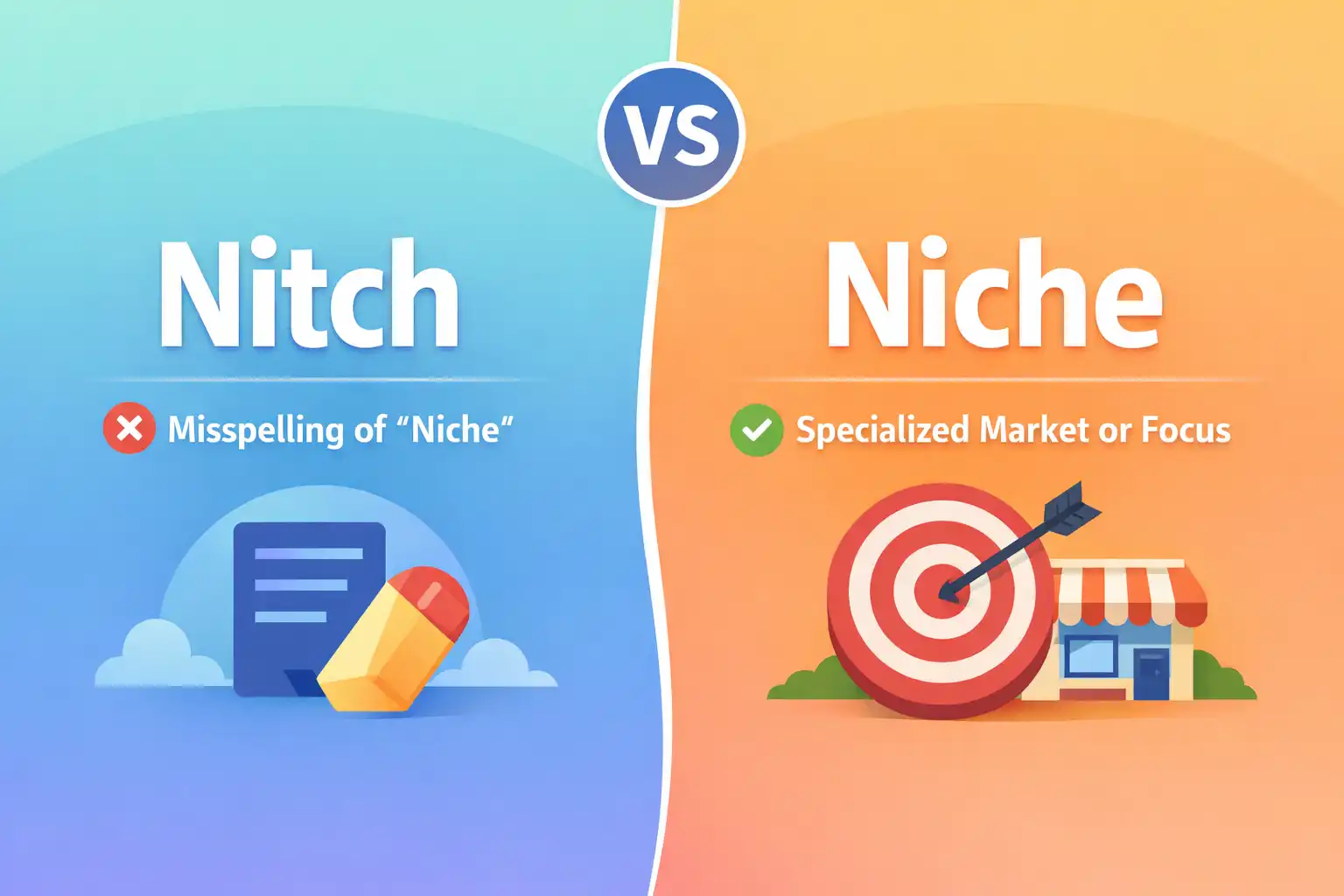
If you have ever typed “nitch” in a professional email or business document, you are not alone. Millions of English learners and even native speakers face this exact confusion every day. The word sounds one way but is spelled another — and that gap between sound and spelling is what creates the “nitch or niche” debate.
This guide will settle that debate completely. You will learn the correct spelling, the history behind the confusion, how different countries pronounce it, what it actually means in business and biology, and how to avoid the most common mistakes people make when using this word.
Nitch or Niche — The Quick Answer
The correct spelling is always niche.
“Nitch” is not a real word in standard English. It does not appear in any major dictionary as an accepted spelling. It is simply how many American speakers pronounce the word “niche” — and over time, people began spelling it the way they say it.
Simple rule to remember:
- In writing → always use niche
- In speech → you may hear nitch (US) or neesh (UK)
Both pronunciations are acceptable in spoken English. But only one spelling is correct in written English: niche.
What Does Niche Mean?
Before diving into pronunciation, it helps to understand what the word actually means. “Niche” has three main uses depending on context.
1. In Architecture and Design
Originally, a niche referred to a shallow recess or hollow space built into a wall. These spaces were common in churches, museums, and grand buildings to display statues, vases, or decorative objects. This is where the word first entered the English language from French.
Example: “The sculptor placed the bronze figure inside a niche carved into the stone wall.”
2. In Business and Marketing
This is where most people encounter the word today. In business, a niche refers to a focused, specialized segment of a larger market. A niche market targets a specific audience with very particular needs, preferences, or interests.
Examples:
- “She built a successful blog by targeting a niche audience of vegan athletes.”
- “The startup found its niche in affordable luxury skincare for men.”
- “Instead of competing with Amazon, the store focused on a niche in handmade wooden toys.”
Niche marketing is a powerful strategy because it reduces competition and increases loyalty. When you serve a specific group extremely well, they trust your brand more than a general store that serves everyone.
3. In Biology and Ecology
In ecology, a niche describes the specific role an organism plays in its ecosystem. This includes what it eats, where it lives, how it behaves, and how it interacts with other species.
Example: “The red fox occupies a niche as a mid-level predator, controlling small mammal populations in suburban areas.”
The Origin of the Word Niche
Understanding where this word comes from explains a lot about why the spelling and pronunciation are so confusing.
“Niche” comes from the Old French word nicher, which means “to nest.” Before that, it traces back to the Latin word nidus, meaning “nest.” The word entered English in the early 1600s, borrowed directly from French during a period when many French architectural terms were adopted into English.
Because the word came from French, the original English pronunciation followed French phonology — which is why educated British speakers say “neesh.” Over time, American English speakers adapted the pronunciation to fit more natural English sound patterns, arriving at “nitch.”
This is not unusual. Many French-origin words in English have shifted pronunciation over centuries. The spelling, however, stayed fixed. That is why “nitch” as a spelling never became formally accepted — the written form was already established as “niche” before pronunciation drifted.
Nitch vs Niche — Why the Confusion Exists
The core reason people write “nitch” is simple: they are spelling what they hear. This is called phonetic spelling, and it is extremely common among English learners and even fluent speakers.
Here is the chain of confusion:
- An American speaker says “nitch”
- A listener hears “nitch”
- The listener writes “nitch”
- The error spreads online, in blog posts, forums, and social media
In fact, if you search “blogging nitch” or “find your nitch” online, you will find thousands of results — which reinforces the false impression that the spelling is acceptable. It is not.
Another reason the confusion persists is inconsistency in how people around the world pronounce the word. When someone hears both “nitch” and “neesh” from different speakers, they assume the word must be spelled differently too. But it is not.
American vs British Pronunciation — Full Breakdown
This is where the real difference lies: not in spelling, but in sound.
| Region | Pronunciation | Phonetic Symbol | Rhymes With |
| American English | nitch | /nɪtʃ/ | witch, pitch, switch |
| British English | neesh | /niːʃ/ | leash, feast (approximately) |
| Some dialects | nish | /nɪʃ/ | dish, wish |
All three pronunciations are considered acceptable in spoken English. Merriam-Webster, the leading American dictionary, lists both /nɪtʃ/ and /niːʃ/ as correct. The Collins English Dictionary follows the same approach.
The key point: pronunciation varies by region, but spelling does not.
A British CEO and an American entrepreneur will spell it the same way in any formal document: niche.
How to Use Niche Correctly — Real Examples
Seeing the word used correctly in context is one of the fastest ways to build the habit of spelling it right.
In business writing:
- “Our agency specializes in niche digital marketing for healthcare brands.”
- “Before launching, identify your niche and understand your target audience deeply.”
- “The product failed because the team tried to appeal to everyone instead of owning a specific niche.”
In career and personal development:
- “After years of trying different roles, she finally found her niche in UX research.”
- “Finding your niche does not mean limiting yourself — it means focusing your strengths.”
Ecology:
- “Every species occupies a unique niche in its ecosystem.”
- “When two species compete for the same niche, one typically dominates or the other adapts.”
Interior design:
- “The architect designed a niche beside the fireplace to display family photographs.”
- “Small niches cut into the bathroom tiles create a practical space for shampoo and soap.”
Common Mistakes — And How to Fix Them
These are the most frequent errors people make with this word.
| Incorrect | Correct |
| I found my nitch in blogging. | I found my niche in blogging. |
| This is a profitable nitch market. | This is a profitable niche market. |
| She works in a small nitch. | She works in a small niche. |
| Our nitch is sustainable fashion. | Our niche is sustainable fashion. |
| He is a nitch content creator. | He is a niche content creator. |
Why this matters in professional writing:
When you write “nitch” in a resume, proposal, or client email, it signals one of two things to the reader: either you are not a native English speaker who has learned the word through listening, or you did not proofread your work. Either way, it undermines your credibility. A single spelling error in a professional document can raise doubts about the quality of your other work.
Does “Nitch” Appear in Any Dictionary?
This is a fair question. The answer is: not as a standard spelling of “niche.”
Some dictionaries list “nitch” as a dialectal or informal variant — meaning it is recognized as a spoken form in certain regional dialects, particularly in parts of the American Midwest and South. But no major style guide or dictionary accepts “nitch” as correct written spelling for the word “niche.”
Grammar and spell-checking tools, including Grammarly, Microsoft Word, and Google Docs, will flag “nitch” as a spelling error and suggest “niche” as the correction.
So if you are ever unsure, your spell-checker will confirm: niche is correct.
Nitch or Niche in SEO and Content Writing
This word creates a specific challenge for content writers and SEO professionals. Many users search for “nitch” because that is how they heard the word — so some content creators deliberately use the misspelling to capture that search traffic.
This is a risky strategy. While “nitch” does receive search volume, Google’s algorithm is smart enough to understand that users searching “nitch” actually mean “niche.” Google typically corrects the query automatically. Beyond that, publishing content with a deliberate misspelling can damage your site’s credibility in the eyes of readers and reduce trust signals.
The better approach is to acknowledge the confusion — as this article does — by discussing both forms, explaining the correct spelling, and naturally including the misspelled version as a topic of discussion rather than as accepted usage.
Frequently Asked Questions
Is “nitch” the same as “niche”? They refer to the same idea, but “nitch” is only a spoken pronunciation. In writing, only “niche” is correct.
Why do Americans say “nitch” instead of “neesh”? American English adapted the French-origin word to fit natural English sound patterns. Over generations, the “neesh” sound shifted to “nitch” in American speech. Both are valid pronunciations — just different regional habits.
Is “nitch” in the dictionary? Not as a standard spelling. Some dictionaries mention it as a dialectal pronunciation variant, but no style guide accepts it as correct written English.
Can I use “nitch” in informal writing? Even in informal writing, “niche” is strongly preferred. It takes no extra effort to spell it correctly, and it avoids any risk of looking unprofessional.
How do I remember the correct spelling? Think of the word’s French origin — “nicher” means to nest. The French spelling has an “e” at the end, and so does niche. Once you connect the spelling to the word’s history, it becomes much easier to remember.
Does Google autocorrect “nitch” to “niche”? Yes. Google’s search algorithm recognizes “nitch” as a likely misspelling of “niche” and typically shows results for “niche” automatically.
What is a niche market in simple terms? A niche market is a small, specific group of customers with shared needs that are not fully served by mainstream products. Businesses that target niche markets face less competition and often build stronger customer loyalty.
What is the plural of niche? The plural is simply niches — pronounced “nitches” in American English or “neeshes” in British English.
Final Summary
The nitch or niche debate has one simple answer. There is no debate about spelling — only about pronunciation.
You may say “nitch” if you are American. You may say “neesh” if you are British. Both are fine in conversation. But when you sit down to write — whether it is a blog post, a business proposal, a resume, or a social media caption — there is only one correct option: niche.
Remember this rule and you will never make this mistake again:
“If you write it, spell it niche. If you say it, it might sound like nitch.”

Ibrahim Jhon is an English language editor with over ten years of experience working with writers, publishers, and international businesses. He specialises in word choice, grammar accuracy, and the differences between British and American English.