
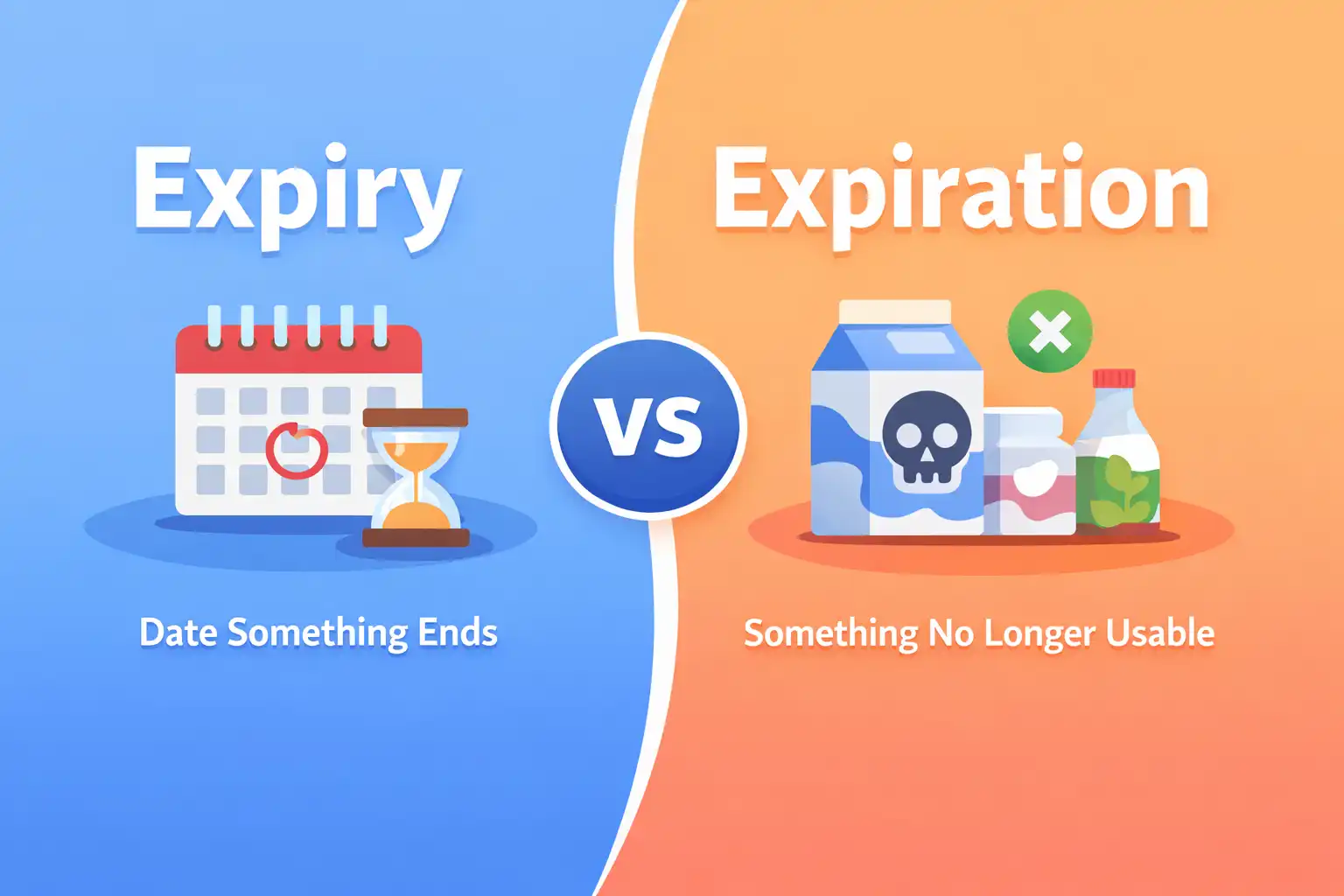
Many people feel confused when they see expiry vs expiration. Both words look similar, and both relate to something ending. So, users often wonder: are they the same, or is one more correct?
This confusion shows up in real life. You may see expiry date on food packaging, but expiration date in software or legal documents. Because of this, writers, students, and even professionals sometimes mix them. That can make writing look inconsistent or unclear.
In this guide, you will learn the exact difference between expiry and expiration. You will also see when to use each word, how they are used in real life, and how to avoid common mistakes. By the end, you will feel confident using both words correctly.
Expiry vs Expiration – Quick Answer
Expiry and expiration both mean “the end of a period of time.”
Meaning of Expiry
- Short form of expiration
- Common in British English
- Used in everyday contexts
- Example: The expiry date is tomorrow
Meaning of Expiration
- Full form of the word
- Common in American English
- Used in formal and technical writing
- Example: The contract expiration is next week
Easy rule:
Use expiry for UK-style or casual use. Use expiration for US or formal writing.
The Origin of Expiry vs Expiration
Both words come from the Latin root expirare. This word means “to breathe out” or “to end.” Over time, English adopted the word expiration first. It was used in medicine and science to describe breathing out.
Later, expiry appeared as a shorter version. It kept the same meaning but became more common in daily speech. British English started using expiry more often, especially in labels and everyday writing.
So, the two words share the same history. The only real difference is how people use them today.
Writers often confuse them because both forms are correct. However, style and region decide which one sounds more natural.
British vs American English Spelling
The main difference between expiry and expiration comes from regional usage.
In British English, people prefer expiry. It sounds shorter and more natural in daily use. You will often see it on food labels, tickets, and official forms.
In contrast, American English prefers expiration. It sounds more formal and complete. It is also common in legal, technical, and medical writing.
Here is a simple comparison:
| Feature | Expiry | Expiration |
| Region | UK, Commonwealth | USA |
| Style | Short, simple | Formal, complete |
| Usage | Everyday labels | Legal, technical |
| Example | Expiry date | Expiration date |
However, both words are correct. The choice depends on your audience.
How to Choose the Right Word Fast
Choosing between expiry and expiration becomes easy when you focus on your audience.
If you write for a US audience, use expiration. It matches their standard spelling and feels more natural. For example, software companies and legal documents in the US use this form.
If your audience is in the UK or Commonwealth countries, use expiry. It appears more often in everyday communication, especially on packaging.
For global or professional writing, expiration is usually safer. It sounds more formal and widely accepted across industries.
Now, here is a simple rule you can follow:
Use expiry for casual or UK contexts, and use expiration for formal or US contexts.
Common Mistakes with Expiry vs Expiration
Writers often make small mistakes with these words. These errors may look minor, but they can affect clarity.
❌ The product expiration is printed as expiry date
✅ The product expiry date is printed clearly
❌ Check the expiry of your visa before renewal (US context)
✅ Check the expiration of your visa before renewal
One common mistake is mixing both words in the same document. This makes writing look inconsistent.
Another issue is using expiry in formal US writing. Editors usually replace it with expiration to match style guidelines.
So, consistency matters more than the word itself.
Expiry vs Expiration in Real Life Examples
These words appear in many real-life situations. Seeing them in context helps you understand better.
In emails:
- Please check the expiration date of your subscription
- Your card expiry date is next month
In news:
- The government extended the expiration period of licenses
- Food items close to expiry were removed from shelves
On social media:
- My passport expiry is coming soon
- The app shows the subscription expiration clearly
In professional writing:
- The contract expiration will occur next year
- The expiry date must be printed on all packages
As you can see, both words work. However, the tone and audience change the choice.
Expiry vs Expiration – Word Usage Patterns and Search Trends
People search for expiry vs expiration because they want clarity. Many ESL learners and students struggle with similar-looking words. Writers also want to avoid errors in formal documents.
In general, expiration appears more in global and professional content. It is common in law, medicine, and technology.
On the other hand, expiry is popular in daily use, especially in countries that follow British English.
A real problem happens when someone uses the wrong word in a formal document. For example, using expiry in a US legal contract may look unprofessional or incorrect. This can create confusion or reduce trust.
So, understanding usage patterns helps avoid these issues.
Expiry vs Expiration Comparison Table
| Feature | Expiry | Expiration |
| Meaning | End of time period | End of time period |
| Part of Speech | Noun | Noun |
| Context | Informal, everyday | Formal, technical |
| Region | UK, Commonwealth | USA |
| Formality | Less formal | More formal |
| Common Mistake | Used in US formal writing | Seen as too formal in casual UK use |
| Correct Example | Check the expiry date | Check the expiration date |
This table shows that the meaning is the same. The difference is mainly style and region.
FAQs About Expiry vs Expiration
Is expiry the same as expiration?
Yes, both mean the end of a time period. The difference is only in usage and region.
Which one is correct in formal writing?
Expiration is preferred in formal and professional writing, especially in the US.
Can they be used interchangeably?
Yes, but context matters. Use the correct form for your audience.
Why do people confuse them?
They look similar and share the same meaning. Also, both appear in different regions.
Can grammar tools catch this mistake?
Some tools suggest one form based on region. However, they may not always match your audience.
Is there a British vs American difference?
Yes. British English prefers expiry, while American English prefers expiration.
Which one is better for global content?
Expiration is safer for global and professional use.
Conclusion
Expiry and expiration may look different, but they share the same meaning. Both describe the end of a period. The real difference comes from usage, tone, and region.
Expiry feels shorter and more common in British English. It appears often in daily use, such as labels and casual writing. On the other hand, expiration sounds more formal and is widely used in American English, especially in legal or technical content.
Writers often make the mistake of mixing both forms in one document. This can confuse readers and reduce clarity. So, consistency is key.
Overall, the best approach is simple. Choose your word based on your audience. If you write for the US or need a formal tone, use expiration. If your context is casual or UK-based, use expiry.
Finally, remember this easy rule:
Use expiry for everyday UK-style writing, and use expiration for formal or US writing.

Ibrahim Jhon is an English language editor with over ten years of experience working with writers, publishers, and international businesses. He specialises in word choice, grammar accuracy, and the differences between British and American English.