
I once edited a client’s product page that said, “We revised the pricing on all plans this morning.” The client had not changed the pricing structure at all. They had only swapped old numbers for new ones after a sale ended. That one word made the change sound bigger, more deliberate, and more structural than it really was. A few readers assumed the plans themselves had been reworked.
That is where this confusion usually starts. Revise and update both suggest change, but they do not point to the same kind of change. In my experience editing content, students often use revise when a teacher means “rewrite and improve,” while workplace writers often use update for almost every kind of edit, even when the content has been deeply reworked.
Here is the difference that matters: one word points to rethinking and refining, while the other points to bringing something current. By the end, you will know when each word fits, how teachers and editors hear them, where writers lose credibility by mixing them up, and how to choose the right one fast.
Revise vs update – Quick Answer
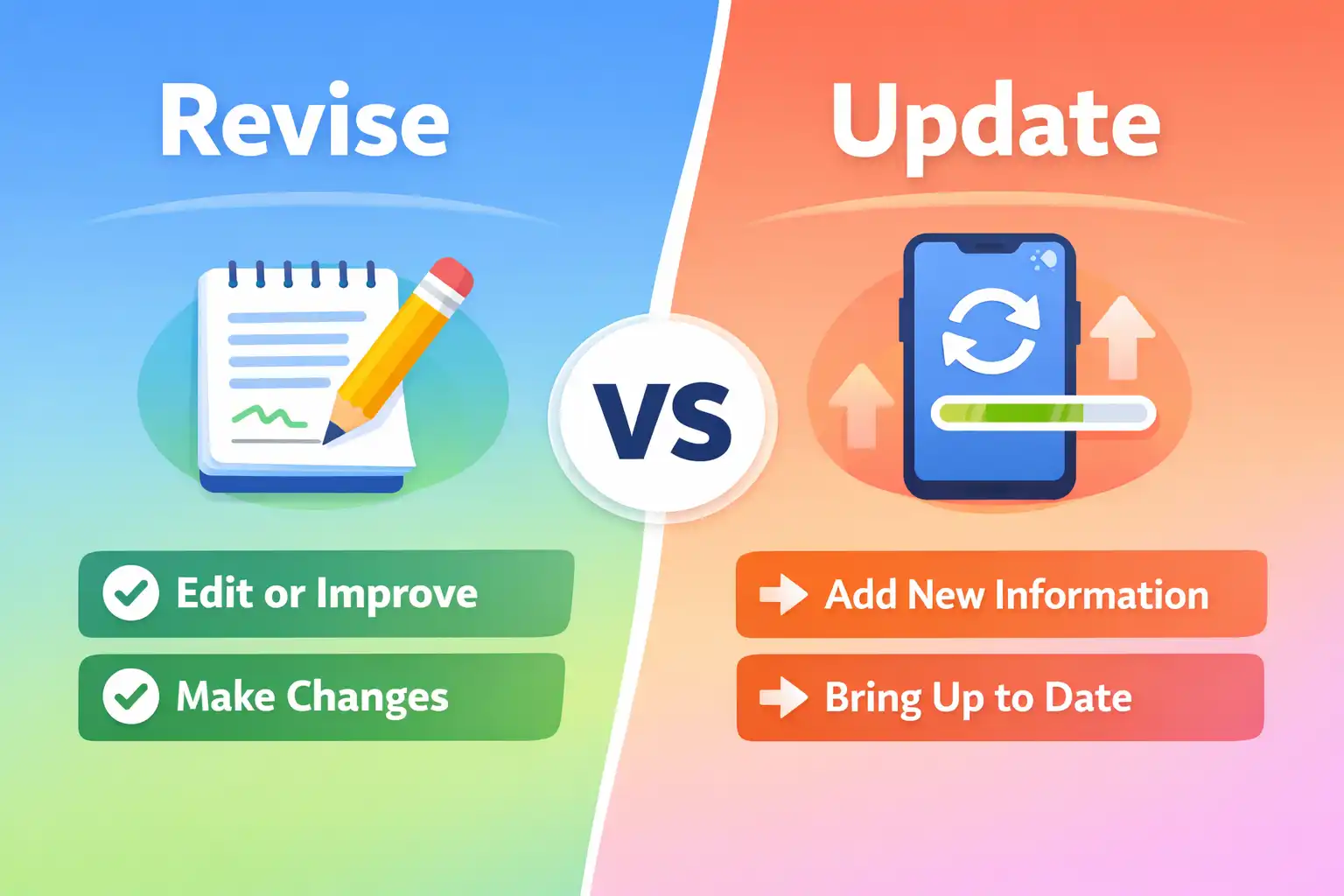
Revise means to review and change something to improve, correct, or rethink it. Update means to add new information or make something current. If you improve the structure, logic, or wording, use revise. If you replace old facts with new ones, use update.
Meaning of revise
Revise means to look at something again and change it for accuracy, quality, or clarity. Writers revise essays, editors revise headlines, and companies revise policies when they rethink the wording or content itself.
Meaning of update
Update means to bring something up to date. You update a report with this quarter’s numbers, update an app, or update a bio after a job change. The focus is freshness, not deep rewriting.
One decision rule
If the change improves the writing or thinking, use revise. If the change adds new, current information, use update.
The Origin of revise vs update
The roots explain the modern confusion better than most quick grammar posts do.
Revise comes through French from Latin revidere, meaning “to look at again.” That older sense still shows up in real editing work. When I revise a draft, I am not just fixing commas. I am looking again at the whole piece: tone, logic, order, and wording.
Update is much newer in feel. It builds from date, meaning a marked point in time, with up to date becoming a common English phrase for something current. That time-based meaning never really left. When a newsroom updates a breaking story, the main idea is not “we polished the prose.” It is “we added the latest facts.”
That history creates the modern mix-up. Both words involve change after a first version exists. Yet one points backward to review, while the other points forward to newness.
A historical note matters here too: in school and publishing contexts, revise has long carried the sense of careful reworking. Teachers still use it that way. In software, media, and workplace dashboards, update became dominant because teams often care most about current status.
British vs American English
There is no major spelling difference between revise and update in British and American English. Both forms are the same on both sides of the Atlantic.
The real difference is often in tone and context. In British school use, revise also commonly means “study again for an exam.” American readers usually hear revise as “edit or rewrite.” That small shift matters more than spelling.
| Usage Point | British English | American English |
| revise in school context | Often means study for exams | Usually means rewrite or edit |
| revise in writing | Rewrite, correct, improve | Rewrite, correct, improve |
| update in writing/work | Add current information | Add current information |
| Tone difference | Revise feels more academic in some contexts | Update feels more common in office and tech use |
I have seen this trip up international students more than once. A UK teacher may tell a student to “revise before the test,” while a US-based content editor who reads the same sentence may briefly think the student needs to rewrite notes, not study them.
How to Choose the Right Word Fast
For a US audience, ask one question: Did the content itself improve, or did the facts simply change?
Use revise for improved structure, wording, or argument. Use update for new dates, prices, names, or figures.
For a UK or Commonwealth audience, watch the school context closely. Revise may mean “study,” especially in student-facing content. In writing tasks, though, it still means rework the draft.
For global or professional writing, choose the word that reduces ambiguity. In manuals, reports, and client emails, vague wording causes more trouble than minor style issues. I often change “Please revise the spreadsheet with March numbers” to “Please update the spreadsheet with March numbers.” That tells the reader not to redesign the file, just replace old data.
Fast rule for every audience:
Use revise for quality changes. Use update for current-information changes.
Common Mistakes with revise vs update
Editors see these errors most often in work that moves fast.
❌ We revised our contact page with the new phone number.
✅ We updated our contact page with the new phone number.
A new phone number makes the page current. It does not mean the page was reworked.
❌ Please update your essay before resubmitting it.
✅ Please revise your essay before resubmitting it.
A teacher usually wants better argument, grammar, and structure, not just newer facts.
❌ The newsroom updated the headline after legal review.
✅ The newsroom revised the headline after legal review.
Legal review often changes wording for risk and precision, which is revision.
❌ We revised the staff directory after two employees joined.
✅ We updated the staff directory after two employees joined.
A directory becomes current through new entries. That is an update.
❌ Kindly revise me on the latest changes.
✅ Kindly update me on the latest changes.
This is a common workplace email error. In real office English, you update a person on new information.
One of the most expensive mistakes I have seen appeared in a sales email for software pricing. The team wrote, “We have revised our plans,” when they had only changed renewal dates and added one current feature line. A few customers read that as a full package redesign and replied with confused questions. One word changed the perceived scope of the announcement.
revise vs update in Real-Life Examples
Here is how the difference works in real writing.
Professional email
“Could you update the client deck with Q2 revenue before the 3 p.m. call?”
That asks for fresh numbers.
“Could you revise slide 6? The argument feels weak and the wording is too vague.”
That asks for better thinking and phrasing.
News writing
A local news editor might say: “We updated the live blog at 10:42 a.m. with the police statement.”
Later, the same editor may say: “We revised the headline to remove an unsupported claim.”
I have corrected this exact mix-up in newsroom-style student assignments. Many new writers use updated for every second-round change, even when the task was really to sharpen language.
Social media
“Profile updated: new role, new city, same coffee habit.”
That works because the account details are current now.
“Caption revised after I noticed the quote was incomplete.”
That works because the wording itself was corrected.
Formal document
“The committee revised Section 4 of the policy to clarify who approves exceptions.”
That signals thoughtful redrafting.
“The committee updated Appendix B with the 2026 reporting dates.”
That signals new information added to an existing document.
revise vs update – Word Usage Patterns and Search Trends
The people who search this phrase are usually students, ESL learners, content writers, office staff, and professionals who send lots of emails.
Students often meet the pair in teacher comments. One teacher writes “revise your conclusion,” while the student thinks that means “add one more sentence.” It usually means much more: rethink, rewrite, and improve. I have seen this cost students marks because they corrected surface grammar but did not address the weak argument the teacher actually flagged.
ESL learners and native speakers tend to make different mistakes here.
From what I have seen in editing, ESL learners often overuse update because it feels practical and familiar in business English. They may write “update the paragraph” when they mean “rewrite it for clarity.” Native speakers often make the opposite mistake in formal settings: they choose revise to sound more polished, even when the task is only to swap in new facts.
That difference matters in real work. On a product team, “revise the release notes” can send a writer into a full rewrite when the manager only wanted the latest version number and launch date. In school, “update your essay” sounds odd because essays are usually revised, not updated, unless the assignment requires new sources or recent data.
Here is a comparison that clears the issue fast:
| Feature | Revise | Update |
| Meaning | Review and improve something | Bring something current |
| Part of speech | Verb | Verb |
| Curved edges possible | Not applicable | Not applicable |
| Used in formal writing | Yes, especially in academic and editorial work | Yes, especially in business, tech, and reporting |
| Common mistake | Used when only new facts were added | Used when deep rewriting was needed |
| Correct example | Revise the proposal to make the argument clearer. | Update the proposal with April sales data. |
The real credibility hit comes when the chosen word misstates the size of the change. That is why editors care. The wrong word does not just sound off. It tells the reader the wrong story about what changed.
FAQs
Is revise the same as update?
No. Revise means improve or rethink the content. Update means add new information or make it current.
Do teachers usually want students to revise or update essays?
They usually want students to revise essays. They want better structure, logic, evidence, or wording.
Can I say “update me” but not “revise me”?
Yes. English uses update me for giving someone new information. Revise me sounds wrong in standard usage.
Is “revise for an exam” British English?
Mostly, yes. In British English, revise often means study again before a test. American English uses that sense less often.
Can a report be both revised and updated?
Yes. You can update a report with new data and then revise it for clarity and flow.
Which word sounds better in a business email?
Pick the one that matches the task. Use update for current facts. Use revise for deeper wording or structural changes.
Why do job applicants misuse these words?
Many applicants want to sound formal, so they choose revise too often. In resumes and cover letters, that can make small factual edits sound larger than they were.
Conclusion
Overall, the most important distinction is simple: revise changes the quality or shape of the writing, while update changes how current it is.
That is the line most writers blur. The single most common mistake is using revise when the task only involves new facts, dates, numbers, or names. I see that most often in client emails, product copy, and internal reports. It makes a small factual refresh sound like a major rewrite.
In short, the wrong choice does more than break a grammar rule. It changes the reader’s expectation. A teacher who asks for revision expects stronger writing. A manager who asks for an update expects the latest information. Those are not the same job.
Finally, use one rule and you will rarely miss: if the thinking changed, revise it; if the facts changed, update it.

Ibrahim Jhon is an English language editor with over ten years of experience working with writers, publishers, and international businesses. He specialises in word choice, grammar accuracy, and the differences between British and American English.