
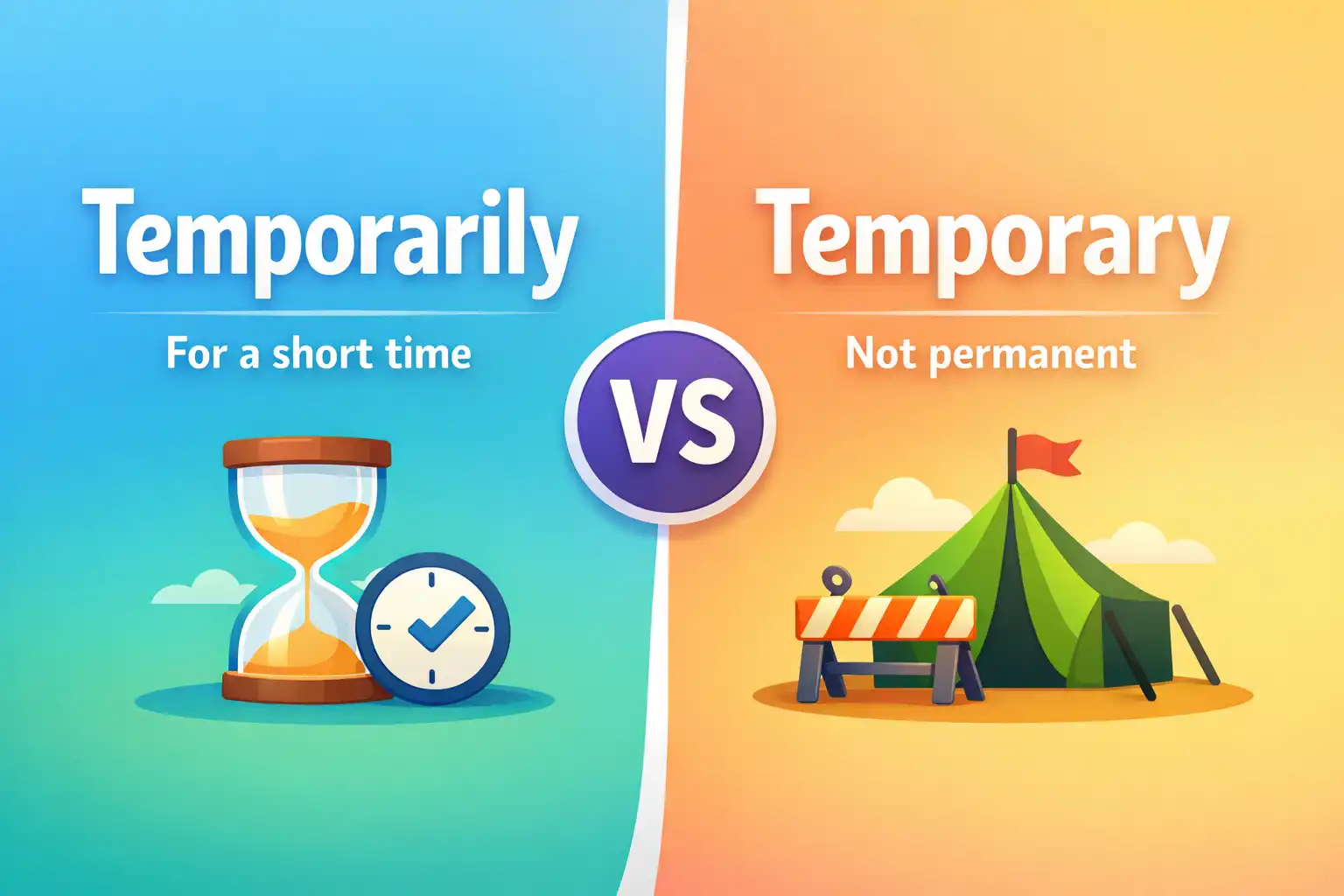
Many learners stop and think when they see temporary and temporarily. Both look similar, but they do not work the same way. So people often mix them in writing and speech.
This confusion usually happens because both words come from the same root. Also, they both relate to time. But their role in a sentence is different. One is a describing word, and the other explains how something happens.
In this guide, you will learn the exact difference between temporary or temporarily. You will also see real examples, common mistakes, and an easy rule to remember. By the end, you will use both words with full confidence.
Temporary or Temporarily – Quick Answer
Temporary (adjective)
- Describes something that is not permanent
- Example: The office is temporary
Temporarily (adverb)
- Describes how something happens for a short time
- Example: The office is closed temporarily
Easy rule:
Use temporary to describe a thing. Use temporarily to describe an action.
Meaning of Temporary
Temporary is an adjective. It describes a noun.
- Means: lasting for a short time
- Not permanent
Examples:
- She has a temporary job.
- The shelter is temporary.
- This solution is temporary.
Meaning of Temporarily
Temporarily is an adverb. It describes a verb.
- Means: for a short time
- Shows how something happens
Examples:
- The shop is closed temporarily.
- He moved here temporarily.
- The system stopped temporarily.
The Origin of Temporary or Temporarily
Both words come from the Latin word “temporarius”, which means “for a time.” Later, it entered Old French and then English.
Temporary came first. It stayed as an adjective to describe things.
Temporarily formed later by adding “-ly,” which turns adjectives into adverbs.
However, confusion started because both words look almost the same. Writers often forget their grammar roles. So they use one in place of the other, especially in fast writing.
British vs American English Spelling
There is no spelling difference between British and American English for these words.
Both forms use:
- Temporary
- Temporarily
So spelling is simple. The challenge is usage, not regional variation.
| Aspect | Temporary | Temporarily |
| UK spelling | Same | Same |
| US spelling | Same | Same |
| Difference | Usage only | Usage only |
How to Choose the Right Word Fast
Choosing between temporary or temporarily is easy if you focus on grammar.
For US users:
Use grammar rules. Schools strongly teach adjective vs adverb use.
For UK and Commonwealth users:
Same rule applies. No spelling change.
For global or professional writing:
Always check what the word is describing.
- If it describes a thing → use temporary
- If it describes an action → use temporarily
Quick test:
Replace the word with “short-term.”
If it fits, use temporary.
If not, you likely need temporarily.
Common Mistakes with Temporary or Temporarily
Writers often mix these two forms. Here are common errors:
❌ The office is temporary closed
✅ The office is temporarily closed
Explanation: “Closed” is a verb, so it needs an adverb.
❌ This is a temporarily solution
✅ This is a temporary solution
Explanation: “Solution” is a noun, so it needs an adjective.
❌ He works here temporary
✅ He works here temporarily
Explanation: The sentence describes how he works.
❌ The problem is temporarily
✅ The problem is temporary
Explanation: The sentence describes the problem, not an action.
Temporary or Temporarily in Real Life Examples
Here is how people use these words in daily life:
Emails:
- The system is temporarily unavailable.
- This is a temporary fix for the issue.
News:
- The road is temporarily closed due to rain.
- The government announced a temporary ban.
Social Media:
- I am temporarily offline today.
- This is just a temporary change.
Professional Writing:
- The employee is on temporary leave.
- Services will stop temporarily during maintenance.
Temporary or Temporarily – Word Usage Patterns and Search Trends
People search temporary or temporarily because they feel unsure while writing sentences.
Students and ESL learners search this keyword often. Writers and office workers also check it while editing emails or reports.
The mistake usually happens in fast typing. For example, someone writes:
“The service is temporary closed.”
This small error can confuse readers or look unprofessional.
In real life, misuse can affect clarity. For example, in a notice board:
- “Temporary closed” looks incorrect
- “Temporarily closed” is clear and correct
So correct usage helps communication stay smooth and professional.
Comparison Table: Temporary vs Temporarily
| Feature | Temporary | Temporarily |
| Meaning | Lasts a short time | Happens for a short time |
| Part of speech | Adjective | Adverb |
| Use | Describes a noun | Describes a verb |
| Context | Objects, situations | Actions, processes |
| Formality | Neutral | Neutral |
| Common mistake | Used for verbs | Used for nouns |
| Correct example | A temporary job | Closed temporarily |
FAQs About Temporary or Temporarily
1. Is temporary the same as temporarily?
No. Temporary describes things. Temporarily describes actions.
2. Which one is correct in formal writing?
Both are correct. Use them based on grammar, not formality.
3. Can they be used interchangeably?
No. They have different roles in a sentence.
4. Why do people confuse them?
They look similar and come from the same root word.
5. Can grammar tools catch this mistake?
Yes, most tools can detect wrong usage.
6. Is there a British vs American difference?
No. Both use the same spelling and rules.
7. Which is more common in daily use?
Both are common, but usage depends on sentence structure.
Conclusion
Temporary and temporarily may look alike, but they serve different roles. Temporary describes a thing that does not last long. Temporarily explains how an action happens for a short time.
This small difference matters in clear writing. Many errors happen when writers forget whether they are describing a noun or a verb. But once you understand this, the choice becomes simple.
Overall, focus on what the word is doing in the sentence. If it describes a thing, use temporary. If it describes an action, use temporarily.
Finally, remember this easy rule:
Temporary = describes something
Temporarily = describes an action
This one idea will help you avoid mistakes every time.

Ibrahim Jhon is an English language editor with over ten years of experience working with writers, publishers, and international businesses. He specialises in word choice, grammar accuracy, and the differences between British and American English.