
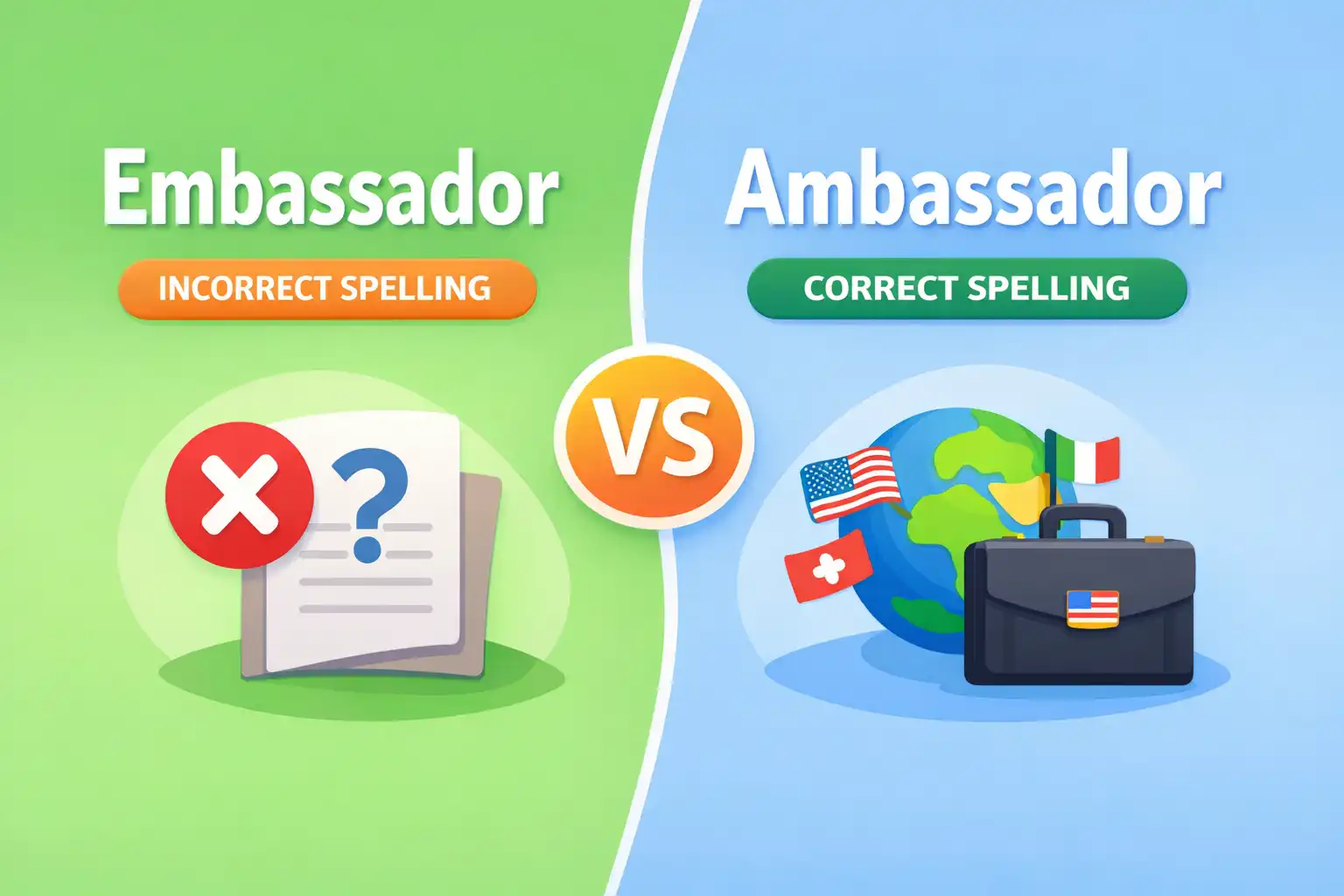
Many people type “embassador” when they mean “ambassador.” This mistake shows up in emails, school work, and even job applications. It looks close, so the confusion feels natural. But in real writing, only one form is correct.
So, why does this happen? The words sound similar. Also, English spelling can feel tricky. As a result, writers guess based on sound. That guess leads to errors. Get a clear understanding of embassador or ambassador by visiting our word comparison page for more details.
In this guide, you will learn the exact difference. You will see real examples. You will also get a simple rule to remember forever. This will help you avoid mistakes and write with confidence.
Embassador or Ambassador – Quick Answer
- “Ambassador” is the correct spelling.
- “Embassador” is incorrect and not used in standard English.
- Use “ambassador” in all formal and informal writing.
Examples:
- She is the brand ambassador. ✅
- He met the ambassador of France. ✅
- She is the brand embassador. ❌
Easy Rule: If you mean a representative, always write ambassador, never embassador.
Meaning of Ambassador
- A person who represents a country, brand, or idea
- Often used in diplomacy, marketing, or public roles
Examples:
- He works as an ambassador for peace.
- She became a student ambassador at her university.
Meaning of Embassador
- This word has no accepted meaning in English
- It is a misspelling of ambassador
Examples:
- He is an embassador. ❌
- Correct form: He is an ambassador. ✅
The Origin of Embassador or Ambassador
The word “ambassador” comes from the Latin word ambactus, which means “servant” or “messenger.” Later, it moved into French as ambassadeur. Then it entered English.
Over time, the spelling stayed stable as ambassador. The “am” at the start comes from its Latin root. That is why “em” is wrong.
So, where does “embassador” come from? It comes from how people hear the word. When spoken fast, “ambassador” may sound like “embassador.” Writers then spell it the same way they hear it.
Writers often confuse sound with spelling. Editors usually see this mistake in early drafts, especially from ESL learners. However, only one spelling has history and proof: ambassador.
British vs American English Spelling
There is no difference between British and American English for this word. Both use ambassador.
| Style | Correct Spelling | Example |
| American English | ambassador | US ambassador to Japan |
| British English | ambassador | UK ambassador to India |
So, you do not need to change spelling based on region. The rule stays the same everywhere.
How to Choose the Right Word Fast
You only need one rule.
- If you are writing about a representative, use ambassador
- Never use “embassador” in any context
By audience:
- US writers: Always use ambassador
- UK / Commonwealth writers: Always use ambassador
- Global or professional writing: Ambassador is standard
There is no variation. The correct form is universal.
Common Mistakes with Embassador or Ambassador
Many errors come from spelling by sound. Here are common mistakes:
❌ He is an embassador.
✅ He is an ambassador.
❌ Brand embassador program
✅ Brand ambassador program
Writers often forget that English spelling does not always match sound. So, it helps to memorize tricky words like this one. Discover how the use of embassador or ambassador differs between UK and US in our detailed guide.
Embassador or Ambassador in Real Life Examples
Let’s see how “ambassador” appears in daily use.
Emails:
- I am happy to apply for the ambassador role.
- She acts as a brand ambassador for our company.
News:
- The ambassador met with the president today.
- A new ambassador was appointed last week.
Social Media:
- Proud to be a fitness ambassador!
- Join our ambassador program now.
Professional Writing:
- He serves as an ambassador for cultural exchange.
- The company selected her as a global ambassador.
In every case, “ambassador” stays correct. “Embassador” does not appear in real or formal writing.
Embassador or Ambassador – Word Usage Patterns and Search Trends
The word “ambassador” is widely used across many fields. Students, marketers, and professionals all use it often.
However, many people search for “embassador or ambassador” online. This shows a common spelling confusion. ESL learners and new writers face this issue more often.
In real situations, wrong spelling can cause problems. For example, in a job application, writing “embassador” may look unprofessional. It can affect first impressions.
So, learning the correct form is important for clear communication. Explore the difference between embassador or ambassador and other commonly confused words like discard or disgard in our related posts.
Comparison Table: Embassador vs Ambassador
| Feature | Ambassador | Embassador |
| Meaning | Representative of a country, brand, or idea | No meaning |
| Part of Speech | Noun | Not valid |
| Context of Use | Formal and informal | Incorrect usage |
| Formal vs Informal | Used in both | Not used at all |
| Common Mistake | Rare | Very common misspelling |
| Correct Example | She is a brand ambassador. | She is a brand embassador. ❌ |
This table makes it clear: only ambassador works in real English.
FAQs
Is embassador the same as ambassador?
No. “Embassador” is incorrect. “Ambassador” is the correct word.
Which one is correct in formal writing?
Only ambassador is correct in formal writing.
Can they be used interchangeably?
No. “Embassador” should never be used.
Why do people confuse them?
People spell based on sound. “Ambassador” can sound like “embassador.”
Can grammar tools catch this mistake?
Yes, most tools mark “embassador” as incorrect.
Is there a British vs American difference?
No. Both use “ambassador.”
Is ambassador used in business?
Yes. It is common in marketing, such as brand ambassador roles.
Conclusion
The confusion between embassador or ambassador is common, but the answer is simple. Only ambassador is correct. “Embassador” is just a spelling mistake.
This confusion happens because of pronunciation. However, English spelling follows history, not just sound. That is why the correct form stays “ambassador.”
In real writing, this small mistake can affect clarity and professionalism. So, it is important to get it right. Learn about the correct spelling of embassador or ambassador alongside other confusions, such as wisp or whisp, in our comparison articles.
Overall, remember one easy rule:
If you mean a representative, always write “ambassador.”
This simple rule will help you avoid errors every time.

Ibrahim Jhon is an English language editor with over ten years of experience working with writers, publishers, and international businesses. He specialises in word choice, grammar accuracy, and the differences between British and American English.