
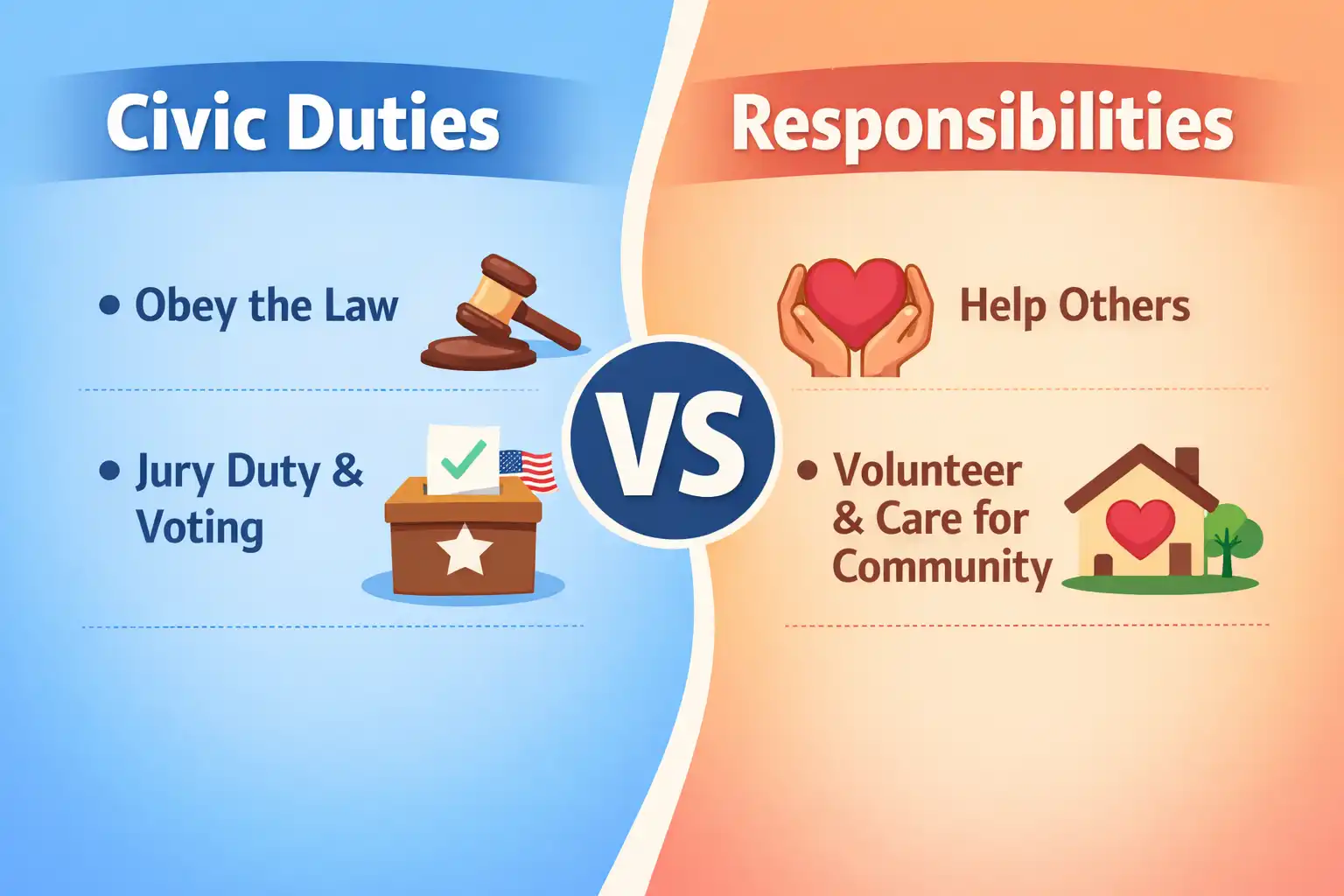
A few months ago, I edited a school website page that told parents, “Students learn their civic responsibilities, such as voting in every election and serving on a jury.” That line looked polished, but it blurred two ideas that careful writers should keep apart. Voting and jury service are often framed as civic duties. Civic responsibilities are broader. The page sounded less precise than the school intended, and that kind of slip shows up more often than people think.
I have corrected this mix-up in student essays, nonprofit brochures, and even local news copy. ESL learners often use responsibilities as a safe umbrella word because it feels flexible. Native speakers, by contrast, often swap in duties when they want a formal tone, even when the meaning is too narrow. The result is fuzzy writing.
By the end of this article, you will know what each term means, where they overlap, how editors hear the difference, and which word to choose when the sentence has to sound clear, credible, and exact.
[civic duties vs responsibilities] – Quick Answer
Civic duties are obligations citizens are expected to fulfill for the good of the community, often with a strong legal or moral force. Civic responsibilities are broader actions citizens should take to support society, even when the law does not require them.
Meaning of civic duties
Civic duties refers to core obligations tied to citizenship. In many writing contexts, the phrase points to acts such as obeying laws, paying taxes, serving on a jury, or, depending on the source, voting.
Meaning of civic responsibilities
Civic responsibilities covers a wider range of expected social behavior. That can include staying informed, helping the community, respecting others’ rights, and taking part in public life.
One decision rule
Use duties when the sentence stresses obligation. Use responsibilities when the sentence stresses broader social conduct.
The Origin of civic duties vs responsibilities
The confusion starts with the history of the words. Civic comes from the Latin civicus, meaning “relating to a citizen.” Duty comes through Anglo-French and Old French from the idea of “what is owed.” That sense of something owed still shapes how editors hear the word now. It sounds firm. Sometimes it sounds official.
Responsibility is newer in tone and broader in feel. It comes from the Latin respondere, “to answer.” The root idea is accountability. You answer for an action, a role, or a result. That is why responsibility often fits better when the sentence is about conduct rather than fixed obligation.
Here is where many writers go wrong: they assume both phrases mean “good citizenship,” so they treat them as perfect twins. In my experience editing civics lesson plans, that shortcut creates weak definitions. One worksheet I revised listed “keeping public spaces clean” under civic duties. The teacher meant well, but the phrasing suggested a formal obligation on the same level as tax payment or jury service. That kind of mismatch makes educational writing sound careless.
A useful historical note: older civic education materials often used duties of citizens much more often than responsibilities of citizens. Modern classrooms and public agencies now use both, but not always with the same boundaries.
British vs American English
There is no major spelling difference between British and American English here. Both use civic duties and civic responsibilities in the same form. The real difference is tone and preference in context, not spelling.
In American school materials, writers often separate the two terms more sharply. In UK and Commonwealth contexts, the same distinction exists, but public-facing materials sometimes lean on responsibilities for a broader, less rigid tone.
| Feature | American English | British/Commonwealth English |
| Spelling | civic duties / civic responsibilities | civic duties / civic responsibilities |
| Core distinction | Often taught as a clear duties vs responsibilities split | Same split, though tone may be softer in public guidance |
| Tone of duties | More formal, civic-ed style | Formal, institutional |
| Tone of responsibilities | Broader, community-focused | Broader, citizenship-focused |
| Editing advice | Use duties for obligation, responsibilities for wider public conduct | Same rule works well |
I once edited copy for an international education client that mixed US and UK examples in the same lesson. The US section called jury service a civic duty, which fit. The UK section reused the same line without adjusting the context. That made the text feel imported rather than written for its audience. Small word choices can expose that kind of mismatch fast.
How to Choose the Right Word Fast
For a US audience, choose civic duties when you mean obligations commonly taught in civics class or tied closely to law and citizenship. Choose civic responsibilities when you mean the wider habits of public-minded behavior, such as staying informed or volunteering. Fast rule: if the sentence sounds like a rule, use duties.
For a UK or Commonwealth audience, the same split works, but responsibilities often sounds more natural in broad public messaging. Government, charity, and school writing may prefer language that feels less rigid unless the context is clearly formal. Fast rule: if you are describing good citizenship in general, use responsibilities.
For global or professional writing, clarity matters more than tradition. If readers come from different education systems, define the phrase once and stay consistent. I have seen nonprofit reports lose authority because one page said “citizens’ duties” and the next said “social responsibilities” for the same list. Fast rule: pick one frame, then match every example to it.
Common Mistakes with civic duties vs responsibilities
❌ Every civic responsibility is required by law.
✅ Some civic responsibilities are encouraged, not legally required.
This is wrong because responsibilities is the broader category.
❌ Volunteering at a food bank is a civic duty.
✅ Volunteering at a food bank is a civic responsibility.
This is wrong because volunteering is usually praised, not required.
❌ The article explained civic duties like recycling, kindness, and joining local events.
✅ The article explained civic responsibilities like recycling, kindness, and joining local events.
This is wrong because the examples describe social participation, not strict obligation.
❌ Headline: “City reminds residents of their civic responsibilities to report for jury duty.”
✅ Headline: “City reminds residents of their civic duty to report for jury service.”
This is wrong because the sentence points to a specific obligation. I have seen headlines like this flattened by last-minute edits from writers who wanted a softer tone.
❌ In my essay, I wrote that paying taxes is just a civic responsibility.
✅ In my essay, I wrote that paying taxes is a civic duty.
This is wrong because just a responsibility weakens the force of the idea.
civic duties vs responsibilities in Real-Life Examples
In a professional email, precision matters because tone affects trust. A compliance officer might write: “Please include a short section on employees’ civic responsibilities, such as respectful public conduct and community participation.” That works because the message is broad. If the same email says “civic duties” but then lists optional behavior, the writer sounds imprecise.
In news writing, the distinction can change the weight of a sentence. A clean line would read: “The mayor urged residents to treat voting as a civic duty and public debate as a civic responsibility.” That balance feels intentional. I have edited local news drafts where both acts were called duties, and the story suddenly sounded preachy.
On social media, people often use responsibility because it feels less stiff. A city campaign post might say: “Staying informed is part of our civic responsibility.” That sounds natural. If the same post says “civic duty” for every good action, readers may hear it as scolding.
In a formal document, accuracy matters even more. A school handbook could say: “The course introduces students to civic duties such as obeying laws and paying taxes, along with civic responsibilities such as informed participation in community life.” That sentence works because it separates the categories. I have fixed this exact issue in curriculum copy more than once, usually after a teacher noticed the examples did not match the heading.
civic duties vs responsibilities – Word Usage Patterns and Search Trends
The people who search this phrase are usually students, teachers, content writers, ESL learners, and professionals drafting public-facing copy. They are not only asking for dictionary meanings. They are trying to avoid sounding wrong in a sentence that will be graded, published, or shared.
A real cost shows up in job and scholarship writing. One applicant statement I edited said, “I learned the civic responsibilities of jury duty and paying taxes.” The phrase was understandable, but it sounded loose in a piece meant to show maturity and precision. We changed it to “the civic duties of jury service and tax payment, and the broader civic responsibility to stay informed.” That single revision made the writing sound more thoughtful.
I have noticed a pattern in error types. ESL learners often overuse responsibilities because many language textbooks teach it as a wide, useful noun for tasks and obligations. Native speakers make a different mistake. They often choose duties when they want formal style, then attach casual, voluntary actions to it. That is where credibility slips. The sentence looks serious, but the examples do not support the word.
Editors and teachers usually solve this by testing the force of the noun. Ask: is this owed, expected, or legally tied to citizenship? Then duty fits. Is this broader social behavior that supports public life? Then responsibility fits better.
Comparison Table
| Feature | Civic duties | Civic responsibilities |
| Meaning | Core obligations tied to citizenship | Broader expectations tied to good citizenship |
| Part of speech | Noun phrase | Noun phrase |
| Legal or moral force | Usually stronger | Usually broader and softer |
| Used in formal writing | Yes, especially in civics and policy contexts | Yes, especially in education and public messaging |
| Common mistake | Using it for optional community actions | Using it for fixed obligations like jury service |
| Correct example | “Paying taxes is a civic duty.” | “Staying informed is a civic responsibility.” |
FAQs
What is the difference between civic duties and civic responsibilities?
Civic duties are core obligations of citizenship. Civic responsibilities are wider actions that support society but may not be required by law.
Is voting a civic duty or a civic responsibility?
Writers and teachers use both, depending on context. If you want stronger obligation, use civic duty. If you want broader democratic participation, civic responsibility also appears.
Is jury service a civic duty?
Yes. In most formal writing, jury service fits civic duty because it carries a clear legal obligation.
Can I use civic duties and responsibilities together?
Yes. That pairing works well when you want to separate required obligations from broader social expectations.
Do British and American English use these phrases differently?
Not much in spelling. The main difference is tone and teaching style, not vocabulary form.
Why do students confuse these terms so often?
Textbooks and online summaries often blur the categories. Many examples also mix legal obligations with optional public behavior.
Which word sounds better in formal writing?
Both work. Choose duties for obligation and responsibilities for broader conduct. Precision matters more than formality.
Conclusion
Overall, the most important distinction is simple: civic duties points to obligations, while civic responsibilities covers the wider habits of good citizenship. That is the line editors listen for. When the noun and the example do not match, the sentence loses force.
The single most common mistake is using duties for actions that are encouraged but not required. I see that most in school writing, nonprofit copy, and rushed articles that want to sound formal. The word feels stronger, so writers reach for it too quickly. Then the list under it includes volunteering, helping neighbors, or staying informed, which really belongs under responsibilities.
In short, test the pressure of the sentence. Does the action sound owed, required, or fixed by citizenship? Use duty. Does it describe the wider role of a good citizen in public life? Use responsibility. Finally, use one rule you can remember: if the word sounds like a rule, choose duty; if it sounds like a role, choose responsibility.

Ibrahim Jhon is an English language editor with over ten years of experience working with writers, publishers, and international businesses. He specialises in word choice, grammar accuracy, and the differences between British and American English.