
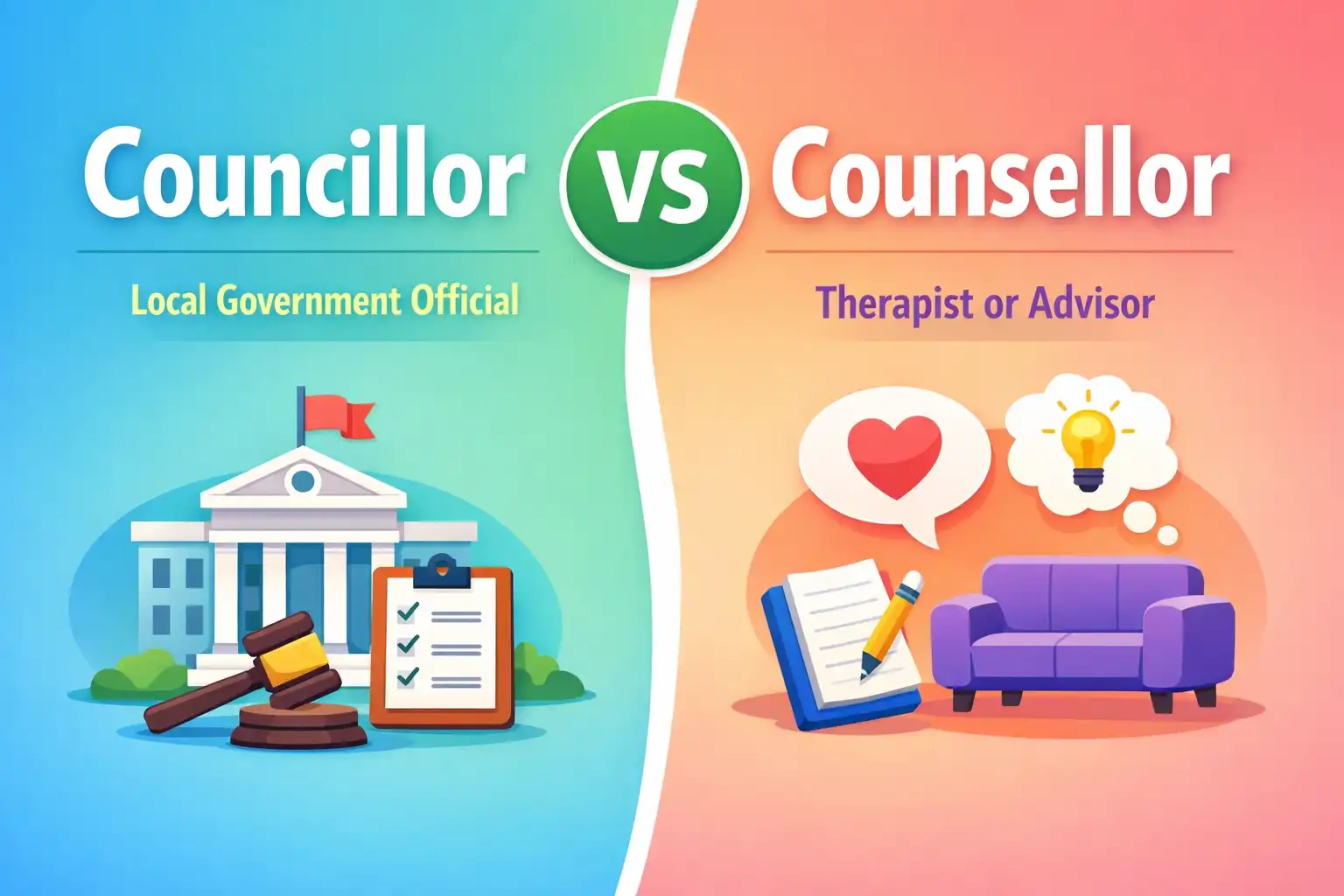
Many people get stuck on councillor or counsellor. The words look almost the same. They sound the same too. So confusion is common, especially in writing emails, essays, or job titles. A small spelling mistake can change the meaning completely.
You may have seen both words in news or online forms. You may also wonder which one is correct. This confusion matters because each word has a very different role. One is about local government. The other is about giving advice or support. So if you mix them, your message may feel wrong or unclear.
In this guide, you will learn the exact difference. You will see real examples. You will also learn a simple trick to choose the right word every time.
Councillor or Counsellor – Quick Answer
Councillor means a member of a local council.
Counsellor means a person who gives advice or therapy.
Examples:
- She spoke to a councillor about city plans.
- He met a counsellor for stress help.
Easy rule:
If it relates to government → use councillor.
If it relates to advice or support → use counsellor.
Meaning of Councillor
- A person elected to a local government council
- Works on public issues like roads, schools, and policies
Examples:
- The councillor approved the new park plan.
- I emailed my councillor about traffic issues.
Meaning of Counsellor
- A person who gives advice, support, or therapy
- Works in schools, clinics, or private practice
Examples:
- The school counsellor helped the student.
- She became a career counsellor after training.
The Origin of Councillor or Counsellor
Both words come from the same root: “counsel.” This word comes from old Latin and French. It means advice or opinion. Over time, English split the meaning into two paths.
Councillor developed from “council.” This word refers to a group that makes decisions. So a councillor became a person in that group.
Counsellor kept the meaning of advice. It came to describe a person who guides or supports others.
Today, the spelling difference shows the role clearly. However, many writers still confuse them because the base word is the same.
British vs American English Spelling
The main difference is not between US and UK. Both use councillor and counsellor with the same meaning. However, there is a small spelling variation for counsellor.
- British English: counsellor (double “l”)
- American English: counselor (single “l”)
Examples:
- UK: She spoke to a counsellor.
- US: She spoke to a counselor.
Important:
Councillor keeps double “l” in both UK and US.
How to Choose the Right Word Fast
Choosing between councillor or counsellor is simple if you focus on the role.
For US users:
- Use councillor for government
- Use counselor for advice or therapy
For UK / Commonwealth users:
- Use councillor for government
- Use counsellor for advice or therapy
Global or professional writing:
- Match the region style
- Keep the meaning clear
Quick tip:
Think of “council” inside councillor. It helps you remember the correct word.
Common Mistakes with Councillor or Counsellor
Writers often mix these words because they sound the same. Here are common errors:
❌ The school councillor helped me.
✅ The school counsellor helped me.
❌ She works as a government counsellor.
✅ She works as a government councillor.
These mistakes change the meaning. So always check the context before writing.
Councillor or Counsellor in Real Life Examples
Emails:
- I contacted my councillor about waste issues.
- I booked a session with a counsellor.
News:
- The councillor voted on the new law.
- The counsellor spoke about mental health support.
Social media:
- Tag your local councillor for help.
- Talk to a counsellor if you feel stressed.
Professional writing:
- The councillor attended the council meeting.
- The counsellor guided the patient through therapy.
Councillor or Counsellor – Word Usage Patterns and Search Trends
The keyword councillor or counsellor is searched often by students, ESL learners, and writers. Many users want quick clarity. They often type both words together because they are unsure.
Search trends show that confusion rises during exam seasons and job applications. People want to avoid mistakes in formal writing.
One real problem happens in resumes. If someone writes “councillor” instead of “counsellor,” it can mislead employers. So correct usage is important in real life.
Comparison Table: Councillor vs Counsellor
| Feature | Councillor | Counsellor |
| Meaning | Member of a local council | Person who gives advice or therapy |
| Part of Speech | Noun | Noun |
| Context of Use | Government, politics | Health, education, guidance |
| Formal vs Informal | Formal | Both formal and informal |
| Common Mistake | Used for advice roles | Used for political roles |
| Correct Example | The councillor approved the plan. | The counsellor helped the student. |
FAQs About Councillor or Counsellor
Is councillor the same as counsellor?
No. A councillor works in government. A counsellor gives advice or support.
Which one is correct in formal writing?
Both are correct. However, you must choose based on meaning.
Can they be used interchangeably?
No. They have different roles and cannot replace each other.
Why do people confuse them?
They sound the same and share the same root word.
Can grammar tools catch this mistake?
Sometimes. However, many tools miss context-based errors.
Is there a British vs American difference?
Yes, only for counsellor spelling. US uses “counselor.”
Which one is more common?
It depends on context. Both are common in different fields.
Conclusion
The difference between councillor or counsellor is simple once you understand the context. A councillor works in local government and deals with public issues. A counsellor gives advice and supports people in personal or professional matters.
Many writers confuse these words because they look and sound alike. However, the meaning changes completely with just one letter. So this mistake can affect clarity, especially in formal writing.
Overall, always focus on the role. If it involves a council or politics, use councillor. If it involves advice or support, use counsellor.
In short, remember this easy rule:
Council = councillor, Advice = counsellor.

Ibrahim Jhon is an English language editor with over ten years of experience working with writers, publishers, and international businesses. He specialises in word choice, grammar accuracy, and the differences between British and American English.